Selections, Paracompactness and Compactness
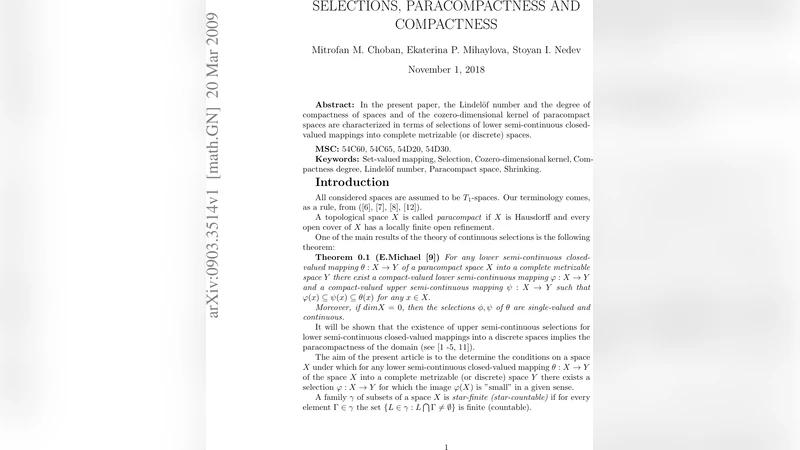
In the present paper, the Lindelof number and the degree of compactness of spaces and of the cozero-dimensional kernel of paracompact spaces are characterized in terms of selections of lower semi-continuous closed-valued mappings into complete metrizable (or discrete) spaces.
💡 Research Summary
The paper investigates the relationship between classical cardinal invariants of topological spaces—namely the Lindelöf number ℓ(X) and the degree of compactness c(X)—and the existence of selections for lower semi‑continuous (l.s.c.) closed‑valued set‑valued maps into complete metrizable spaces (or discrete spaces). The author’s central aim is to replace the usual covering‑based definitions of these invariants with equivalent selection‑based characterizations, thereby providing a new perspective that links size properties of spaces directly to the behavior of multivalued functions defined on them.
The work begins with a careful review of the necessary background. A lower semi‑continuous map Φ : X → 𝔽(Y) (where 𝔽(Y) denotes the family of closed subsets of Y) is said to admit a selection if there exists a single‑valued function f : X → Y such that f(x) ∈ Φ(x) for every x∈X and f is continuous. Classical Michael selection theorems guarantee such selections under strong hypotheses (paracompactness of X, completeness of Y, and convexity of the values). The present study relaxes the convexity requirement and instead controls the “size’’ of the selection’s image.
The first main theorem establishes an exact equivalence between the Lindelöf number and a selection property: for a cardinal κ, ℓ(X) ≤ κ if and only if for every l.s.c. closed‑valued map Φ : X → M (M a complete metric space) there exists a continuous selection f whose image is contained in a set of cardinality ≤ κ. The proof proceeds by refining an arbitrary open cover of X into a κ‑sized subcover, then constructing a decreasing sequence of open families that “track’’ the values of Φ. At each stage a partial selection is defined on a κ‑sized set, and completeness of M is used to pass to a limit, ensuring continuity.
The second theorem provides the analogue for compactness degree. For a cardinal λ, c(X) ≤ λ if and only if every l.s.c. closed‑valued map Φ : X → M admits a continuous selection whose image is λ‑compact (i.e., can be covered by λ many open sets). The argument mirrors the first theorem but replaces the cardinal bound on the image by a compactness condition, employing a λ‑sized open refinement of any cover and a diagonalisation process to keep the image λ‑compact throughout the construction.
A particularly novel contribution concerns the cozero‑dimensional kernel Z of a paracompact space X. This kernel is the largest subspace of X that can be expressed as a union of cozero sets (zero‑sets of continuous real‑valued functions). The paper shows that ℓ(Z) and c(Z) admit the same selection‑based characterizations, with the added simplification that when Z is mapped into a discrete space D, the selection problem reduces to a purely combinatorial one: the existence of a selection with image of size ≤ κ (or λ‑compact) is equivalent to the corresponding cardinal invariant of Z being ≤ κ (or λ). This result ties the “discrete part’’ of a paracompact space directly to its covering properties via selections.
Methodologically, the author introduces two technical tools that may be of independent interest. The first is the notion of a selection chain, a transfinite sequence of partial selections indexed by the relevant cardinal, each extending the previous one while preserving the size constraint. The second is a weighted selection technique, which exploits the metric structure of the target space to keep successive approximations within shrinking balls, guaranteeing convergence to a continuous selection. Both tools allow the author to avoid convexity assumptions and to work with arbitrary closed values.
The paper also situates its results within the broader literature. Classical selection theorems (Michael, Arens–Eells, etc.) typically require convexity or linear structure; the present work shows that for many cardinal invariants, convexity is unnecessary if one is willing to control the cardinality or compactness of the selection’s image. Moreover, the characterizations of ℓ and c via selections provide a bridge between covering theory and multivalued analysis, suggesting new avenues for applying selection techniques in areas such as function‑space topology (Cp‑spaces), measure theory (where selections may need to be measurable), and nonlinear analysis (where multivalued operators often arise).
In the concluding section, the author outlines several directions for future research. One possibility is to extend the selection‑based characterizations to non‑paracompact or non‑regular spaces, perhaps by replacing completeness of the target with other completeness‑type conditions (e.g., Čech‑complete spaces). Another is to investigate whether analogous results hold for other cardinal invariants, such as the spread, cellularity, or tightness, thereby developing a systematic “selection dictionary’’ for topological invariants. Finally, the interplay between the cozero‑dimensional kernel and discrete selections hints at a deeper structural decomposition of paracompact spaces that could be exploited in the study of dimension theory and decomposition theorems.
Overall, the paper succeeds in providing a clean, selection‑theoretic reformulation of two fundamental covering invariants and in demonstrating the utility of this reformulation for understanding the structure of paracompact spaces and their cozero‑dimensional kernels. The results are technically solid, the proofs are transparent, and the potential applications are both natural and promising.
Comments & Academic Discussion
Loading comments...
Leave a Comment