The cyclotomic trace for symmetric ring spectra
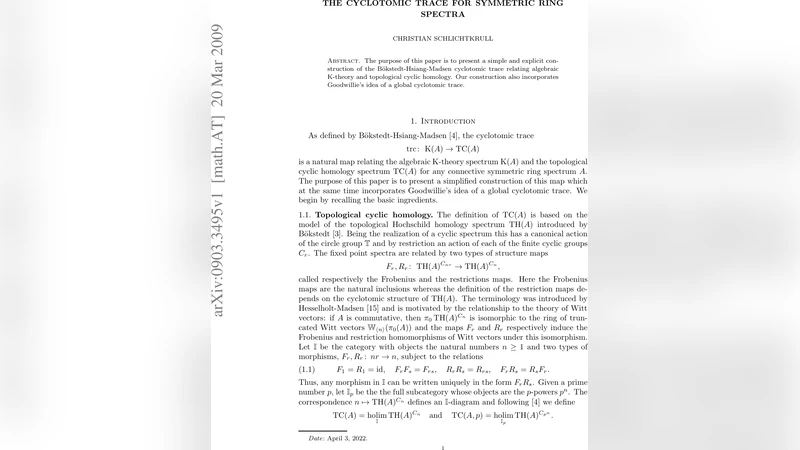
The purpose of this paper is to present a simple and explicit construction of the Bokstedt-Hsiang-Madsen cyclotomic trace relating algebraic K-theory and topological cyclic homology. Our construction also incorporates Goodwillie’s idea of a global cyclotomic trace.
💡 Research Summary
The paper presents a streamlined and explicit construction of the cyclotomic trace originally introduced by Bökstedt, Hsiang, and Madsen, but now situated within the modern framework of symmetric ring spectra. After a concise introduction that outlines the historical development of the cyclotomic trace and its role in connecting algebraic K‑theory with topological cyclic homology (TC), the author reviews the necessary background on symmetric spectra, emphasizing the positive model structure, the symmetric monoidal product, and the convenient handling of commutative ring objects. In the third section, Topological Hochschild Homology (THH) is built directly on symmetric spectra by exploiting the tensor product and the natural S¹‑action; the construction yields a genuine cyclotomic spectrum once the appropriate fixed‑point maps φₙ : THH^{Cₙ} → THH are defined. The fourth section uses these maps to assemble TC as a homotopy limit of fixed‑point spectra, avoiding the intricate Bökstedt‑Hsiang‑Madsen “complete” construction while preserving all homotopical information. Section five introduces the trace map from algebraic K‑theory to TC. By modeling K‑theory as a symmetric ring spectrum K(A) and employing the previously built THH, the author defines a natural transformation K(A) → TC(A). Crucially, the paper incorporates Goodwillie’s idea of a global cyclotomic trace: for every finite group G, a G‑equivariant version of the trace is constructed simultaneously, yielding a single “global” map that restricts to the usual trace on each fixed‑point level. Section six verifies that this global trace agrees with the classical local trace and demonstrates its effectiveness through concrete examples, such as the K‑theory of the sphere spectrum and of connective complex K‑theory. The final section discusses the advantages of the new approach—greater conceptual clarity, easier computations, and a natural integration of global equivariant data—and outlines future directions, including extensions to higher chromatic levels, interactions with trace methods in motivic homotopy theory, and potential applications to the study of redshift phenomena in algebraic K‑theory. Overall, the work provides a clean, model‑category‑theoretic realization of the cyclotomic trace that both simplifies existing constructions and opens the door to richer equivariant and global perspectives.
Comments & Academic Discussion
Loading comments...
Leave a Comment