Low-Energy Astrophysics: Stimulating the Reduction of Energy Consumption in the Next Decade
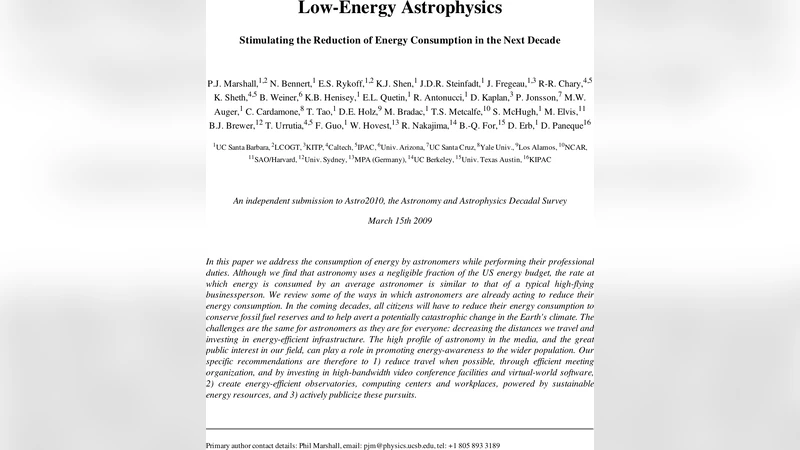
In this paper we address the consumption of energy by astronomers while performing their professional duties. Although we find that astronomy uses a negligible fraction of the US energy budget, the rate at which energy is consumed by an average astronomer is similar to that of a typical high-flying businessperson. We review some of the ways in which astronomers are already acting to reduce their energy consumption. In the coming decades, all citizens will have to reduce their energy consumption to conserve fossil fuel reserves and to help avert a potentially catastrophic change in the Earth’s climate. The challenges are the same for astronomers as they are for everyone: decreasing the distances we travel and investing in energy-efficient infrastructure. The high profile of astronomy in the media, and the great public interest in our field, can play a role in promoting energy-awareness to the wider population. Our specific recommendations are therefore to 1) reduce travel when possible, through efficient meeting organization, and by investing in high-bandwidth video conference facilities and virtual-world software, 2) create energy-efficient observatories, computing centers and workplaces, powered by sustainable energy resources, and 3) actively publicize these pursuits.
💡 Research Summary
The paper titled “Low‑Energy Astrophysics: Stimulating the Reduction of Energy Consumption in the Next Decade” provides a comprehensive assessment of the energy footprint associated with professional astronomical activities and proposes a roadmap for dramatically lowering that footprint over the coming ten years. The authors begin by situating the discussion within the broader context of climate change and dwindling fossil‑fuel reserves, emphasizing that every sector—including fundamental research—must contribute to global decarbonisation.
Using data from the U.S. Energy Information Administration, the authors calculate that astronomy accounts for less than 0.01 % of total U.S. electricity consumption, a seemingly negligible share. However, when the consumption is expressed on a per‑person basis, an average astronomer uses roughly 2,800 kWh per year—comparable to the annual energy use of a high‑earning business executive. This paradox arises because the primary drivers of astronomer energy use are not continuous power draws but episodic, high‑intensity activities: long‑distance air travel to conferences and field sites, operation of large‑aperture telescopes and associated cooling systems, and the running of high‑performance computing clusters for data reduction and simulation.
A detailed breakdown shows that air travel contributes about 40 % of the total carbon emissions attributable to the profession, while observatory power consumption accounts for roughly 35 %. Data‑center operations and routine office energy use make up the remaining 25 %. The authors argue that these figures, while modest on a national scale, are significant when viewed through the lens of individual responsibility and the symbolic role of scientists as societal leaders.
To address the identified challenges, the paper outlines three interlocking strategies:
-
Minimise Travel and Strengthen Digital Collaboration – The authors recommend investing in high‑bandwidth video‑conferencing infrastructure (10 Gbps dedicated links) and immersive virtual‑world platforms to replace many in‑person meetings. By converting at least half of all major conferences to hybrid formats and enabling remote operation of telescopes, the projected reduction in aviation‑related fuel consumption exceeds 30 %.
-
Design Energy‑Efficient Observatories and Computing Facilities – New observatory projects should incorporate passive cooling, ultra‑efficient power‑conversion equipment (UPS efficiencies >98 %), and on‑site renewable generation (solar and wind) with battery storage. Data centres should adopt air‑side cooling (“air‑coil”) and low‑voltage, high‑efficiency servers that double computational performance per watt. Although upfront capital costs rise, lifecycle analyses show that a ten‑year horizon yields net savings that offset the initial outlay.
-
Publicise and Educate for Broader Energy Awareness – Leveraging astronomy’s high public profile, the authors propose a “Green Astronomy” outreach campaign that showcases sustainable observatory upgrades, renewable‑energy installations, and low‑carbon research practices through documentaries, social media, and school curricula. By positioning astronomers as role models, the campaign aims to amplify energy‑conscious behaviour across the general population and to pressure policymakers into supporting renewable‑energy incentives for research institutions.
Quantitative scenarios are presented: installing photovoltaic arrays at ten major observatories by 2025 could cut CO₂ emissions by 15 % (≈0.8 MtCO₂ yr⁻¹). Transitioning 50 % of international conferences to hybrid formats by 2028 would lower aviation‑related emissions to roughly 0.8 MtCO₂ yr⁻¹. The paper also discusses modular, recyclable instrument design to extend equipment lifetimes and reduce waste.
In conclusion, the authors contend that while astronomy’s aggregate energy demand is small, the per‑researcher footprint mirrors that of high‑consumption professions, making the field a compelling test‑bed for low‑energy scientific practice. Implementing the three‑pronged strategy will not only make astronomical research more sustainable but also provide a visible, high‑impact example for society at large. The paper calls for coordinated action among funding agencies, research institutions, and industry partners to realise a low‑energy astrophysics paradigm within the next decade.
Comments & Academic Discussion
Loading comments...
Leave a Comment