TR02: State dependent oracle masks for improved dynamical features
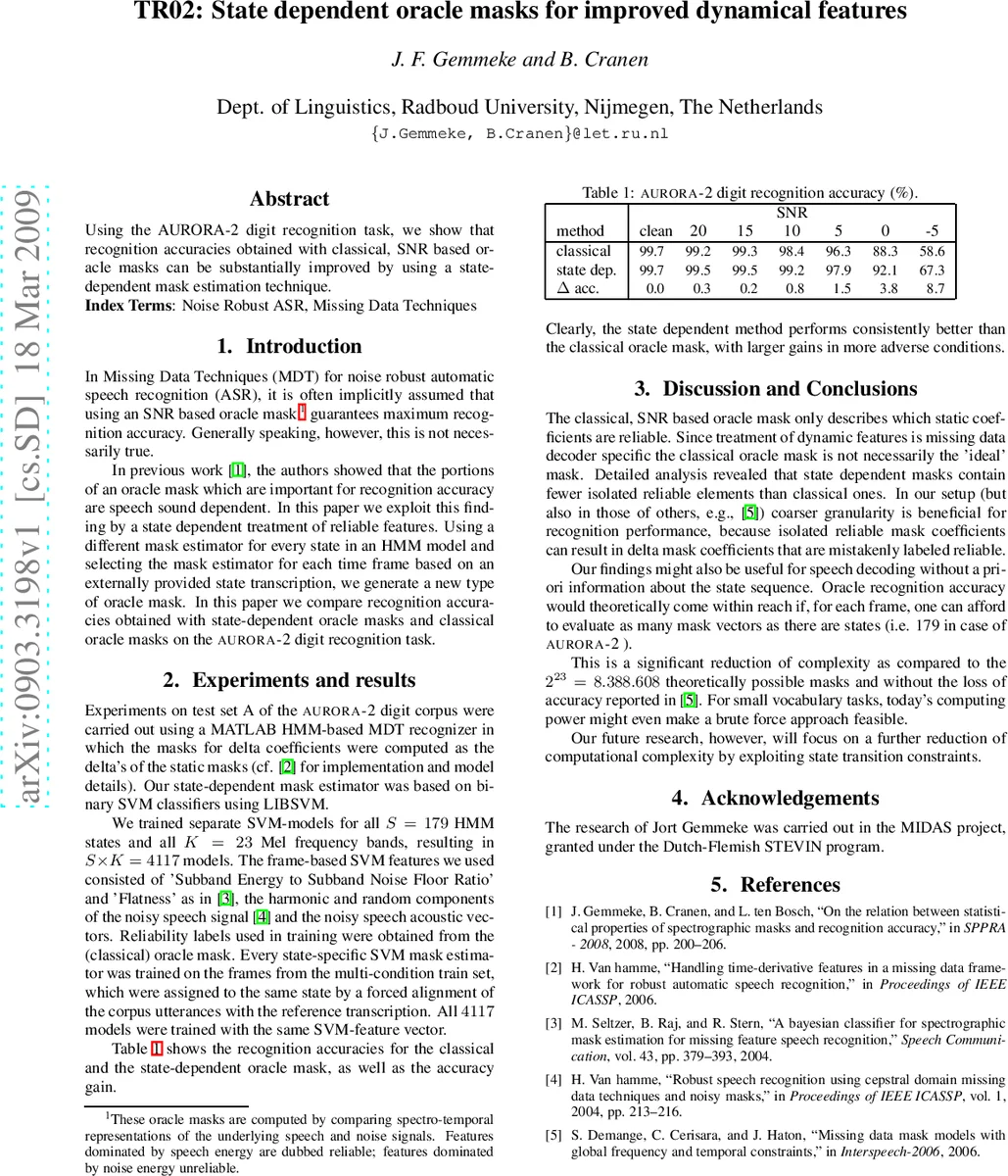
Using the AURORA-2 digit recognition task, we show that recognition accuracies obtained with classical, SNR based oracle masks can be substantially improved by using a state-dependent mask estimation technique.
💡 Research Summary
The paper investigates the limitations of conventional oracle masks—binary reliability masks derived solely from signal‑to‑noise ratio (SNR) comparisons—in missing‑data techniques (MDT) for robust automatic speech recognition (ASR). While such masks are traditionally assumed to provide the best possible information for the recognizer, the authors argue that they only describe the reliability of static spectral features and ignore the interaction with dynamic features (delta and delta‑delta coefficients). Consequently, isolated reliable elements in the static mask can produce incorrectly labeled dynamic masks, degrading recognition performance, especially under adverse noise conditions.
To address this shortcoming, the authors propose a state‑dependent oracle mask. The key idea is to train a separate binary support‑vector‑machine (SVM) classifier for each hidden Markov model (HMM) state and each mel‑frequency band, resulting in 179 × 23 = 4 117 SVM models. All models share the same feature vector, which includes sub‑band energy‑to‑noise‑floor ratio, spectral flatness, harmonic and random components of the noisy speech signal, and the noisy acoustic vectors. The training labels (reliable/unreliable) are taken from the conventional oracle mask, ensuring that each state‑specific SVM learns to predict reliability conditioned on the acoustic context of that state.
During testing on the AURORA‑2 digit recognition task, the system receives an external state transcription (ground‑truth state sequence). For each frame, the appropriate state‑specific SVM is selected, and its binary output constitutes the static reliability mask for that frame. Dynamic masks for delta coefficients are then derived as the differences of the static masks, following the standard MDT implementation.
Experimental results on test set A (covering SNRs from +20 dB down to –5 dB) show consistent improvements over the classical oracle mask. At high SNRs the two approaches are comparable, but as noise becomes more severe the state‑dependent mask yields larger gains: 0.3 % at 15 dB, 0.8 % at 10 dB, up to 8.7 % absolute improvement at –5 dB. The authors attribute this to the state‑dependent masks containing fewer isolated reliable elements, resulting in a coarser granularity that is less prone to generating spurious reliable delta coefficients.
The discussion highlights that the classical oracle mask is not truly “ideal” because it lacks a model for dynamic feature reliability. By conditioning mask estimation on HMM states, the proposed method effectively incorporates contextual information that aligns with the recognizer’s decoding process. Moreover, the combinatorial complexity of evaluating all possible masks (2^23 ≈ 8.4 × 10⁶) is dramatically reduced when only the 179 state‑specific masks need to be considered. For small‑vocabulary tasks, the authors suggest that current computational resources could even permit a brute‑force evaluation of all state‑conditioned masks, bringing oracle‑level performance within reach.
Future work will focus on further reducing computational load by exploiting state‑transition constraints, potentially enabling real‑time deployment without requiring an external state transcription. The authors also note that the insights gained may be valuable for speech decoding scenarios where state sequences are not known a priori, as the state‑dependent mask framework could be integrated with joint state‑estimation and mask‑estimation algorithms.
In summary, the study demonstrates that oracle masks can be significantly improved by making them state‑dependent, leading to robust gains in noisy ASR performance and opening new avenues for efficient, context‑aware missing‑data processing.
Comments & Academic Discussion
Loading comments...
Leave a Comment