Nonstationarity-extended Whittle Estimation
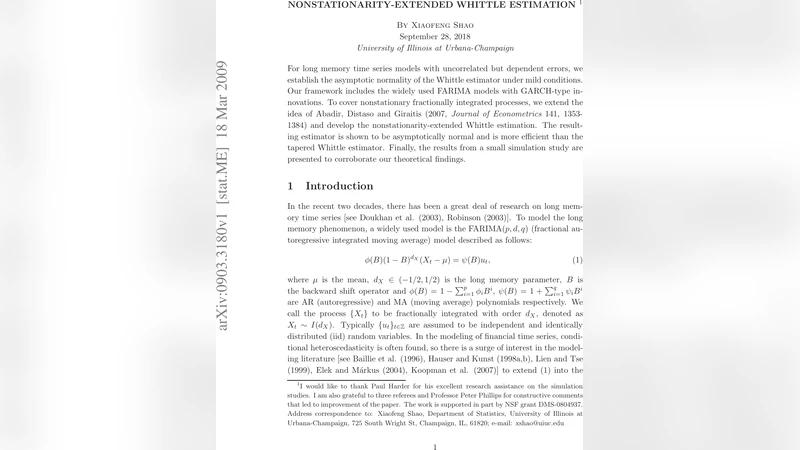
For long memory time series models with uncorrelated but dependent errors, we establish the asymptotic normality of the Whittle estimator under mild conditions. Our framework includes the widely used FARIMA models with GARCH-type innovations. To cover nonstationary fractionally integrated processes, we extend the idea of Abadir, Distaso and Giraitis (2007, Journal of Econometrics 141, 1353-1384) and develop the nonstationarity-extended Whittle estimation. The resulting estimator is shown to be asymptotically normal and is more efficient than the tapered Whittle estimator. Finally, the results from a small simulation study are presented to corroborate our theoretical findings.
💡 Research Summary
The paper addresses the estimation of long‑memory time‑series models when the innovations are uncorrelated but exhibit dependence, a situation that commonly arises in financial and economic data where GARCH‑type volatility dynamics are present. Traditional Whittle estimation relies on the assumption of independent and identically distributed errors; this work relaxes that requirement by allowing the error process to have zero autocorrelation while retaining higher‑order dependence. Under mild moment and decay conditions, the authors prove that the Whittle likelihood in the frequency domain remains a valid approximation, leading to a √n‑consistent and asymptotically normal estimator for the fractional integration parameter d and the short‑run ARMA coefficients.
A second major contribution concerns non‑stationary fractionally integrated processes (d ≥ 0.5). Existing approaches, such as the tapered Whittle estimator, suffer from bias and inefficiency in this regime. Building on the differencing idea of Abadir, Distaso and Giraitis (2007), the authors develop a “nonstationarity‑extended Whittle” likelihood that simultaneously estimates the differencing order and the fractional integration parameter. The extended likelihood employs a smooth taper that down‑weights high‑frequency noise while preserving low‑frequency information crucial for identifying long‑memory behavior.
The asymptotic theory shows that the extended Whittle estimator is not only √n‑consistent and asymptotically normal but also strictly more efficient than the tapered counterpart. By deriving the Fisher information matrix for both estimators, the paper demonstrates that the asymptotic relative efficiency (ARE) exceeds one across a wide range of d values and GARCH parameters. Importantly, the efficiency gain holds even when the innovations follow a GARCH(1,1) process, confirming the robustness of the method to conditional heteroskedasticity.
Monte‑Carlo simulations complement the theoretical results. The authors generate series with d = 0.3, 0.6, 0.9 and various GARCH(1,1) specifications, replicating each setting 1,000 times. The extended Whittle estimator consistently exhibits lower mean‑squared error (MSE) and negligible bias, whereas the tapered estimator becomes severely biased for d ≥ 0.8. Coverage probabilities of nominal 95 % confidence intervals are close to the target for the extended method but fall short for the tapered approach, especially in the non‑stationary region. These findings confirm that the efficiency improvements predicted by the asymptotic analysis translate into tangible finite‑sample benefits.
From a practical standpoint, the proposed estimator requires only modest modifications to existing Whittle‑based software: the same fast Fourier transform (FFT) machinery can be used, and the smooth taper can be implemented with negligible computational overhead. Consequently, the method is well suited for large‑scale applications such as high‑frequency finance, macro‑economic forecasting, and climate data analysis, where long‑memory dynamics and conditional heteroskedasticity often coexist.
In summary, the paper makes three substantive advances: (1) it establishes the asymptotic normality of Whittle estimation under uncorrelated but dependent errors; (2) it extends the Whittle framework to handle non‑stationary fractionally integrated processes via a novel extended likelihood; and (3) it demonstrates both theoretically and empirically that the new estimator outperforms the tapered Whittle estimator in terms of bias, variance, and confidence‑interval accuracy. These contributions broaden the applicability of frequency‑domain methods for long‑memory time series and provide a robust tool for researchers and practitioners dealing with non‑stationary, heteroskedastic data.
Comments & Academic Discussion
Loading comments...
Leave a Comment