We study statistical properties of long gamma-ray bursts (GRBs) produced by the collapsing cores of WR stars in binary systems. Fast rotation of the cores enables a two-stage collapse scenario, implying the formation of a spinar-like object. A burst produced by such a collapse consists of two pulses, whose energy budget is enough to explain observed GRBs. We calculate models of spinar evolution using results from a population synthesis of binary systems (done by the `Scenario Machine') as initial parameters for the rotating massive cores. Among the resulting bursts, events with the weaker first peak, namely, precursor, are identified, and the precursor-to-main-pulse time separations fully agree with the range of the observed values. The calculated fraction of long GRBs with precursor (about 10 per cent of the total number of long GRBs) and the durations of the main pulses are also consistent with observations. Precursors with lead times greater by up to one order of magnitude than those observed so far are expected to be about twice less numerous. Independently of a GRB model assumed, we predict the existence of precursors that arrive up to >~ 10^3 s in advance of the main events of GRBs.
Deep Dive into Population synthesis of gamma-ray bursts with precursor activity and the spinar paradigm.
We study statistical properties of long gamma-ray bursts (GRBs) produced by the collapsing cores of WR stars in binary systems. Fast rotation of the cores enables a two-stage collapse scenario, implying the formation of a spinar-like object. A burst produced by such a collapse consists of two pulses, whose energy budget is enough to explain observed GRBs. We calculate models of spinar evolution using results from a population synthesis of binary systems (done by the `Scenario Machine’) as initial parameters for the rotating massive cores. Among the resulting bursts, events with the weaker first peak, namely, precursor, are identified, and the precursor-to-main-pulse time separations fully agree with the range of the observed values. The calculated fraction of long GRBs with precursor (about 10 per cent of the total number of long GRBs) and the durations of the main pulses are also consistent with observations. Precursors with lead times greater by up to one order of magnitude than thos
Gravitational collapse is believed to be the underlying mechanism for the most energetic events observed in the Universe: GRBs and supernovae. While it is commonly accepted that the remnant of such events is a black hole or a neutron star, the details of the process are uncertain. In relation to GRBs, we investigate here the collapse of a fast rotating magnetized object, which can be understood in terms of the 'spinar paradigm'. We define spinar as a critically-fast rotating magnetized relativistic object, whose quasi-equilibrium is maintained by the balance of centrifugal and gravitational forces. The evolution of a spinar is determined by its magnetic field. A benefit of the spinar model is that it describes transparently and in a simple way the main features of a real collapse.
The properties of rotating magnetized objects were first investigated to understand the mechanisms of active galac-⋆ E-mail: galja@sai.msu.ru † E-mail: gorbovskoy@sai.msu.ru tic nuclei by, e.g., Hoyle & Fowler (1963); Ozernoi (1966); Morrison (1969); Woltjer (1971); Bisnovatyi-Kogan & Blinnikov (1972); Ozernoy & Usov (1973), of pulsars by Gunn & Ostriker (1969), and of supernova explosions by LeBlanc & Wilson (1970); Bisnovatyi-Kogan (1971). A rotationsupported ‘cold’ configuration with magnetic field received the name ‘spinar’ (see early reviews by Morrison & Cavaliere 1971;Ginzburg & Ozernoi 1977). Stellar mass spinars were suggested by Lipunov (1983Lipunov ( , 1987)). In the works by Lipunova (1997) and Lipunova & Lipunov (1998) a burst of electromagnetic radiation produced during the collapse of a spinar was studied, and a spinar mechanism for GRBs was first suggested.
As Lipunov & Gorbovskoy (2007) point out, there should be energy release in a process of spinar formation as well. This approach enables one to consider a two-stage scenario of a collapse. At the first stage, a spinar forms from a collapsing rotating body when centrifugal forces halt contraction. The effective dimensionless Kerr parameter of the spinar is greater than unity. At the second stage, the angular momentum is carried away, and the spinar evolves to a limiting Kerr black hole or a neutron star, depending on its mass. Lipunov & Gorbovskoy (2008) develop a 1D model of the magneto-rotational collapse of a spinar, which includes all principle relativistic effects on the dynamics and the magnetic field, along with the pressure of nuclear matter and neutrino cooling. A variety of burst patterns is obtained, generally a combination of two peaks. It is shown that the spinar paradigm agrees with the basic observed GRB properties.
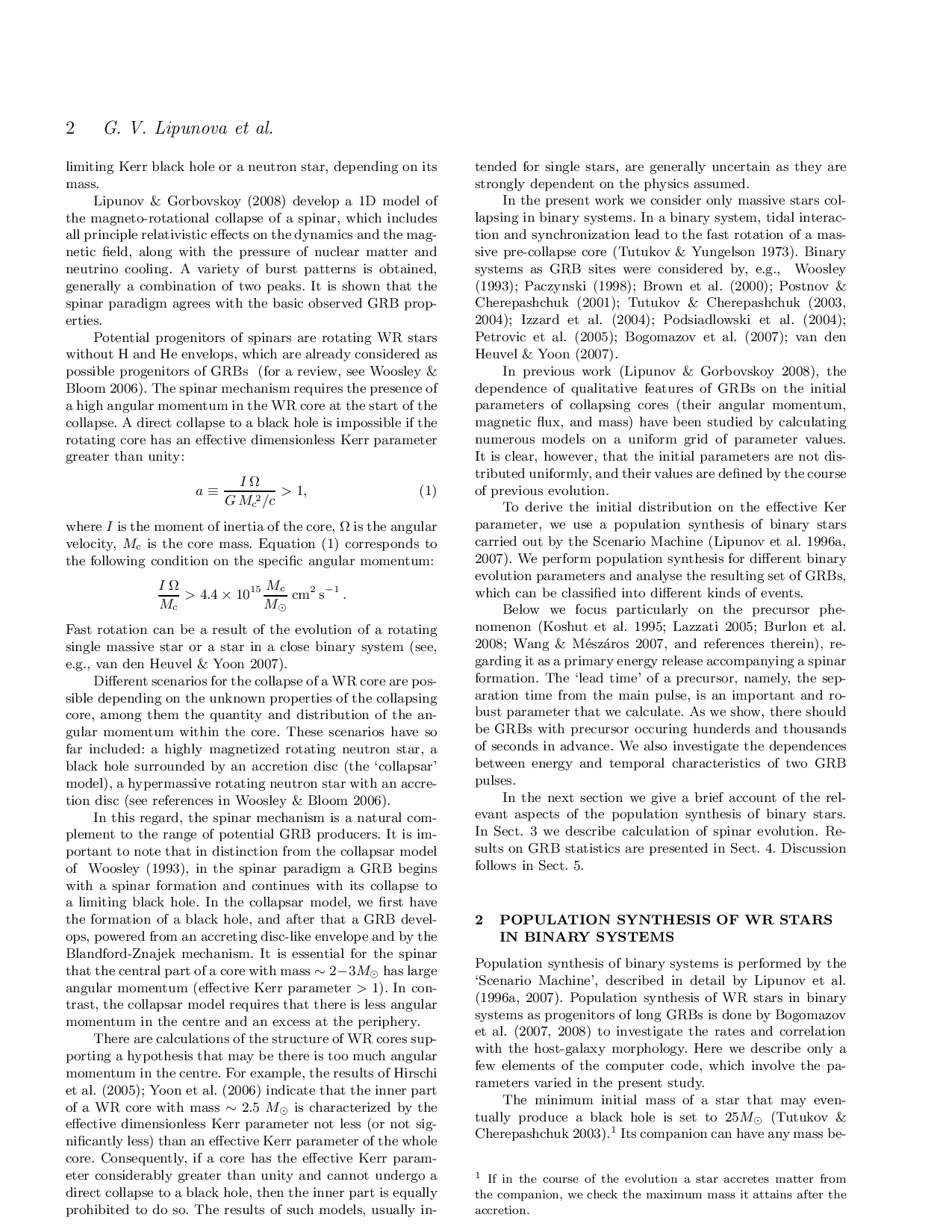
Potential progenitors of spinars are rotating WR stars without H and He envelops, which are already considered as possible progenitors of GRBs (for a review, see Woosley & Bloom 2006). The spinar mechanism requires the presence of a high angular momentum in the WR core at the start of the collapse. A direct collapse to a black hole is impossible if the rotating core has an effective dimensionless Kerr parameter greater than unity:
where I is the moment of inertia of the core, Ω is the angular velocity, Mc is the core mass. Equation (1) corresponds to the following condition on the specific angular momentum:
Fast rotation can be a result of the evolution of a rotating single massive star or a star in a close binary system (see, e.g., van den Heuvel & Yoon 2007). Different scenarios for the collapse of a WR core are possible depending on the unknown properties of the collapsing core, among them the quantity and distribution of the angular momentum within the core. These scenarios have so far included: a highly magnetized rotating neutron star, a black hole surrounded by an accretion disc (the ‘collapsar’ model), a hypermassive rotating neutron star with an accretion disc (see references in Woosley & Bloom 2006).
In this regard, the spinar mechanism is a natural complement to the range of potential GRB producers. It is important to note that in distinction from the collapsar model of Woosley (1993), in the spinar paradigm a GRB begins with a spinar formation and continues with its collapse to a limiting black hole. In the collapsar model, we first have the formation of a black hole, and after that a GRB develops, powered from an accreting disc-like envelope and by the Blandford-Znajek mechanism. It is essential for the spinar that the central part of a core with mass ∼ 2-3M⊙ has large angular momentum (effective Kerr parameter > 1). In contrast, the collapsar model requires that there is less angular momentum in the centre and an excess at the periphery.
There are calculations of the structure of WR cores supporting a hypothesis that may be there is too much angular momentum in the centre. For example, the results of Hirschi et al. (2005); Yoon et al. (2006) indicate that the inner part of a WR core with mass ∼ 2.5 M⊙ is characterized by the effective dimensionless Kerr parameter not less (or not significantly less) than an effectiv
…(Full text truncated)…
This content is AI-processed based on ArXiv data.