A Robust Ranging Scheme for OFDMA-Based Networks
Uplink synchronization in orthogonal frequency-division multiple-access (OFDMA) systems is a challenging task. In IEEE 802.16-based networks, users that intend to establish a communication link with the base station must go through a synchronization …
Authors: ** - **Michele Morelli** (Senior Member, IEEE) – University of Pisa, Department of Information Engineering
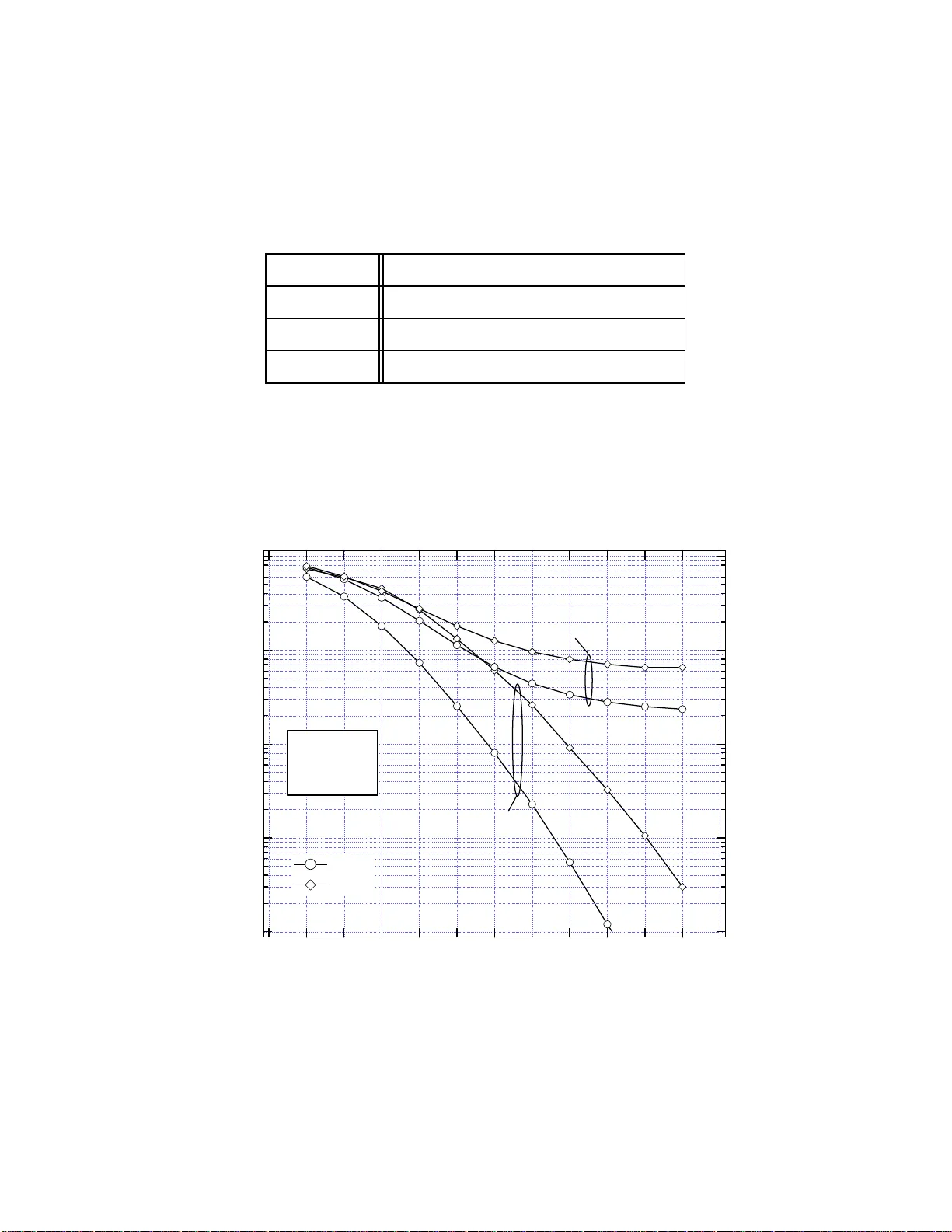
A Rob ust Ranging Scheme for OFDMA-Based Netw orks Michele Morelli, Senior Member , IEEE , Luca Sanguinetti , Me mber , IEEE , and H. V incent Poor , F ello w , IEEE . Abstract Uplink synchro nization in orthog onal frequency-division multiple-acce ss (OFDMA) systems is a challengin g task. In IEEE 802 .16-ba sed netw orks, u sers tha t intend to establish a com munication link with the base station must go through a synchroniza tion proced ure called Initial Ranging (IR). Existing IR schemes aim at estimatin g th e timing offsets an d power levels of ran ging sub scriber stations (RSSs) without con sidering possible freq uency misalignments between the re ceiv ed uplink signals a nd the base station local referen ce. In this work, we p resent a novel I R scheme for OFDMA systems where carrier frequency offsets, timin g er rors and power levels are estimated fo r all RSSs in a d ecoupled fashion. The pro posed frequ ency estimator is based on a subspace decomposition appr oach, while timing recovery is accomplished by measuring the phase shift between the users’channe l responses over adjacent subcarriers. Compu ter simulations are employed to assess the e ffecti veness o f the prop osed solution a nd to make c omparison s with existing alternatives. Index T erms OFDMA, r anging process, timing and frequen cy synch ronization , power estimation. M. Morelli and L. Sanguinetti are with the Unive rsity of Pisa, Department of Information Engineering, V ia Caruso 56126 Pisa, Italy (e-mail: michele.morelli@iet.unipi.it, luca.sanguine tti@i et.unipi.it). This work was completed while L . S anguinetti was with Princeton Univ ersity and it was supported by the U. S. National Science Foundation under Grants ANI-03-38807 and CNS-06-25637. This paper was presented in part at the IEEE International Conference on Communications (IC C), Beijing, China, 2008. H. V incent Poor is with the Department of El ectrical Engineering, Princeton Uni versity , P rinceton, NJ 08544, USA (e-mail: poor@princeton.ed u) July 13, 2021 DRAFT 1 I . I N T R O D U C T I O N The demand for hi gh data rates in wireless comm unications has led to a st rong interest in multicarrier modulation techniques, and particularly in orthogonal frequency-di vision multiple- access (OFDMA), which has become part of the IEEE 802.16 f amily of standards for wireless metropolitan area networks (WMANs) [1]. Despite its many appealing f eatures, OFDMA is e xtremely sensitiv e to timing errors and ca rrier frequency offsets (CFOs). The former give rise to interblock interference (IBI), while the latter produce in terchannel int erference (ICI) as well as m ultiple access interference (MAI). T o cope with such im pairments, the IEEE 802.1 6 standards specify a synchronization procedure called Initial Ranging (IR) by which users adju st t heir transm ission parameters so that uplink sig nals arri ve at the base station (BS) synchronously and with approxi mately the same po wer level. In its b asic form, the IR process develops through the following steps. First of all, each ranging subscriber station (RSS) comp utes frequency and timi ng estimates on the basis of a downlink control channel. The estimated parameters are used in the su bsequent upl ink phase, durin g w hich each RSS transm its a randoml y chosen code over a ranging t ime-slot. As a consequence of the diffe rent users’ pos itions withi n t he cell, uplin k s ignals arrive at the BS at diff erent ti me ins tants. Furthermore, since the ranging code is randomly selected, sev eral users m ay collide over a sam e time-slot. After identifying colliding codes and extracting timin g and power information, the BS will broadcast a response message i ndicating which codes h a ve been detected and giving instructions for tim ing and p owe r adjustment . From t he above dis cussion, t he main functi ons of t he BS during t he ranging process may be classified as multiuser code detection and mul tiuser tim ing/power est imation. Some m ethods to accomplish these tasks were orig inally suggested in [2] and [3]. In th ese works, a long pseudo- noise (PN) code is transmit ted by each RSS over all a vailable ranging subcarriers. Code det ection and timi ng recovery is t hen accomp lished on the basis of sui table correlations computed i n ei ther the frequency or tim e dom ains. Thi s approach requires h uge com putational complexity since o ne correlation must b e ev aluated for each po ssible ranging code and hypothesi zed ti ming o f fset. Moreover , in the presence of multipath disto rtions ranging subcarriers are subject to different attenuations and phase shifts, thereby leading to a l oss of t he code orthogonalit y . This gives ris e to MAI, which sever ely degrades the sys tem performance. A lternativ e soluti ons can be fou nd July 13, 2021 DRAFT 2 in [4] and [5]. In particular , the method in [4] replaces the PN ranging codes with a set of modified generalized chirp-like (GCL) s equences and mi tigates the ef fects of channel distorti on through differential detection of the ranging signals. Unfortunately , this approach is s till plagued by sign ificant MAI. Th e scheme discuss ed i n [5] aims at reducing the syst em complexity by breaking the multiparameter est imation problem i nto a num ber of successive st eps. Howe ver , it is specifically devised for flat channels and fails i n t he presence of mult ipath dis tortions. All pre viousl y d iscussed methods exhibit poor performance in the presence of fre quency selectiv e channels. Such drawback is partly m itigated in [6] by empl oying ranging s ubchannels composed by a small set of adjacent subcarriers over which the channel gains do not vary significantly . In order to achie ve m ultiuser and mu ltiantenna diversity gains, each RSS e xploi ts channel estimates obtained during the downlink phase to select the best su bchannel (i.e., the one characterized by the largest power g ain). Code detection is then accompl ished by correlati ng the recei ved frequency-domain samples with the correspondin g code sequence and com paring the result wit h a pre-assigned threshold. In the presence of t iming offsets, howe ver , the receive d codes are affected by different linear phase s hifts and loose th eir orthogonal ity , thereby leading to residual MAI. A signal desig n which is robust to multip ath distortions is proposed i n [7], where ranging signals are divided into sev eral groups and each group is transmi tted over an exclusiv e set of subcarriers with a specific timi ng delay . Th is approach l eads to a significant reductio n of MAI as signals of d if ferent grou ps are perfectly separable in eit her the frequency or tim e domain. Better results are obtained with the orthogonal signal design presented in [8]. In this scheme, ea ch RSS selects a ranging subchannel compos ed of a specified numb er of subcarriers and transm its a randomly cho sen code over adj acent OFDMA symbols. Spreading is thus performed in the time domain as the s ame code is transmit ted in parallel over all selected subcarriers. In a perfectly frequency synchronized scenario, codes transmit ted on different subcarriers remain disjoi nt at the recei ver . Furthermore, if the channel response keeps constant during the overall ranging period, codes recei ved over the same subcarrier are still orthogonal and can easily be separated at the BS. A fter mul tiuser code d etection, tim ing information is ev entually acquired in [8] through an iterativ e procedure, whi ch exploits the autocorrelation properties induced by t he cyclic prefix (CP). In spi te of the improved robustness against channel distorti ons, spreading across adjacent symbols increases t he sensit ivity of the sy stem to residual CFOs. In [8] i t is ass umed that during the ranging process frequenc y errors are so small that the demod ulated s ignals incur only July 13, 2021 DRAFT 3 negligible phase rotation s over one OFDMA symbol. Ho weve r , phase rotati ons m ay become significant if the rangi ng period s pans sever al adjacent symbols. In such a case, the recei ved ranging signals are no l onger orth ogonal and CFO comp ensation is necessary to av oid a s erious degradation of the system performance. In the present work we adop t the orthogonal s ignal design of [8] and propose a novel ranging met hod for OFDMA networks t hat is robust to frequency errors. T o av oid complex multidim ensional o ptimizations, we adopt a mul tistage approach where the number of active codes is first determined by re sortin g to the minimum description length (MDL) principle [9], and the multiple signal classification (MUSIC ) [10] algorithm is next employed for c ode identification and CFO estim ation. Frequency estimates are then used in th e third step, w here timing and p o wer lev el estimation is accomplished in an ad-hoc fashion. The rest of the paper is organized as follows. Section II describes the adop ted signal model . In Section III we address the problem of code id entification and CFO recover y , whil e Sec tion IV is dev oted to timin g and power estimatio n. Section V ill ustrates a m ethod to detect poss ible collisions between RSSs that use th e same code and ranging subchannel. Simulatio n results are presented in Section VI and some conclusions are drawn in Section VII. Notation : Matrices and vectors are denoted by boldface letters, with I N and 0 N being the identity and null matrices of order N , respecti vely . A = diag { a ( n ) ; n = 1 , 2 , . . . , N } denotes an N × N diagonal matrix with entries a ( n ) along its main diagonal, whil e B − 1 and tr { B } are the in v erse and the trace of a square m atrix B . W e use E {·} , ( · ) ∗ , ( · ) T and ( · ) H for expectation, complex conjugation, t ransposition and Hermitian transposition , respecti vely . The notatio n k·k represents the E uclidean norm of the enclosed vector while | · | stands for the mo dulus. Finally , round { x } indicates the integer closest to x and [ · ] k ,ℓ denotes the ( k , ℓ )t h entry of the enclosed matrix. I I . S Y S T E M D E S C R I P T I O N A N D S I G N A L M O D E L A. System description The in vestigated OFDMA system em ploys N subcarriers with frequency spacing ∆ f and indices in the set J = { 0 , 1 , . . . , N − 1 } . T o a void aliasing problem at the receiver , a number N 0 of null subcarriers are pl aced at both edges of the signal spectrum. W e denote by R the number of ranging subchannels and assume that each of them i s divided in to Q subbands uni formly spaced July 13, 2021 DRAFT 4 over the si gnal bandwidth at a distance ( N U /Q )∆ f from each other , where N U = N − 2 N 0 is the number of modulated sub carriers. A g iv en subband is called a tile and is composed by a set of V adjacent subcarriers. The s ubcarrier indices in t he q th tile ( q = 0 , 1 , . . . , Q − 1) of the r th subchannel ( r = 0 , 1 , . . . , R − 1) are col lected in to a set J ( r ) q = { i ( r ) q ,ν } V − 1 ν =0 with entries i ( r ) q ,ν = q N U Q + r N U QR + N 0 + ν . (1) The r th subchann el is th us com posed of subcarriers wit h in dices t aken from J ( r ) = ∪ Q − 1 q =0 J ( r ) q , while a total of N R = QV R ranging subcarriers are av ailable w ith indices in the set J R = ∪ R − 1 r =0 J ( r ) . The remainin g N D = N U − N R subcarriers are used for data transmissi on and are assigned to d ata subs criber stations (DSSs) which have successful ly completed th eir IR process at an earlier st age. W e denote b y M th e number of OFDM symbol s in a ranging time-slot. In the sequel, we assum e th at M is a power of t wo. The p roposed ranging process deve lops through the follo wing steps: 1) Each RSS s elects one of the R av ailable ranging subchannels according to some specified criterion. In low mobility applications, channel estimates ob tained during the downlink slot can be exploited to choose the less attenuated subchannel [6]. Here, we fol low a simpler approach in which the ranging subchannel is random ly selected b y each RSS. 2) The RSS transmi ts a randomly chosen code of length M during the rangin g tim e-slot. Similarly to [8], s uch a code is transmitted in parallel over all subcarriers belonging to the selected subchannel and is taken from an orthog onal set C = { c 1 , c 2 , . . . , c M } (e.g., a W alsh- Hadamard set) wit h c k = [ c k (0) , c k (1) , . . . , c k ( M − 1)] T and | c k ( m ) | = 1 for 0 ≤ m ≤ M − 1 . 3) On the basis of the receiv ed upl ink signals, the BS determin es which codes are actually being employed and extracts the correspondi ng frequency , timing and power i nformation. It al so detects possi ble collisi ons between RSSs that use the same code and ranging subchannel. 4) Once the above operations hav e been successfuly comp leted, the BS wi ll broadcast a response m essage by which the detected RSSs can adjust t heir syn chronization parameters. Since users th at do not find their ranging i nformation in the response message must re-ini tiate the ranging procedure i n the next frame, there i s no need to notify the collision status to colli ded RSSs. W ithout l oss of generality , in t he ensuing discussi on we concent rate on the r th sub channel and assume th at it has been selected by K ( r ) RSSs. T o sim plify th e notation, the s ubchannel July 13, 2021 DRAFT 5 index ( r ) is dropped henceforth. The wav eform transmi tted by the k th RSS propagates through a multi path channel with impulse response h k = [ h k (0) , h k (1) , . . . , h k ( L k − 1)] T . A s t he channel order L k is usu ally unknown, in practice we replace h k by an L -dim ensional vector h ′ k = [ h T k , 0 , . . . , 0] T , wh ere L ≥ max k { L k } is a design parameter that depends on t he maxim um expected chann el delay spread. At the BS, the receiv ed samples are not synchronized with the local references. W e denote by θ k the timi ng error of the k t h RSS e xpressed in sampling intervals whil e ε k denotes the frequency of fset normalized by the subcarrier spacing. As explained in [11], users that intend to access th e network compute initial frequency and timing estim ates on the basis of a downlink control signal broadcast by the BS. T he estimated parameters are then empl oyed by each RSS as synchroni zation references for t he upl ink ranging transmiss ion. This m eans t hat during IR the CFOs are onl y in duced by Dop pler shi fts and /or downlink estim ation errors and, in consequence, they wil l be qu ite small. As an example, consider the IEEE 802.1 6 standard for WMANs wi th subcarrier spacing ∆ f = 11 . 16 kHz and carrier frequency f 0 = 2 . 5 G Hz. In case of ideal downlink synchronizatio n, the maximum CFO in the uplink is 2 f o v k /c , w here v k denotes the termi nal speed while c = 3 × 10 8 m/s is the speed of light. Letting v k = 120 km/h yields ε k ≤ 0 . 05 , which means that the normalized CFO l ies within 5% of the su bcarrier spacing. Timing errors depend on the di stances of th e RSSs from the BS and t heir maxim um value corresponds t o the round trip propagation delay for a user located at the cell bo undary [11]. Thi s parameter is k nown and give n by θ max = 2 R c / ( cT s ) , where R c is the cell radius and T s = 1 / ( N ∆ f ) the sam pling period. A simple way to count eract the effects of timin g errors relies on the use of sufficiently long CPs comp rising N G ≥ θ max + L samp ling intervals. This leads to a quasi -synchr on ous network in which timing errors do not produce any IBI and only appear as phase shi fts at the output of the recei ve discrete Fourier transform (DFT) unit. Although such a so lution i s n ormally adopt ed duri ng IR, the CP of data sym bols sh ould be made just greater th an the channel l ength to mini mize u nnecessary overhead. It fol lows that accurate timing estimates must be obt ained du ring the ranging period in order to avoid IBI over the data section of the frame. July 13, 2021 DRAFT 6 B. Signal model W e denote by Y m ( i q ,ν ) th e DFT output over the i q ,ν th subcarrier of the m th OFDM sy mbol. Assuming for simplicity th at the DSSs are perfectly aligned to the BS references, their signals do not con tribute to Y m ( i q ,ν ) . In contrast, the presence of uncompensated CFOs d estroys or - thogonality among ranging signals and gives ri se to ICI. On the other hand, recalling that the CFOs are confined within a s mall fraction of the subcarrier spacing , the demodul ated signals incur negligibl e phase rotations over one OFDM sym bol and the resulting ICI can reasonably be neglected. Und er the above ass umptions, we may write Y m ( i q ,ν ) ≈ K X k =1 c k ( m ) e j 2 π mε k N T / N S k ( θ k , i q ,ν ) + n m ( i q ,ν ) (2) where N T = N + N G denotes the duration of t he cyclically extended OFDM symbols and n m ( i q ,ν ) accounts for Gauss ian noi se with zero mean and v ariance σ 2 . In addit ion, we hav e defined S k ( θ k , i q ,ν ) = e − j 2 πθ k i q,ν / N H k ( i q ,ν ) (3) where H k ( i q ,ν ) = L − 1 X ℓ =0 h k ( ℓ ) e − j 2 πℓi q,ν / N (4) is th e k th channel frequency response over the i q ,ν th su bcarrier . The power recei ved from the k th RSS ov er the rangin g su bcarriers i s defined as P k = 1 QV Q − 1 X q =0 V − 1 X ν =0 | S k ( θ k , i q ,ν ) | 2 . (5) In the fol lowing s ections we s how h o w the quantiti es { Y m ( i q ,ν ) } can be exploited to ident ify the active codes and estimate the corresponding CFOs, timin g errors and power l e vels. As anticipated, in doin g so we adopt a multi stage procedure i n whi ch frequency estimates are preliminarily obtained and are next used for timing and power estimation purposes. For the time being, we let K ≤ M − 1 and assu me that the active RSSs use different codes over the considered subchannel [6], [8]. A method to identify possi ble collisions bet ween RSSs employing th e same code is presented in Sect. V . July 13, 2021 DRAFT 7 I I I . C O D E D E T E C T I O N A N D C F O E S T I M A T I O N W e define an M − dimensional vector Y ( i q ,ν ) = [ Y 0 ( i q ,ν ) , Y 1 ( i q ,ν ) , . . . , Y M − 1 ( i q ,ν )] T which collects the i q ,ν th DFT output across the ranging tim e-slot. Then, from (2) we have Y ( i q ,ν ) = K X k =1 S k ( θ k , i q ,ν ) Γ ( ε k ) c k + n ( i q ,ν ) (6) where Γ ( ε k ) = diag { e j 2 π mε k N T / N ; m = 0 , 1 , . . . , M − 1 } (7) while n ( i q ,ν ) = [ n 0 ( i q ,ν ) , n 1 ( i q ,ν ) , . . . , n M − 1 ( i q ,ν )] T is Gaussian distributed with zero-mean and cov ariance matri x σ 2 I M . Let ting ε = [ ε 1 , ε 2 , . . . , ε K ] T and θ = [ θ 1 , θ 2 , . . . , θ K ] T , we may rewrite Y ( i q ,ν ) in a more compact fo rm as Y ( i q ,ν ) = C ( ε ) S ( θ , i q ,ν ) + n ( i q ,ν ) (8) where C ( ε ) is t he following M × K matrix C ( ε ) = [ Γ ( ε 1 ) c 1 Γ ( ε 2 ) c 2 · · · Γ ( ε K ) c K ] (9) and S ( θ , i q ,ν ) = [ S 1 ( θ 1 , i q ,ν ) , S 2 ( θ 2 , i q ,ν ) , . . . , S K ( θ K , i q ,ν )] T . From (6) we see that Y ( i q ,ν ) is a superposition of frequency-rotated codes { Γ ( ε k ) c k } K k =1 embedded in white Gaussian noise and with random amplitudes { S k ( θ k , i q ,ν ) } K k =1 . Thi s model has the same structure as measurements of m ultiple uncorrelated sources from an array of s ensors. W e can thus identify t he active codes and their corresponding CFOs by applying subs pace-based m ethods. A. Determinatio n of the nu mber of a ctive codes The first problem is to determine the number of receiv ed cod es ov er th e considered ranging subchannel. This task can be accomplish ed through the eigen v alue decompositio n (EVD) of the correlation matrix R Y = E { Y ( i q ,ν ) Y H ( i q ,ν ) } . In practice, howe ver , R Y is not av ailable at th e recei ver . One com mon approach is to use t he samp le correlation matrix ˆ R Y = 1 QV V − 1 X ν =0 Q − 1 X q =0 Y ( i q ,ν ) Y H ( i q ,ν ) (10) July 13, 2021 DRAFT 8 which provides an unbiased and cons istent estimate of R Y . Performing the EVD on ˆ R Y and arranging the corresponding eigen v alues ˆ λ 1 ≥ ˆ λ 2 ≥ · · · ≥ ˆ λ M in non-increasing order , we can find an esti mate ˆ K of the number of active codes t hrough information-t heoretic criteria. T wo prominent solu tions in this sense are based on the Akaike and MD L criteria. Here, we adopt t he MDL approach which l ooks for t he minimu m of the foll owing objectiv e function [9] F ( ˜ K ) = 1 2 ˜ K (2 M − ˜ K ) ln( QV ) − QV ( M − ˜ K ) ln ρ ( ˜ K ) (11) with ρ ( ˜ K ) = M Q i = ˜ K + 1 ˆ λ i ! 1 M − ˜ K 1 M − ˜ K M P i = ˜ K + 1 ˆ λ i . (12) Extensive numerical simulations indi cate that a better estim ate o f K is obtained by replacing the s mallest eigen va lue ˆ λ M with an estimate ˆ σ 2 of th e noise po wer . The l atter can be obtained in various ways. One possibl e approach is based on the us e of null su bcarriers placed at the spectrum edges and reads ˆ σ 2 = 1 2 M N 0 M − 1 X m =0 N 0 − 1 X n =0 | Y m ( n ) | 2 + | Y m ( N − n − 1) | 2 (13) where Y m ( n ) is the DFT outpu t correspondi ng to the n th subcarrier of the m th OFDMA s ymbol. B. CFO estimat ion and code det ection Inspection of (6) re veals that the observation space can be decomposed into a signal subs pace S s spanned by the rotated codes { Γ ( ε k ) c k } K k =1 plus a noise subspace S n . Since S n is the orthogonal complement of S s , each vector in S s is orthogonal to any other vector in S n . For simplicit y , we assume that the num ber of active codes has been correctly estimated and deno te by { ˆ u 1 , ˆ u 2 , . . . , ˆ u M } t he eigen vectors of ˆ R Y corresponding to the ordered eigen v alues ˆ λ 1 ≥ ˆ λ 2 ≥ · · · ≥ ˆ λ M . The M USIC algorithm relies on the fac t that the eigen vectors { ˆ u K +1 , ˆ u K +2 , . . . , ˆ u M } associated with the M − K sm allest eigen v alues of ˆ R Y form an estimated basis o f S n and, accordingly , they are appr oximately orthogonal t o all vectors in the signal space [10]. An estimate July 13, 2021 DRAFT 9 of ε k is thus obtained by m inimizing t he proj ection of Γ ( ˜ ε ) c k onto th e subs pace spanned by th e columns of ˆ U n = [ ˆ u K +1 ˆ u K +2 · · · ˆ u M ] . This leads to the following estim ation algori thm ˆ ε k = arg max ˜ ε { Ψ k ( ˜ ε ) } (14) with Ψ k ( ˜ ε ) = 1 ˆ U H n Γ ( ˜ ε ) c k 2 . (15) In prin ciple, CFO reco very mu st only be accomplished for the activ e codes. Howe ver , si nce at this s tage the BS has no knowledge as to which codes are being em ployed over t he consi dered subchannel, frequency esti mates { ˆ ε 1 , ˆ ε 2 , . . . , ˆ ε M } m ust be ev aluated for the complete set C . Next, the p roblem arises of h o w to ident ify t he codes that are actually active. The proposed identification algorithm looks for the K largest values in the s et { Ψ ℓ ( ˆ ε ℓ ) } M ℓ =1 , say { Ψ u k ( ˆ ε u k ) } K k =1 , and declares as active the corresponding codes { c u k } K k =1 . The C FO estimates are e ventually found as ˆ ε u = [ ˆ ε u 1 , ˆ ε u 2 , . . . , ˆ ε u K ] T . In the sequel, we refer to (14) as the MUSIC-based frequency estimator (MFE), wh ile th e described identification algorithm is called the MUSIC-based code detector (MCD). C. Remarks 1) A fundamental assu mption behind the MUSIC estim ator is that the dim ension of S n is at least unitary . This implies K < M , which explains why the number of RSSs over the same ranging subchannel should not exceed M − 1 . 2) Let K ≤ M − 1 and assume that two or mo re RSSs share th e same ranging code over the considered subchannel. In s uch a case, alt hough t he MDL can st ill provide the exact number of active RSSs, the MCD is not capable of ident ifying the correspondin g codes as it impl icitly assumes that any give n code is used by no m ore th an one RSS. As an example, l et M = 4 and K = 3 with one RSS employing code c 1 and t he oth er two RSSs c 2 . In this situat ion, it is likely t hat the MCD declares as active c 1 and c 2 plus a t hird code ( c 3 or c 4 ) which is actually turned o f f and corresponds to a phantom RSS . In a similar way , the MFE will provide th ree CFO estimates, two of which are associated with activ e users while the remaining one corresponds July 13, 2021 DRAFT 10 to the phantom RSS. It is worth observing that, when ˆ K = K , t he presence of a phant om RSS alwa ys implies the mis-det ection o f an active user , which is refe rred to as un detected RSS . 3) In mult iple frequency estimation probl ems t he ESPRIT [12] represents a v alid alt ernati ve to the MUSIC [13]. The main advantage of ESPRIT is that it provides est imates of the s ignal parameters in closed-form without requiring any time consuming grid-search. A basic assumption behind this technique is the rotational in variance property of the o bserv ation vectors, wh ich is guaranteed in the presence of complex exponentials in noise. Unfortunately , in general, the rotated codes { Γ ( ε k ) c k } K k =1 in general do not satisfy t he in var iance property . In this case, the ESPRIT cannot be used and we must apply the MUSIC or alternativ e reduced-complexity schemes like root-MUSIC or the m inimum-no rm m ethod [14]. 4) A key issue is th e maxim um CFO that t he MFE can handle. T o simplify the analys is, assume that the ranging codes belong to t he Fourier basi s of order M , i.e., c k ( m ) = e j 2 π m ( k − 1) / M , 0 ≤ m ≤ M − 1 (16) for k = 1 , 2 , . . . , M . Then, in Append ix it is shown that identifiabilit y of the rotated codes { Γ ( ε k ) c k } K k =1 is guaranteed as lo ng as t he normalized CFOs are smaller than N / (2 M N T ) in magnitude. On the other hand, a ssum e that ε k = N / (2 M N T ) and ε k +1 = − N / (2 M N T ) . In such a case, th e receiv ed codes Γ ( ε k ) c k and Γ ( ε k +1 ) c k +1 are ident ical and there is no way to dis tinguish among them. T he above facts s ay that th e acquis ition range of MFE is | ε k | < N / (2 M N T ) . Although this result cannot be easi ly extended t o ot her code desig ns, extensi ve si mulations indicate that it also appl ies t o W als h-Hadamard bin ary codes. 5) The accuracy of MFE can be assessed with th e m ethods dev eloped in [15]. Specifically , at high SNR values and for large data records (i. e., large values of QV ), the CFO estimati on errors are nearly Gaus sian distributed with zero mean and variances E { ( ˆ ε k − ε k ) 2 } = σ 2 N 2 8 π 2 QV N 2 T P k · 1 d H k ( ε k ) C ⊥ ( ε ) d k ( ε k ) (17) where d k ( ε k ) is an M − dimensional vector with entries { mc k ( m ) e j 2 π mε k N T / N } M − 1 m =0 and C ⊥ ( ε ) = I M − C ( ε )[ C H ( ε ) C ( ε )] − 1 C H ( ε ) . 6) It is i nteresting to assess t he com putational requirement of M FE and MCD. Computing ˆ R Y in (10) approximately in volves 2 QV M 2 real multipli cations plus the same number of real July 13, 2021 DRAFT 11 additions. In writing these figures we hav e borne in m ind that ˆ R Y is Hermitian and , accordingly , only the entries [ ˆ R Y ] m 1 ,m 2 with m 1 ≥ m 2 need be computed. Performing the EVD o n a r eal- valued M × M matrix needs 12 M 3 floating operations (flops) [16]. For the complex- valued matrix ˆ R Y , we approxim ate the flop count as 72 M 3 by pessim istically treating ev ery operation as it were a complex m ultiplication. Finally , ev aluating the metric Ψ k ( ˜ ε ) i n (15) requires (4 M + 2)( M − K ) real products plus 4 M ( M − K ) real addition s for each ˜ ε . Denoting by N ε the number of candidate values ˜ ε and o bserving that the maximization in (14) must be performed over th e entire cod e set { c 1 , c 2 , . . . , c M } , it follows that a t otal of 2 N ε M (4 M + 1) ( M − K )) operations are required to find ˆ ε u . The overa ll number of flops required by MFE and MCD in the considered ranging subchannel are summarized i n t he first row of T ab . I. I V . E S T I M A T I O N O F T H E T I M I N G D E L A Y S A N D P O W E R L E V E L S After code detection and CFO recovery , the BS must acquire i nformation about the ti ming delays and po wer lev els of all rangi ng s ignals. This problem i s addressed by resorting to a two- step procedure i n which est imates of S ( θ , i q ,ν ) are firstly comput ed ove r all rangi ng subcarriers and are subs equently exploited to obtain the timing errors and power lev els. T o sim plify t he notation, in the following deriv ations the indices { u k } ˆ K k =1 of t he detected codes are relabeled according to the m ap u k → k . A. T i ming r ecovery Let ˆ K = K and assume that the accuracy of the CFO esti mates is such t hat ˆ ε ≃ ε . Then, the maximum likelihood (ML) estimat e of S ( θ , i q ,ν ) based on the model (8) is found to be ˆ S ( i q ,ν ) = [ ˆ C H ( ˆ ε ) ˆ C ( ˆ ε )] − 1 ˆ C H ( ˆ ε ) Y ( i q ,ν ) (18) where ˆ C ( ˆ ε ) = [ Γ ( ˆ ε 1 ) c 1 Γ ( ˆ ε 2 ) c 2 · · · Γ ( ˆ ε ˆ K ) c ˆ K ] and we have omit ted the functional dependence of S ( θ , i q ,ν ) on θ . Substituting (8) into (18) yield s ˆ S ( i q ,ν ) = S ( i q ,ν ) + ψ ( i q ,ν ) (19) where ψ ( i q ,ν ) = [ ψ 1 ( i q ,ν ) , ψ 2 ( i q ,ν ) , . . . , ψ K ( i q ,ν )] T is a zero-mean dist urbance vector with co- var iance matrix σ 2 [ ˆ C H ( ˆ ε ) ˆ C ( ˆ ε )] − 1 . From (19) and (3) it follo ws that the entries of ˆ S ( i q ,ν ) can be modeled as July 13, 2021 DRAFT 12 ˆ S k ( i q ,ν ) = e − j 2 πθ k i q,ν / N H k ( i q ,ν ) + ψ k ( i q ,ν ) 1 ≤ k ≤ K (20) for any q ∈ { 0 , 1 , . . . , Q − 1 } and ν ∈ { 0 , 1 , . . . , V − 1 } . The above equ ation indi cates that, under the assum ptions of ideal CFO recov ery and code detectio n, ˆ S k ( i q ,ν ) is on ly contributed by the k t h RSS. Hence, we can use the quantities { ˆ S k ( i q ,ν ) } to get ti ming estimates in dividually for each RSS. T o see how this comes abou t, we recall th at i n practical multicarrier systems the channel gai ns over cont iguous su bcarriers are high ly correlated and their v alues are alm ost the same. Hence, letting H k ( i q ,ν − 1) ≃ H k ( i q ,ν ) and neglecting for simpl icity the noise contribution, from (20) we hav e ˆ S k ( i q ,ν − 1) ˆ S ∗ k ( i q ,ν ) ≃ | H k ( i q ,ν ) | 2 e j 2 π θ k / N . (21) The above result indicates that a t iming estimate can be obt ained in the form ˆ θ k = roun d ( N 2 π arg " Q − 1 X q =0 V − 1 X ν =1 ˆ S k ( i q ,ν − 1) ˆ S ∗ k ( i q ,ν ) #) (22) where the round operation is justified by the fact that θ k is integer-v alued. As discussed in [11], IBI is present du ring the data section of the frame w hene ver the timing error ˆ θ k − θ k lies outside the interval J ∆ θ = [ L − N GD − 1 , 0] , where N G,D is the CP length of th e OFDMA symbols d uring the data sectio n of the frame. Intuitively speaking, the probabilit y of occurrence of IBI can be reduced by shifting the expected value o f the timing error towar d the middle point of J ∆ θ , which is given by ( L − N GD − 1) / 2 . Th is leads to a refined tim ing estimate ˆ θ ( f ) k = ˆ θ k − µ k + ( L − N GD − 1) / 2 , with µ k = E { ˆ θ k − θ k } . Extensiv e sim ulations i ndicate that µ k equals the mean delay associated t o h k . This parameter is generally unk nown at the receiv er , but can roughly b e approxim ated by ( L − 1) / 2 . Combining the above results with (22) produces ˆ θ ( f ) k = roun d ( N 2 π arg " Q − 1 X q =0 V − 1 X ν =1 ˆ S k ( i q ,ν − 1) ˆ S ∗ k ( i q ,ν ) # − N GD 2 ) (23) which is referred to as the ad-hoc timin g estimator (AHTE). An alternativ e approach to get timin g estim ates from the quantit ies { ˆ S k ( i q ,ν ) } is il lustrated in [17] by resorting to the least-squares criterion. Compared to this solut ion, AHTE is s impler July 13, 2021 DRAFT 13 to implement and can handl e a maximum tim ing offset of N / 2 , whereas in [17] the estimation range depends on Q and L and is typ ically much smaller than N / 2 . B. P o wer level estimati on Collecting (3) and (20), we obs erve that ˆ S k ( i q ,ν ) is an unbi ased estimate of S k ( i q ,ν ) with var iance σ 2 k = σ 2 · [ ˆ T − 1 ( ˆ ε )] k ,k (24) where ˆ T ( ˆ ε ) = ˆ C H ( ˆ ε ) ˆ C ( ˆ ε ) . An unbiased estimate of | S k ( i q ,ν ) | 2 is thus gi ven by | ˆ S k ( i q ,ν ) | 2 − σ 2 k . This fact, t ogether wi th (5) and (24), l eads to the following ad-hoc power estimator (AHPE) ˆ P k = 1 QV Q − 1 X q =0 V − 1 X ν =0 | ˆ S k ( i q ,ν ) | 2 − ˆ σ 2 · [ ˆ T − 1 ( ˆ ε )] k ,k (25) where ˆ σ 2 is an estimate of σ 2 . In case of i deal frequency and noise power estim ation (i.e., ˆ ε = ε and ˆ σ 2 = σ 2 ), it can be shown that AHPE provides unbiased estimates with variance var { ˆ P k } = σ 2 k (2 P k + σ 2 k ) QV for k = 1 , 2 , . . . , K . (26) C. Complex ity i ssues In assessing the computational lo ad of AHTE and AHPE, it is useful to distingu ish between a first stage, leading to vectors ˆ S ( i q ,ν ) i n (18), and a second stage where these vectors are used to compute the timing and power esti mates. W e begin by observing that ˆ S ( i q ,ν ) is the solution of a linear sys tem ˆ C H ( ˆ ε ) ˆ C ( ˆ ε ) ˆ S ( i q ,ν ) = ˆ C H ( ˆ ε ) Y ( i q ,ν ) . Assumin g that the entries of ˆ C ( ˆ ε ) are a vailable, computing the Hermitian matrix ˆ C H ( ˆ ε ) ˆ C ( ˆ ε ) in volves 4 K 2 M flops whi le e valuating ˆ C H ( ˆ ε ) Y ( i q ,ν ) needs 8 K M flops for any pair ( q , ν ) . Each linear system is efficiently solved with approximately 2 K 2 ( K + 6) flops by exploiting the Choles ky factorization of ˆ C H ( ˆ ε ) ˆ C ( ˆ ε ) [16]. A total of 4 K 2 M + 2 K QV ( K 2 + 6 K + 4 M ) flops are thu s required to obtai n ˆ S ( i q ,ν ) for q ∈ { 0 , 1 , . . . , Q − 1 } and ν ∈ { 0 , 1 , . . . , V − 1 } . In the second stage of the estim ation process, timing and powe r estimates are obtained through (23) and (25), respectively . Comput ing ˆ θ k from (23) in v olves 8 Q ( V − 1) flops for any activ e RSS, while 4 QV additional flops are needed to July 13, 2021 DRAFT 14 e valuate ˆ P k in (25). The overall requirement of AHTE and APHE in the consi dered ranging subchannel is summarized in th e second ro w of T ab . I. In writing these figures we have not considered the n oise power estimate (13), which i s computed off-line wit h negligible compl exity . V . C O L L I S I O N D E T E C T I O N So far , we have neglected possible collisio ns b etween RSSs that choose th e same ranging opportunity . This implies that each subchannel is accessed by no more than M − 1 RSSs which employ di f ferent codes. Although a proper syst em desi gn can reduce the risk of a collision, su ch e vent occurs with some non -zero p robability . As mentioned pre viousl y , i f K ≥ M the M FE cannot work properly since in this case the noi se sub space reduces to the nul l vector . Another critical situation is represented by the presence of pairs of ph antom and und etected RSSs, which is likely t o occur wh en K ≤ M − 1 and the same code is shared by t wo o r more RSSs. If the undetected RSS employs the same code of a detected RSS, t he former wi ll adjust its t ransmission parameters according to the response message transmitted to the latter . Such adjustment may hav e detrim ental effects as it is based on incorrect synch information . On the ot her hand, the presence of a phantom RSS is not a big problem as the code associated to the correspondi ng response message will not recogni zed b y any of the acti ve RSSs. The above dis cussion indicates that, although it is not strictly n ecessary to not ify t he colli sion st atus t o col lided RSSs, colli sion e vents must be detected to av oid t hat i ncorrect synch informatio n be trasmit ted t o t he activ e RSSs. For this pu rpose, we consider the follo wing vectors ∆ Y ( i q ,ν ) = Y ( i q ,ν ) − ˆ C ( ˆ ε ) ˆ S ( i q ,ν ) (27) for q ∈ { 0 , 1 , . . . , Q − 1 } and ν ∈ { 0 , 1 , . . . , V − 1 } . From (8), we conjecture t hat the entries of ∆ Y ( i q ,ν ) will hav e small ampli tudes if ˆ C ( ˆ ε ) and ˆ S ( i q ,ν ) are good approximation s of C ( ε ) and S ( i q ,ν ) , respectively . Such sit uation occurs when the estimates ˆ K and ˆ ε are sufficiently accurate. Indeed, using standard comp utations i t can be shown that E {k ∆ Y ( i q ,ν ) k 2 } = σ 2 ( M − ˆ K ) + δ ( ˆ ε , ε , i q ,ν ) (28) where July 13, 2021 DRAFT 15 δ ( ˆ ε , ε , i q ,ν ) = 0 ˆ Z H ( ˆ ε ) C ( ε ) S ( i q ,ν ) 2 if ˆ K = K and ˆ ε = ε otherwise (29) and ˆ Z ( ˆ ε ) ˆ Z H ( ˆ ε ) is the Cholesky f actorization of the M × M matrix I M − ˆ C ( ˆ ε )[ ˆ C H ( ˆ ε ) ˆ C ( ˆ ε )] − 1 ˆ C H ( ˆ ε ) . Inspection of (29) reveals that δ ( ˆ ε , ε , i q ,ν ) is minimum when K and ε are perfectly estimated, while mu ch larger values are expected in the presence of col liding RSSs due to the poor quali ty of ˆ K and ˆ ε . This su ggests the use of δ ( ˆ ε , ε , i q ,ν ) as a col lision detection met ric. Unfortun ately , this quant ity is unknown and must be estimated in some manner . Replacing t he expectation of k ∆ Y ( i q ,ν ) k 2 in (28) with the correspondin g ensemble average, an estimate of δ ( ˆ ε , ε , i q ,ν ) is obtained as ˆ δ = 1 QV Q − 1 X q =0 V − 1 X ν =0 k ∆ Y ( i q ,ν ) k 2 − ˆ σ 2 ( M − ˆ K ) (30) where ˆ σ 2 is expressed in (13). Hence, a coll ision status is declared to o ccur whenever ˆ δ exceeds a specified t hreshold η . In that case, the BS do es not send any response message to the us ers on the considered subchannel as their estim ated synch parameters and power le vels are regarded as not sufficiently reli able. The RSSs that do not find their information repeat the ranging process in the next frame usin g a diff erent ranging opportunit y . If ˆ δ < η , the BS consi ders the users’ parameters as accurately estimated and sends a response message for al l detected codes in the considered subchannel. In the sequel, we refer to the above procedure as the ad- hoc collision detector (AHCD). Clearly , η mu st be properly designed to achieve a reasonable trade-of f between the probability of declaring a colli sion when in fact it is not p resent (false alarm) and the probabili ty o f not detecting a col lision when in fact it is present (mis-detectio n). Since computing such probabilities by theoretical analysis appears a formidabl e task, numerical simulatio ns can be used i n practice for the design of η . In ass essing the computati onal load of AHCD, we l et ˆ K = K and observe t hat ˆ S ( i q ,ν ) is a vailable at the BS as an output of AHTE. Hence, computing ∆ Y ( i q ,ν ) i n (27) needs 8 K M flops for any value of q and ν while 4 M − 1 flops are required to get k ∆ Y ( i q ,ν ) k 2 . Finally , e valuating ˆ δ in (30) in volves QV real additions. The resulting complexity for the considered subchannel is shown in the third li ne of T ab . I. July 13, 2021 DRAFT 16 V I . S I M U L A T I O N R E S U L T S A. System parameters The i n vestigated OFDMA system is based on the IEEE 802.16e standard for wireless MANs. The D FT size is N = 102 4 and the sampling period is T s = 87 . 5 ns , corresponding to a subcarrier distance of 1 / ( N T s ) = 11 . 16 kHz. W e ass ume that N 0 = 80 sub carriers are placed at bot h edges of the signal spectrum. Th e n umber of modu lated subcarriers is t hus N U = 864 while the u plink bandwidth is approximately B w = N U / ( N T s ) = 9 . 7 MHz. A total of N R = 144 subcarriers are reserved for ranging. They are divided into R = 18 s ubchannels, each comprising Q = 4 tiles uniformly spaced over the signal spectrum at a distance of N U /Q = 216 . The number of s ubcarriers in any ti le is V = 2 . The remaining N U − N R = 720 subcarriers are grouped into 15 data subchannels, each compo sed by 48 subcarriers. A ranging time-slot includes M = 4 OFDMA symbol s. Hence, the number of ranging oppo rtunities i n each frame is N total = R ( M − 1) = 54 . The rangi ng codes are t aken from the Fourier basis o f order 4 , while DSS data symbol s belong to a QPSK const ellation. The discrete-time CIRs hav e maximum order L = 14 . Their entries are modeled as ind ependent and circularly symmet ric Gaussian random variables with zero-mean and an exponential power delay profile, i.e., E {| h k ( ℓ ) | 2 } = σ 2 h,k · exp( − ℓ/L k ) , ℓ = 0 , 1 , . . . , L k − 1 (31) where { L k } K k =1 are taken from t he set { 8 , 9 , . . . , 14 } with equal probability while σ 2 h,k = (1 − e − 1 ) / (1 − e − 1 /L k ) so as to have E {k h k k 2 } = 1 for all activ e users. In this way , the powers P k of t he recei ved signals are random variables with unit m ean. Channels of different users are statistically i ndependent of each other . W e cons ider a cell radius of 1.5 km , correspondi ng to a maximum propagation delay of θ max = 114 samp ling periods. Ranging sym bols are preceded by a CP of length N G = 128 in order to a void IBI. The norm alized CFOs are u niformly d istributed over the interval [ − ε max , ε max ] and vary at each run. Recalling that the estimation range of MFE is | ε k | < N/ (2 M N T ) , th roughout s imulations we set ε max ≤ 0 . 1 for the RSSs. T he numb er of CFO trial values in (14 ) i s N ε = 400 , corresponding to an MFE frequency resoluti on of 2 ε max / N ε ≤ 5 · 10 − 4 . For the DSSs we fix ε max = 0 . 02 , wh ile the maximum tim ing error is limited to 48 samp les. July 13, 2021 DRAFT 17 Unless otherwise specified, we consider a stati c scenario where channel coef ficients are generated at each simulation run and kept fixed over an entire t ime-slot. In ev aluating the accurac y of the synchronization and code detection algorithms , we assume that all RSSs attemp t their ranging process si multaneously at the first time-slot choos ing diffe rent ranging opportuniti es. Collision events are simul ated only to assess the p erformance of AHCD. Comparisons are made with the ranging schem e proposed by Fu, Li and Mi nn (FLM) in [8] under a comm on si mulation set-up. T his includes the same number of ranging subcarriers, ranging subchannels and data subchannels, as well as the s ame transm itted energy from each user terminal. Ho weve r , as FLM can support M different RSS ov er the same subchannel, the total number of ranging opportuniti es is 72 with FLM and 54 w ith our scheme. In all subsequent simul ations, the same number K of RSSs is present i n each rangi ng subchannels. Thi s i mplies th at a t otal of γ R = K R RSSs are si multaneously activ e in the system. Note that l etting K = 3 in our ranging scheme corresponds to a fully-loaded system where all ranging opportu nities are em ployed. W e fix the n umber of DSSs to γ D = 10 , although extensi ve simulations indicate th at the syst em performance is o nly marginally af fected by this parameter . B. P erf ormance evaluatio n 1) Mul tiuser code detection: W e begin by i n vestigating the performance o f MCD in terms of mis-detection and false alarm probabilities, say P md and P f a . Fig. 1 illu strates P md as a function of SNR = 1 /σ 2 . The num ber of activ e RSSs in each subchannel is either 2 o r 3 while the maximum normalized CFO is 0 . 05 . Th e FLM code detector declares the k th rangi ng code as activ e p rovided that the quanti ty Z k = 1 QV M 2 Q − 1 X q =0 V − 1 X ν =0 c H k Y ( i q ,ν ) 2 (32) exceeds a suitable t hreshold η F LM which is proportio nal to the estimated noise po wer ˆ σ 2 . The results of Fig. 1 indicate that MCD performs remarkably better than FLM. As expected, the system performance deteriorates as K approaches M . The reason is that increasing K reduces the noise subsp ace dimens ion, thereby de grading the accuracy of MCD. July 13, 2021 DRAFT 18 Fig. 2 s hows P f a versus SNR for K = 1 o r 2 and ε max = 0 . 0 5 . As is seen, MCD outperforms FLM at SNR values greater than o f 6 dB. Interestingly , when usi ng FLM the probability of false alarm in creases with SNR. Such behavior can be explained by obs erving that the threshold η F LM is proporti onal to ˆ σ 2 , so that i t b ecomes sm aller and smaller as the SNR i ncreases. 2) F r equency estima tion: Fig. 3 i llustrates the root m ean-square-error (RMSE) of th e fre- quency estimates obtained with MFE vs. SNR for K = 2 or 3 and ε max = 0 . 05 . The theoretical analysis in (17) is also sho wn for comparison. As it is seen, the frequency RMSE is approximately 2 dB worse than its predicted value. Th e reason is that the resul t (17) is accurate only for lar ge values of QV (lar ge data records), whi le in our simulation set-up QV is limi ted t o 8. Again, the system performance deteriorates as K increases. Nev ertheless, the accurac y of MFE is satis factory at all SNR values of practical interest. Indeed, an RMSE of 1 0 − 2 is obtai ned e ven with K = 3 if SNR > 1 3 d B. The imp act of th e CFOs on the p erformance of MFE is assessed in Fig. 4, where the frequency RMSE is sho wn as a function o f ε max . The SNR is fixed to 16 dB while K is s till 2 or 3 . W e see that the esti mation accuracy is onl y m ar ginally aff ected by ε max . 3) T iming r ecovery: Th e performance of t he timing estimato rs is assessed by measurin g t he probability P ( ǫ ) o f a tim ing error e vent. The latter occurs whenev er the estim ate ˆ θ ( f ) k giv es rise to IBI du ring the data section of the frame. This amounts to saying that the tim ing error ∆ ˆ θ ( f ) k = ˆ θ ( f ) k − θ k is larger than zero or smaller than L − N GD − 1 , where N GD = 48 is the CP length during the data t ransmission period. Note that t he mean-shift N GD / 2 employed in (23) is also applied to the FLM t iming estimator in o rder t o reduce P ( ǫ ) . Fig. 5 illustrates P ( ǫ ) vs . SNR as o btained with AHTE and FLM. T he number of active codes in each ranging sub channel is K = 2 or 3 whi le ε max = 0 . 05 . At practical SNR v alues, we see that AHT E provides much better results than FLM. In Fig. 6 t he timing estim ators are compared in terms of their sensit ivity to CFOs. For this purpose, P ( ǫ ) is shown as a function of ε max for K = 2 or 3 and SNR = 16 dB. Again, we see that AHTE outp erforms FLM, even though the latter i s m ore robust to CFOs. 4) P ower estimation: Fig. 7 illustrates the RMSE of the power estimates as o btained with AHPE and the FLM power esti mator . In the l atter case, the quantity ˆ P k is computed as ˆ P k = Z k / ( QV ) − ˆ σ 2 / M with Z k as given in (32). The numb er of active RSSs in each subchannel is eit her 2 or 3 and ε max = 0 . 05 . The theoreti cal analysis (26) is also shown for comp arison. July 13, 2021 DRAFT 19 Good agreement between simul ation and theory is obtained for K = 2 , while a l oss of 2 dB is observed with K = 3 . The reason is that (26) h as been derived ass uming p erfect knowledge of the frequency of fsets, while in practice the accuracy of the CFO est imates degrades with K . At low SNR values, both AHPE and FLM provide sim ilar results, but the former t akes the lead as the SNR grows large. 5) Impact of channel vari ations: All previous measurements hav e been conducted by keeping the channel resp onses fixed during one sim ulation run. In order to assess th e impact of channel var iations on t he system performance, we now consider ti me-va rying chann el taps generated by passing white Gaussian noise through a third-order l ow- pass Butterworth filter . The 3-dB bandwidth of the filter is taken as a measure of the Dopp ler bandwidth B D = v f c /c , where v denotes the mobile speed, f c = 2 . 5 GH z is the carrier frequency and c the speed of light . Figs. 8 and 9 illu strate the accuracy of MFE and AHTE, respectively , as a function of v with SNR = 16 dB. Again, the number of acti ve codes in each ranging subchannel is K = 2 or 3 while ε max = 0 . 05 . The proposed scheme exhibit s a remarkable rob ustness against channel variations and can handle a mo bile speed of 30 m/ s wi th n egligible loss wit h respect to a stat ic scenario. 6) Colli sion detection : Fig. 10 ill ustrates the performance of AHCD is terms of false alarm ( P f a ) and mis -detection ( P md ) probabiliti es as a function of the threshold η . The false alarm is measured in a scenario where two RSSs employing different ranging opportunit ies are activ e in each s ubchannel. V ice versa, P md is ob tained with K = 3 and ass uming that two RSSs in each s ubchannel choos e t he same code. In both situations the SNR i s fixed to 16 dB while ε max = 0 . 05 . As m entioned in Sect. V , it is imp ortant that the probabil ity of mis-det ecting a collision ev ent is kept as low as possible in order to a void that RSSs sharing t he same ranging opportunity adjus t their transmis sion parameters on the basis of incorrect synch information. The results shown in Fig. 10 in dicate that a P md and P f a of 2 · 1 0 − 3 can be obtained by s etting η = 0 . 05 . C. Computational complexity It is interesting to com pare the proposed ranging scheme with the FLM app roach in terms of processing requirement in the considered simulation scenario. As suming t hat K = 2 RSSs are activ e (on a verage) in each ranging subchannel, from T able I it follows that 1 14,000 flops are approximately needed by MCD and MFE for each ranging subchannel, wh ile 1,280 flops are July 13, 2021 DRAFT 20 required by AHTE and AHPE. The complexity ev aluation for FLM is performed in [8], where it is shown that code detection in volv es 1,088 flops while m ore than 3 Mflops are necessary for timing recove ry in each subchannel. These results in dicate th at our scheme allo ws a significant complexity sa ving with respect to FLM, wit h a reduct ion of th e overall number of flops by a factor 26. V I I . C O N C L U S I O N S W e have presented a ne w ranging m ethod for OFDMA s ystems where upli nk s ignals arriving at t he base s tation are plagued by frequency errors in addition to timing m isalignments . The synchronization parameters of all ranging users are estimated in a decoupled fashion with af fordable complexity . This is accomplished through a m ultistage procedure, where user identi- fication and CFO estimation is performed first by means of a subspace d ecomposition approach. Frequency estimates are next employed for tim ing recovery and power lev el estim ation. A s imple method to detect possib le collision s between RSSs empl oying the same ranging opp ortunity i s also in vestigated. Compared to previous techniques, the proposed scheme exhibits improved accurac y with reduced complexity . Computer simulations indi cate that the sy stem performance is satisfactory even in the presence of frequency errors as l ar ge as 1 0% of the subcarrier sp acing. The propo sed approach can be used to enhance the ranging process of commercial IEEE 802.16- based OFDMA systems . A P P E N D I X This App endix establi shes necessary condit ions for code identi fiability by means of MCD. T o make t he problem analy tically tractable, t he ranging codes are t aken from the Fourier basis of o rder M as expressed in (16). From (7) and (16) we s ee that matrix C ( ε ) in (9) h as the following V andermonde structure C ( ε ) = 1 1 · · · 1 z 1 z 2 · · · z K . . . . . . . . . . . . z M − 1 1 z M − 1 2 . . . z M − 1 K (33) with July 13, 2021 DRAFT 21 z k = e j 2 π [ ( k − 1) / M + ε k N T / N ] for k = 1 , 2 , . . . , K . (34) Recalling th at any given code can be un iv ocally id entified as long as it is linearly independent of all other codes, it follows that C ( ε ) must be full-rank. On the other h and, for a V andermonde matrix the full-rank conditi on i s met if and only if z k 1 6 = z k 2 for k 1 6 = k 2 . Bearing in m ind (34), it is easily seen that z k 1 6 = z k 2 is equiv alent to putt ing k 1 M + ε k 1 N T N 6 = ℓ + k 2 M + ε k 2 N T N (35) for any int eger number ℓ . T o proceed further , we reformul ate (35) as M N T N | ε k 1 − ε k 2 | 6 = | M ℓ + k 2 − k 1 | (36) and o bserve that the right-hand-sid e cannot be small er than unity when k 1 6 = k 2 . H ence, a necessary condition f or code identifiability is that M N T | ε k 1 − ε k 2 | / N < 1 , which can be ensured by setting | ε k | < N 2 M N T (37) for k = 1 , 2 , . . . , K . R E F E R E N C E S [1] “IEEE standard for local and metropolitan area networks: Air interface for fi xed and mobile broadban d wireless access systems amendment 2 : Physical and medium access control layers for combined fixed and mobile operation in licensed bands and corrigendum 1, ” IEEE S td 802.16e -2005 and IEEE Std. 802.16-2004/Cor 1-2005 Std. 2006 , T ech. Rep., 2006. [2] J. Kr inock, M. S ingh, M. Paf f, A. L onkar , L . Fung, and C.-C. Lee, “Comments on OFDMA ranging scheme described in IEEE 802.16ab -01/01r1, ” IEE E 802.16 Br oadban d W ireless Access W orking Group, T ech. Rep., July 2001. [3] X. F u and H. Minn, “Initial uplink synchronization and power control (ranging process) for OFDMA systems, ” in Pr oceedings of the IEE E Global C ommunications Confer ence (GLOB ECOM) , Dallas, T e xas, USA, Nov . 29 - Dec. 3, 2004, pp. 3999 – 4003. [4] D. H. Lee, “OFDMA uplink ranging for IEEE 802.16e using modified generalized chirp-like polyphase sequences, ” in Pr oceedings of the International C onfer ence in Central A sia on Internet (2005) , Bi shk ek, K yrgyz Republic, Sept. 26 - 29, 2005, pp. 1 – 5. [5] H. A. Mahmoud, H. Arslan, and M. K. Ozdemir , “Initial ranging for WiMAX (802.16e) OFDMA, ” in Pr oceedings of the IEEE Military Communications Confer ence , W ashington, D.C., Oct. 23 – 25, 2006 , pp. 1 – 7. July 13, 2021 DRAFT 22 [6] J. Z eng and H. Minn, “ A nove l OFDMA ranging method exploiting multiuser dive rsity , ” in Pr oceedings of the I EEE Global T elecommunications Confer ence , vol. 1, W ashington , D. C., U SA, N ov . 26 – 30 2007, pp. 1498 – 1502. [7] X. Zhuan, K. Baum, V . Nangia, and M. C udak, “Ranging enhancement for 802.16e OFDMA PHY, ” document IEE E 802.16e-04 /143r1, T ech . Rep., June 2004. [8] X. F u, Y . Li, and H. Minn, “ A ne w ranging method for OFDMA systems, ” IEEE T ransactions on W ir eless Communications , vol. 6, no. 2, pp. 659 – 669, February 2007. [9] M. W ax and T . Kailath, “Detection of signals by information theoretic criteria, ” IEEE T ransactions on Acoustic, Speec h and Signal Pr ocessing , v ol. ASSP -33, pp. 387 – 392, April 1985. [10] R. Schmidt, “Multiple emitter location and signal parameter estimation, ” in Pr oceedings of RADC Spectrum Estimation W orkshop . R ome Air Deve lopment Corp., 1979, pp. 243 – 258. [11] M. Morelli, “Timing and frequency synchronization f or the uplink of an OFDMA system, ” I EEE T ransac tions on Communications , vol. 52, no. 2, pp. 296 – 306, Feb . 2004. [12] R. Roy , A. Paulraj, and T . Kailath, “ESP RIT - direction-of-arriv al estimation by subspace rotation methods, ” IEEE T ran sactions on Acoustic, Speech and Signal Pr ocessing , vol. 37, no. 7, pp. 984 – 995, July 1989. [13] L. Sanguinetti, M. Morelli, and H. V . Poor, “ An ES PRIT-based approach for i nitial ranging in OF DMA systems, ” T o appear in IEEE T ransaction s on Communications , Presented in part at the 9th IEEE W ork shop on Signal Processing Advan ces for Wireless C ommunications (SP A WC), Recife, P ernambu co, Brazil, 2008. [14] P . Stoica and R. Moses, Intr oduction to Spectr al Analysis . Engle wood Cliffs, NJ: Prentice Hall, 1997. [15] P . Stoica and A. Nehorai, “MUSIC, maximum likelihood , and Cramer-Rao bound, ” IEEE Tr ansactions on Acoustics, Speec h, and Signal P r ocessing , vo l. 37, no. 5, pp. 720 – 741, May 1989. [16] G. Golub and C. V . Loan, Matrix Computations, Third Edition . Johns Hopkins Uni versity P ress, 1996. [17] L. S anguinetti, M. Morelli, and H. V . Poor , “ A scheme f or initial ranging in OFDMA-based networks, ” in Pr oceedings of the International Confer ence on Communications (ICC) , Beijing, China, May 19 - 23, 2008, pp. 3469 – 3474. July 13, 2021 DRAFT 23 T ABLE I C O M P U TA T I O N A L L OA D F O R E A C H R A N G I N G S U B C H A N N E L Algorithm Required Flops MFE & MCD 4 M 2 ( QV + 18 M ) + 2 M N ǫ (4 M + 1)( M − K ) AHTE & AHP E 4 K 2 M + 2 K QV (4 M + 6 K + K 2 + 6) AHCD 4 M Q V (2 K + 1) 10 -4 10 -3 10 -2 10 -1 10 0 P md 22 20 18 16 14 12 10 8 6 4 2 0 -2 SNR, dB FLM MCD K = 2 K = 3 ε max = 0.05 Fig. 1. Mis-detection probability vs. SNR wi th K = 2 or 3 and ε max = 0 . 05 . July 13, 2021 DRAFT 24 10 -5 10 -4 10 -3 10 -2 P fa 22 20 18 16 14 12 10 8 6 4 2 0 -2 SNR, dB MCD FLM K = 1 K = 2 ε max = 0.05 Fig. 2. False alarm probability vs. SNR with K = 1 or 2 and ε max = 0 . 05 . July 13, 2021 DRAFT 25 10 -4 10 -3 10 -2 10 -1 10 0 Frequency RMSE 22 20 18 16 14 12 10 8 6 4 2 0 -2 SNR, dB MFE, ε max = 0.05 K = 2 K = 3 Theoretical analysis Fig. 3. Frequency RMSE vs. SNR with K = 2 or 3 and ε max = 0 . 05 . July 13, 2021 DRAFT 26 10 -3 10 -2 10 -1 10 0 Frequency RMSE 0.100 0.075 0.050 0.025 0.000 e max K = 2 K = 3 MFE, SNR = 16 dB Fig. 4. Frequency RMSE vs. ε max with K = 2 or 3 and SNR = 16 dB. July 13, 2021 DRAFT 27 10 -3 10 -2 10 -1 10 0 P (e) 22 20 18 16 14 12 10 8 6 4 2 0 -2 SNR, dB FLM AHTE K = 2 K = 3 ε max = 0.05 Fig. 5. P ( ǫ ) vs. S NR wit h K = 2 or 3 and ε max = 0 . 05 . July 13, 2021 DRAFT 28 10 -2 10 -1 10 0 P (e) 0.100 0.075 0.050 0.025 0.000 e max FLM AHTE K = 2 K = 3 SNR = 16 dB Fig. 6. P ( ǫ ) vs. ε max with K = 2 or 3 and SNR = 16 dB. July 13, 2021 DRAFT 29 10 -2 10 -1 10 0 10 1 Power RMSE 22 20 18 16 14 12 10 8 6 4 2 0 -2 SNR, dB FLM AHPE K = 2 K = 3 ε max = 0.05 Theoretical analysis Fig. 7. RMSE of the power estimates vs. SNR wi th K = 2 or 3 and ε max = 0 . 05 . July 13, 2021 DRAFT 30 10 -3 10 -2 10 -1 10 0 Frequency RMSE 30 25 20 15 10 5 0 mobile speed, v (m/s) K = 2 K = 3 MFE, SNR = 16 dB ε max = 0.05 Fig. 8. Frequency RMSE vs. v with K = 2 or 3 and S NR = 16 dB. July 13, 2021 DRAFT 31 10 -2 10 -1 10 0 P (e) 30 25 20 15 10 5 0 mobile speed, v (m/s) K = 2 K = 3 AHTE, SNR = 16 dB ε max = 0.05 Fig. 9. P ( ǫ ) vs. v with K = 2 or 3 and SNR = 16 dB. July 13, 2021 DRAFT 32 10 -3 10 -2 10 -1 10 0 P fa & P md 0.19 0.17 0.15 0.13 0.11 0.09 0.07 0.05 0.03 0.01 h K = 2 K = 3 AHCD, SNR = 16 dB ε max = 0.05 P fa P md Fig. 10. Performance of AHCD wit h S NR = 16 dB. July 13, 2021 DRAFT
Original Paper
Loading high-quality paper...
Comments & Academic Discussion
Loading comments...
Leave a Comment