Analysis of "SIR" ("Signal"-to-"Interference"-Ratio) in Discrete-Time Autonomous Linear Networks with Symmetric Weight Matrices
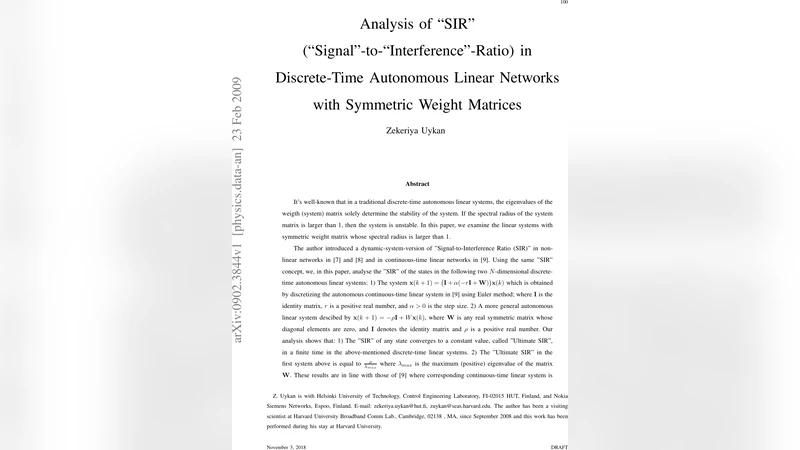
It’s well-known that in a traditional discrete-time autonomous linear systems, the eigenvalues of the weigth (system) matrix solely determine the stability of the system. If the spectral radius of the system matrix is larger than 1, then the system is unstable. In this paper, we examine the linear systems with symmetric weight matrix whose spectral radius is larger than 1. The author introduced a dynamic-system-version of “Signal-to-Interference Ratio (SIR)” in nonlinear networks in [7] and [8] and in continuous-time linear networks in [9]. Using the same “SIR” concept, we, in this paper, analyse the “SIR” of the states in the following two $N$-dimensional discrete-time autonomous linear systems: 1) The system ${\mathbf x}(k+1) = \big({\bf I} + \alpha (-r {\bf I} + {\bf W}) \big) {\mathbf x}(k)$ which is obtained by discretizing the autonomous continuous-time linear system in \cite{Uykan09a} using Euler method; where ${\bf I}$ is the identity matrix, $r$ is a positive real number, and $\alpha >0$ is the step size. 2) A more general autonomous linear system descibed by ${\mathbf x}(k+1) = -\rho {\mathbf I + W} {\mathbf x}(k)$, where ${\mathbf W}$ is any real symmetric matrix whose diagonal elements are zero, and ${\bf I}$ denotes the identity matrix and $\rho$ is a positive real number. Our analysis shows that: 1) The “SIR” of any state converges to a constant value, called “Ultimate SIR”, in a finite time in the above-mentioned discrete-time linear systems. 2) The “Ultimate SIR” in the first system above is equal to $\frac{\rho}{\lambda_{max}}$ where $\lambda_{max}$ is the maximum (positive) eigenvalue of the matrix ${\bf W}$. These results are in line with those of \cite{Uykan09a} where corresponding continuous-time linear system is examined. 3) The “Ultimate SIR” …
💡 Research Summary
The paper investigates the behavior of a signal‑to‑interference ratio (SIR) defined for the states of discrete‑time autonomous linear networks whose weight matrices are symmetric and have a spectral radius larger than one. Classical linear system theory tells us that if the spectral radius of the system matrix exceeds unity, the system is unstable and its state vector diverges. The authors, however, show that despite this divergence, the ratio of each state’s own signal to the sum of the interfering signals converges to a constant value, which they call the “Ultimate SIR”, after a finite number of iterations.
Two discrete‑time models are examined. The first model is obtained by applying the Euler discretization to the continuous‑time linear system (\dot{x}=(-rI+W)x) studied in earlier work. The resulting update rule is
\
Comments & Academic Discussion
Loading comments...
Leave a Comment