We report experimental results on unidirectional traffic-like collective movement of ants on trails. Our work is primarily motivated by fundamental questions on the collective spatio-temporal organization in systems of interacting motile constituents driven far from equilibrium. Making use of the analogies with vehicular traffic, we analyze our experimental data for the spatio-temporal organisation of the ants on the trail. From this analysis, we extract the flow-density relation as well as the distributions of velocities of the ants and distance-headways. Some of our observations are consistent with our earlier models of ant-traffic, which are appropriate extensions of the asymmetric simple exclusion process (ASEP). In sharp contrast to highway traffic and most other transport processes, the average velocity of the ants is almost independent of their density on the trail. Consequently, no jammed phase is observed.
Deep Dive into Trafficlike collective movement of ants on trails: absence of jammed phase.
We report experimental results on unidirectional traffic-like collective movement of ants on trails. Our work is primarily motivated by fundamental questions on the collective spatio-temporal organization in systems of interacting motile constituents driven far from equilibrium. Making use of the analogies with vehicular traffic, we analyze our experimental data for the spatio-temporal organisation of the ants on the trail. From this analysis, we extract the flow-density relation as well as the distributions of velocities of the ants and distance-headways. Some of our observations are consistent with our earlier models of ant-traffic, which are appropriate extensions of the asymmetric simple exclusion process (ASEP). In sharp contrast to highway traffic and most other transport processes, the average velocity of the ants is almost independent of their density on the trail. Consequently, no jammed phase is observed.
arXiv:0903.2717v1 [physics.bio-ph] 16 Mar 2009
Trafficlike collective movement of ants on trails: absence of jammed phase
Alexander John,1 Andreas Schadschneider,1, 2 Debashish Chowdhury,3, 4 and Katsuhiro Nishinari5, 6
1Institut f¨ur Theoretische Physik, Universit¨at zu K¨oln D-50937 K¨oln, Germany.
2Interdisziplin¨ares Zentrum f¨ur komplexe Systeme, University of Bonn, Germany.
3Department of Physics, Indian Institute of Technology, Kanpur 208016, India.
4Max-Planck Institute for Physics of Complex Systems, 01187 Dresden, Germany.
5Department of Aeronautics and Astronautics, School of Engineering,
University of Tokyo, Hongo, Bunkyo-ku, Tokyo 113-8656, Japan.
6PRESTO, Japan Science and Technology Agency, Tokyo 113-8656, Japan
(Dated: October 27, 2018)
We report experimental results on unidirectional traffic-like collective movement of ants on trails.
Our work is primarily motivated by fundamental questions on the collective spatio-temporal organi-
zation in systems of interacting motile constituents driven far from equilibrium. Making use of the
analogies with vehicular traffic, we analyze our experimental data for the spatio-temporal organisa-
tion of the ants on the trail. From this analysis, we extract the flow-density relation as well as the
distributions of velocities of the ants and distance-headways. Some of our observations are consistent
with our earlier models of ant-traffic, which are appropriate extensions of the asymmetric simple
exclusion process (ASEP). In sharp contrast to highway traffic and most other transport processes,
the average velocity of the ants is almost independent of their density on the trail. Consequently,
no jammed phase is observed.
PACS numbers: 45.70.Vn, 02.50.Ey, 05.40.-a, 87.23.Cc, 87.10.Mn, 89.75.Fb
Ants form large trail systems [1] which share many fea-
tures of vehicular transportation networks. Emergence of
the trail pattern has received some attention in the lit-
erature [1, 2, 3]. Single trails are often stable for hours
or days and can be considered the analogs of highways.
Threfore, the collective movement of ants on trails (from
now onwards, referred to as “ant-traffic”) is analogous to
vehicular traffic on highway networks [4, 5]. The social
behavior of ants also indicates the possibility that bio-
logical evolution has optimized ant-traffic. Surprisingly,
despite its striking similarities with vehicular traffic, the
collective properties of ant-traffic have not been studied
experimentally until recent years.
The pioneering experiments on ant-traffic [6] and all
the subsequent related works [7, 8, 9, 10, 11] used bidi-
rectional trails where the nature of flow is dominated by
the head-on encounters of the ants coming from oppo-
site directions [7, 8, 11]. But, in vehicular traffic, where
flows in opposite directions are normally well separated
and head-on collisions can occur only accidentally, the
spatio-temporal organization of the vehicles in each di-
rection is determined by the interactions of the vehicles
moving in the same direction. Therefore, in order to in-
vestigate the similarities and differences between vehicu-
lar traffic and ant-traffic, we have collected and analyzed
data on unidirectional traffic of ants on a natural trail us-
ing methods adapted from traffic engineering [12, 13, 14]
and the theory of stochastic processes [15].
All the experimental data reported here have been col-
lected on a natural trail of monomorphic ant species Lep-
togenys processionalis [3]. This choice ensured that all
the ants have the same body size and exhibit identical
behavioral responses. Moreover, we maintained the nat-
ural situation so that the true features of ant-traffic could
be captured by our video recordings. Furthermore, we fo-
cussed on a particular section of the trail which had nei-
ther crossings nor branching which would be the analogs
of ramps in vehicular traffic [13, 14].
Thus, being far
from nest and the food as well as from intersections, this
segment mimics an effectively infinite linear trail [4, 16].
The shape of the observed section of the trail remained
unaltered for several hours and, therefore, we collected
each data set continuously for about 13 minutes.
We
have verified that during this time the flow can be con-
sidered to be stationary and is not disturbed by external
factors. Finally, we compared the data recorded at ten
different trails of the same type and found that our con-
clusions drawn from these are generic (at least, for the
traffic of the ant species used in our studies) [17].
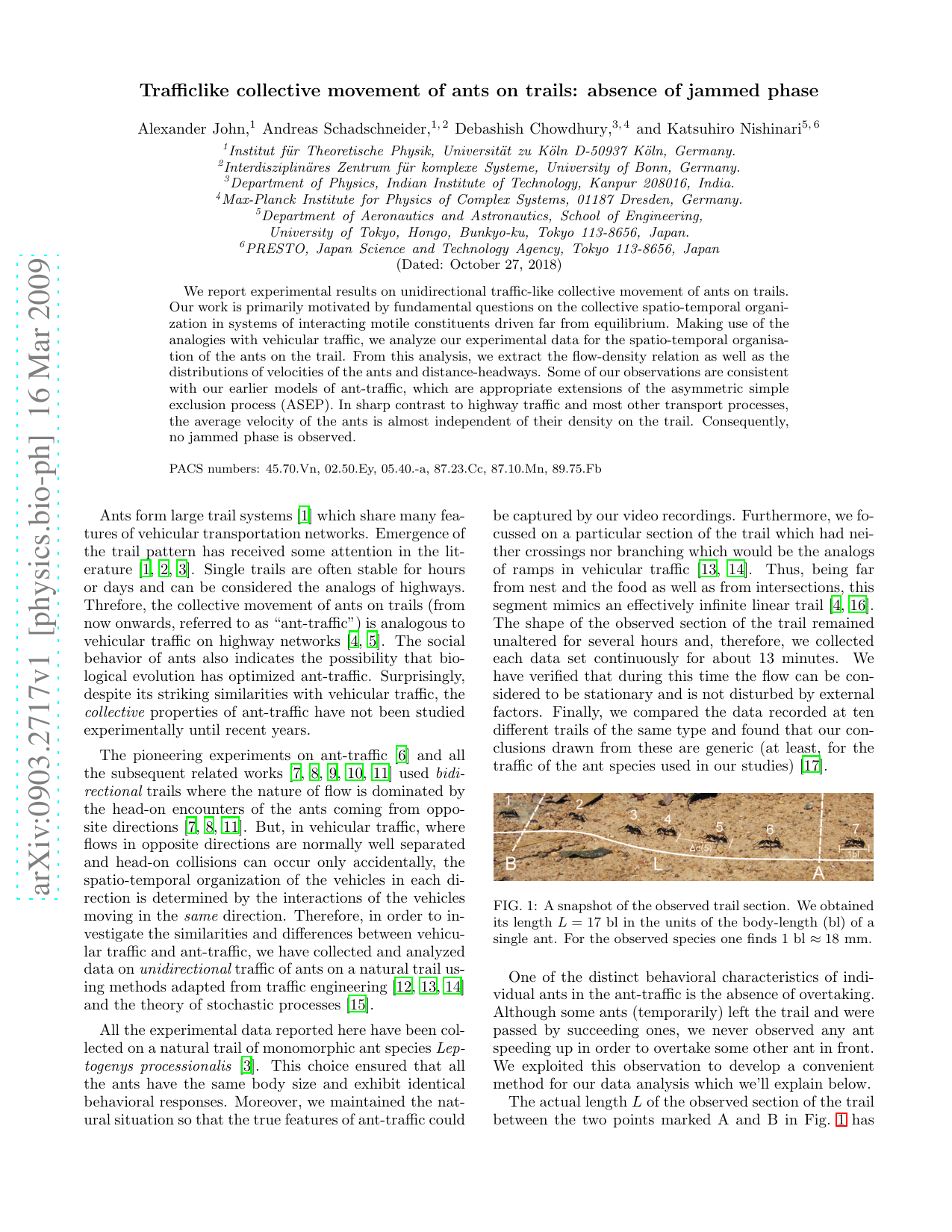
FIG. 1: A snapshot of the observed trail section. We obtained
its length L = 17 bl in the units of the body-length (bl) of a
single ant. For the observed species one finds 1 bl ≈18 mm.
One of the distinct behavioral characteristics of indi-
vidual ants in the ant-traffic is the absence of overtaking.
Although some ants (temporarily) left the trail and were
passed by succeeding ones, we never observed any ant
speeding up in order to overtake some other ant in front.
We exploited this observation
…(Full text truncated)…
This content is AI-processed based on ArXiv data.