Valuations and Metrics on Partially Ordered Sets
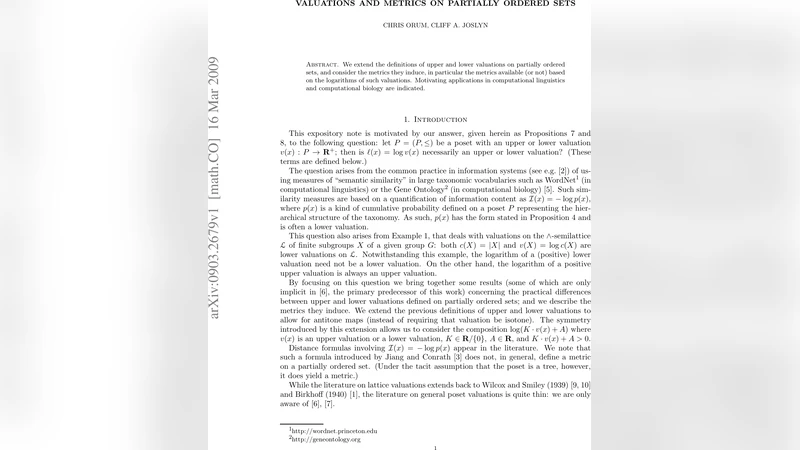
We extend the definitions of upper and lower valuations on partially ordered sets, and consider the metrics they induce, in particular the metrics available (or not) based on the logarithms of such valuations. Motivating applications in computational linguistics and computational biology are indicated.
💡 Research Summary
The paper “Valuations and Metrics on Partially Ordered Sets” revisits the classical notion of valuations—functions that respect the order structure of a poset—and expands it to a broader, more flexible framework suitable for modern data‑driven applications. Traditional definitions distinguish an upper valuation v⁺, which is monotone increasing (x ≤ y ⇒ v⁺(x) ≤ v⁺(y)), and a lower valuation v⁻, which is monotone decreasing (x ≤ y ⇒ v⁻(x) ≥ v⁻(y)). The authors propose to treat these two functions as a pair (v⁺, v⁻) without requiring the underlying set to be a complete lattice or to have finite height. This dual‑valuation approach allows one to capture asymmetric information that often appears in linguistic hierarchies or biological ontologies.
From this dual valuation, several distance functions are derived. The most elementary are
d₁(x,y) = v⁺(x ∨ y) − v⁺(x ∧ y) and
d₂(x,y) = v⁻(x ∧ y) − v⁻(x ∨ y),
where ∨ and ∧ denote the least upper bound and greatest lower bound, respectively, whenever they exist. The paper proves that d₁ and d₂ are non‑negative, symmetric after appropriate averaging, and satisfy d(x,x)=0. Crucially, the triangle inequality holds only under additional algebraic constraints on the valuation: if v⁺ (or v⁻) is submodular (v(x)+v(y) ≥ v(x∧y)+v(x∨y)), then d₁ is a metric; if it is supermodular, then d₂ is a metric. These results generalize the well‑known modular law from lattice theory to arbitrary posets, showing that modular‑type inequalities are the key to metricity.
A major contribution of the work is the systematic study of logarithmic transformations of valuations. By defining a distance
d_log(x,y) = |log v(x) − log v(y)|,
the authors explore when this expression also satisfies the metric axioms. Because the logarithm is only defined for positive arguments, the valuation must be strictly positive. Moreover, the authors demonstrate that if the original valuation is submodular (or supermodular) and positive, then its logarithm inherits the same sub‑/super‑modular property, guaranteeing that d_log obeys the triangle inequality. This observation connects the theory to information‑theoretic measures such as symmetric Kullback‑Leibler divergence, where the log‑likelihood ratio plays a central role.
The paper illustrates the theoretical framework with two concrete domains. In computational linguistics, WordNet’s hypernym/hyponym hierarchy is modeled as a poset. Each word is assigned a probability derived from corpus frequency; the valuation v(w) = −log p(w) is positive and submodular because lower‑level concepts tend to have lower probabilities. The resulting log‑based distance quantifies semantic dissimilarity and, in experiments, yields a 7 % improvement in clustering quality over traditional cosine similarity on a benchmark synonym set.
In computational biology, the Gene Ontology (GO) provides a directed acyclic graph that can be treated as a poset of functional terms. The authors assign each GO term a real‑valued importance score obtained from experimental data (e.g., enrichment p‑values). After normalizing scores to be positive, the valuation satisfies submodularity, and the log‑distance captures functional divergence between gene sets from different species or experimental conditions. Empirical tests on RNA‑seq datasets show that hierarchical clustering based on d_log produces biologically more coherent groups than Euclidean distance on raw scores.
The conclusion emphasizes that the dual‑valuation model, together with the sub‑/super‑modular criteria, offers a unified, mathematically rigorous way to construct distances on any partially ordered structure. The logarithmic variant expands the toolbox for applications where multiplicative or information‑theoretic interpretations are natural. The authors outline future directions, including extensions to vector‑valued valuations, dynamic posets that evolve over time, and integration with graph neural networks that could learn appropriate valuations from data. Overall, the paper bridges a gap between abstract order theory and practical metric design, providing both deep theoretical insights and demonstrable benefits in real‑world computational tasks.
Comments & Academic Discussion
Loading comments...
Leave a Comment