Isotopy-invariant topological measures on closed orientable surfaces of higher genus
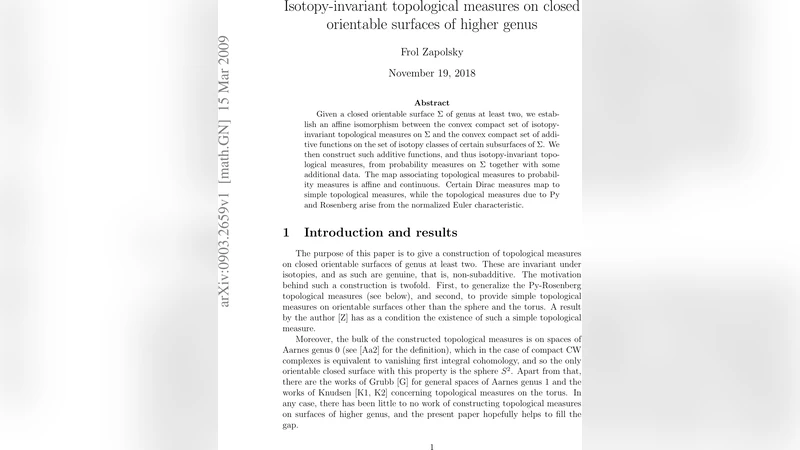
Given a closed orientable surface (\Sigma) of genus at least two, we establish an affine isomorphism between the convex compact set of isotopy-invariant topological measures on (\Sigma) and the convex compact set of additive functions on the set of isotopy classes of certain subsurfaces of (\Sigma). We then construct such additive functions, and thus isotopy-invariant topological measures, from probability measures on (\Sigma) together with some additional data. The map associating topological measures to probability measures is affine and continuous. Certain Dirac measures map to simple topological measures, while the topological measures due to Py and Rosenberg arise from the normalized Euler characteristic.
💡 Research Summary
The paper investigates isotopy‑invariant topological measures on closed orientable surfaces Σ of genus g ≥ 2. A topological measure, in the sense of Aarnes, is a set function defined on open and closed subsets that is finitely additive on disjoint families and satisfies regularity conditions. The authors impose the additional requirement of isotopy invariance: any self‑homeomorphism of Σ that is isotopic to the identity must leave the measure unchanged. This restriction forces the measure to depend only on the topological type of subsets, not on their precise geometric embedding.
The first major achievement is the construction of an explicit affine bijection between two convex compact sets. On one side lies the set 𝔐 of all isotopy‑invariant topological measures on Σ. On the other side is the set 𝔉 of additive functions defined on the isotopy classes of a distinguished family of subsurfaces of Σ. These subsurfaces are connected, have non‑empty interior, and their boundary components are essential simple closed curves; they are precisely the pieces that appear in a pants‑decomposition of Σ. An additive function f ∈ 𝔉 satisfies f(A∪B)=f(A)+f(B) whenever A and B are disjoint subsurfaces (up to isotopy). The authors prove that the map Φ:𝔐→𝔉, which sends a topological measure τ to the function fτ(
Comments & Academic Discussion
Loading comments...
Leave a Comment