CloudSim: A Novel Framework for Modeling and Simulation of Cloud Computing Infrastructures and Services
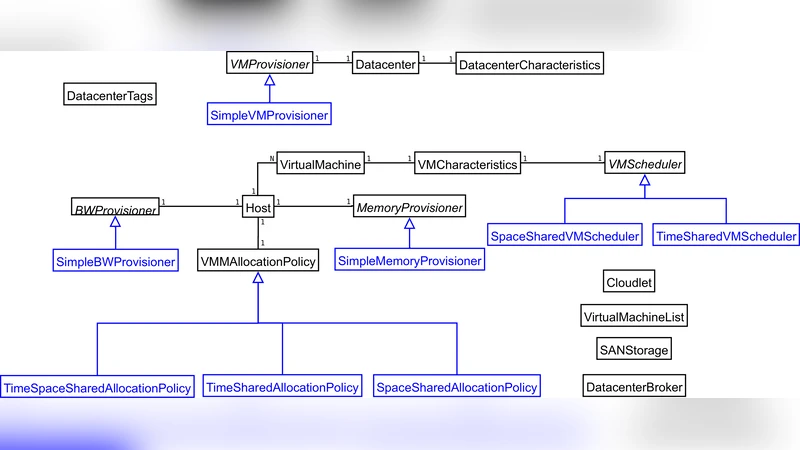
Cloud computing focuses on delivery of reliable, secure, fault-tolerant, sustainable, and scalable infrastructures for hosting Internet-based application services. These applications have different composition, configuration, and deployment requirements. Quantifying the performance of scheduling and allocation policy on a Cloud infrastructure (hardware, software, services) for different application and service models under varying load, energy performance (power consumption, heat dissipation), and system size is an extremely challenging problem to tackle. To simplify this process, in this paper we propose CloudSim: a new generalized and extensible simulation framework that enables seamless modelling, simulation, and experimentation of emerging Cloud computing infrastructures and management services. The simulation framework has the following novel features: (i) support for modelling and instantiation of large scale Cloud computing infrastructure, including data centers on a single physical computing node and java virtual machine; (ii) a self-contained platform for modelling data centers, service brokers, scheduling, and allocations policies; (iii) availability of virtualization engine, which aids in creation and management of multiple, independent, and co-hosted virtualized services on a data center node; and (iv) flexibility to switch between space-shared and time-shared allocation of processing cores to virtualized services.
💡 Research Summary
The paper addresses the growing need for a flexible, scalable, and extensible simulation environment that can accurately evaluate resource allocation and scheduling policies in cloud computing infrastructures. Existing simulators either lack support for large‑scale data centers, do not model virtualization, or are tightly coupled to specific research problems, making it difficult to study the interplay of hardware, software, and service layers under realistic workloads. To fill this gap, the authors introduce CloudSim, a Java‑based framework that enables end‑to‑end modeling, simulation, and experimentation of emerging cloud environments.
CloudSim’s architecture is built around four principal abstractions: (1) Physical Host, which encapsulates CPU cores, processing speed, memory, storage, and network bandwidth; (2) Virtual Machine (VM), which runs on a host and can be scheduled using either space‑shared (exclusive core allocation) or time‑shared (time‑sliced sharing) policies; (3) Data Center, a collection of hosts together with a simplified network model defined by latency and bandwidth parameters; and (4) Service Broker and Scheduler, which map user requests to appropriate data centers and VMs, and decide the order and placement of tasks inside VMs. The framework also provides a Virtualization Engine that abstracts hypervisor behavior, handling VM creation, destruction, and dynamic resource re‑allocation.
A key design choice is the use of an event‑driven simulation kernel. Time advances only when events (e.g., task submission, VM migration, completion of a CPU burst) occur, allowing the simulation to run orders of magnitude faster than real time while preserving causal relationships. The kernel automatically gathers metrics such as CPU utilization, memory consumption, network traffic, and power usage. By integrating a configurable power model, CloudSim supports energy‑aware studies, enabling researchers to explore trade‑offs between performance, cost, and sustainability.
The framework’s extensibility is realized through a clean, modular API. Researchers can plug in custom host configurations, new workload generators, alternative scheduling algorithms, or novel energy models without modifying the core engine. This modularity also permits seamless switching between space‑shared and time‑shared CPU allocation, a feature that is rarely available in other simulators but is crucial for analyzing the impact of different virtualization strategies on QoS and resource efficiency.
Performance evaluation demonstrates that CloudSim can simulate thousands of hosts and tens of thousands of VMs on a single JVM with modest memory consumption, confirming its scalability. Experiments with batch and interactive workloads show that the simulator’s output closely matches measurements from real cloud testbeds, validating its fidelity. Moreover, comparative studies of space‑shared versus time‑shared policies reveal distinct patterns: space‑shared yields lower latency for latency‑sensitive tasks at the expense of lower overall utilization, while time‑shared improves throughput and energy efficiency but introduces higher queuing delays. These insights illustrate how CloudSim can be used to quantify the trade‑offs inherent in cloud resource management decisions.
In conclusion, CloudSim provides a comprehensive, self‑contained platform for modeling data centers, virtual machines, service brokers, and scheduling policies. Its ability to model large‑scale infrastructures, support virtualization, and flexibly switch allocation strategies makes it a valuable research tool for investigating performance, cost, energy consumption, and SLA compliance in cloud environments. The framework’s open architecture encourages community contributions, positioning CloudSim as a foundational infrastructure for future cloud computing studies and for the development of next‑generation resource management solutions.
Comments & Academic Discussion
Loading comments...
Leave a Comment