Cosmological number density in depth from V/Vm distribution
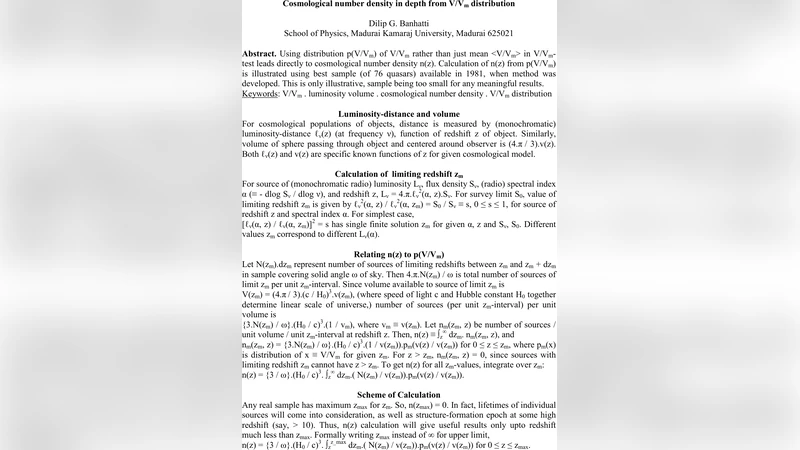
Using distribution p(V/Vm) of V/Vm rather than just mean <V/Vm> in V/Vm-test leads directly to cosmological number density n(z). Calculation of n(z) from p(V/Vm) is illustrated using best sample (of 76 quasars) available in 1981, when method was developed. This is only illustrative, sample being too small for any meaningful results. Keywords: V/Vm . luminosity volume . cosmological number density . V/Vm distribution
💡 Research Summary
The paper revisits the classic V/V m test, which compares the observed volume V occupied by a source to the maximum volume V m in which the source could have been detected, and points out a fundamental limitation of the traditional approach that relies solely on the mean ⟨V/V m⟩. While ⟨V/V m⟩ provides a single scalar indicator of spatial uniformity, it discards the full shape of the V/V m distribution, thereby masking possible asymmetries, multimodality, or subtle selection effects. To overcome this, the author introduces the probability density function p(V/V m) of the V/V m values across a sample and demonstrates how this distribution can be directly transformed into a redshift‑dependent cosmological number density n(z).
The derivation proceeds as follows. For each object the ratio V/V m is computed from its observed flux S and the survey flux limit S_lim, typically using the relation V/V m = (S/S_lim)^{3/2} (the exponent may be altered by the adopted cosmology). Collecting all V/V m values for a sample of N objects, one builds a histogram and normalises it to obtain p(V/V m) = (1/N) dN/d(V/V m). The number density at a given redshift z_i is then expressed as
n(z_i) = ∫_{0}^{1} p(V/V m) ·
Comments & Academic Discussion
Loading comments...
Leave a Comment