An Absolute 2-Approximation Algorithm for Two-Dimensional Bin Packing
We consider the problem of packing rectangles into bins that are unit squares, where the goal is to minimize the number of bins used. All rectangles have to be packed non-overlapping and orthogonal, i.e., axis-parallel. We present an algorithm for this problem with an absolute worst-case ratio of 2, which is optimal provided P != NP.
💡 Research Summary
The paper addresses the classic two‑dimensional bin packing problem in which a set of axis‑parallel rectangles (no rotations allowed) must be placed into an unlimited number of unit‑square bins while minimizing the number of bins used. While most previous work focused on asymptotic approximation ratios—how the algorithm behaves on very large instances—the authors concentrate on the absolute approximation ratio, i.e., the worst‑case factor over all inputs. They present a polynomial‑time algorithm that guarantees a solution using at most twice the optimal number of bins. Under the widely believed assumption P ≠ NP, this factor of 2 is optimal; any algorithm with a strictly smaller absolute ratio would imply P = NP.
The algorithm is built on two main pillars: (1) a careful case analysis for instances that can be packed into a single bin (OPT = 1) and (2) a reduction to the known Bansal‑Caprara‑Sviridenko (BCS) algorithm for instances whose optimal value is larger than one but bounded by a constant k. The constant k is the (unknown) threshold beyond which the BCS algorithm already yields a 2‑approximation in the absolute sense; the authors’ contribution is to handle the remaining “small‑OPT” cases.
Key definitions.
- An item is called wide if its width exceeds ½, high if its height exceeds ½, and big if it is both wide and high.
- For a parameter δ∈(0,½] the set Wδ consists of items with width >1−δ (δ‑wide items); analogously Hδ contains δ‑high items.
- The total area of a set T is A(T), total width w(T), total height h(T), and the maximum width/height are w_max(T), h_max(T).
Step 1: OPT = 1.
If the total height of the δ‑wide items satisfies
h(Wδ) ≤ (δ−ε)/(1+2δ) for some δ∈(ε,½] (ε is a tiny constant, e.g., 1/200), the algorithm proceeds as follows:
- Pack all high items Hγ (where γ is derived from δ) into a vertical stack on the left side of the first bin; the occupied width is w(Hγ).
- Apply the BCS algorithm to the remaining items I \ Hγ inside a rectangle of width 1−w(Hγ) and height 1, using an accuracy ε. Lemma 1 guarantees that at most 2γ+ε area is left unpacked.
- The leftover δ‑wide items are placed as a bottom stack in a second bin; their total height h₀ ≤ γ.
- The rest of the items (now all with width ≤ 1−δ and height ≤ 1−γ) are packed into the free space above the bottom stack of the second bin using Steinberg’s algorithm. The authors verify Steinberg’s conditions via a series of algebraic inequalities.
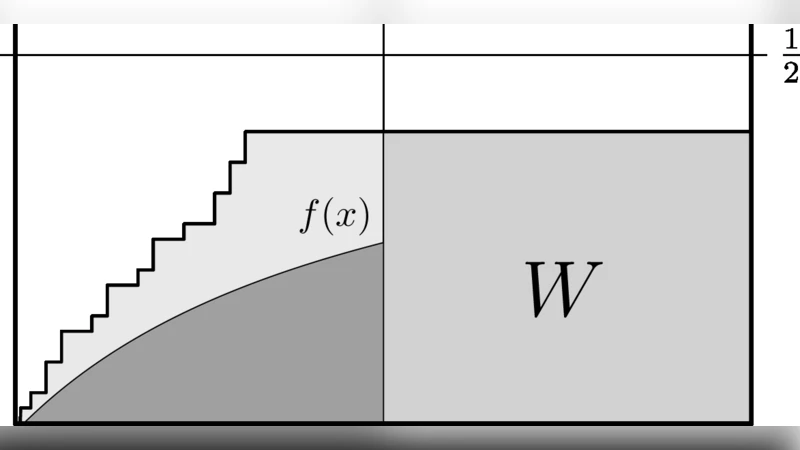
If no δ satisfies the height bound, the instance must contain a large amount of “wide” or “high” area. By integrating the function f(x) = (x−ε)/(1+2x) over x∈
Comments & Academic Discussion
Loading comments...
Leave a Comment