Evaluation of a permeability-porosity relationship in a low permeability creeping material using a single transient test
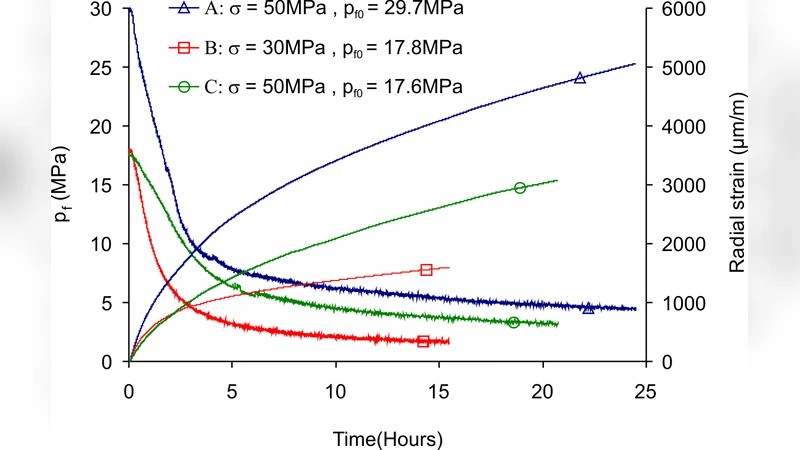
A method is presented for the evaluation of the permeability-porosity relationship in a low-permeability porous material using the results of a single transient test. This method accounts for both elastic and non-elastic deformations of the sample during the test and is applied to a hardened class G oil well cement paste. An initial hydrostatic undrained loading is applied to the sample. The generated excess pore pressure is then released at one end of the sample while monitoring the pore pressure at the other end and the radial strain in the middle of the sample during the dissipation of the pore pressure. These measurements are back analysed to evaluate the permeability and its evolution with porosity change. The effect of creep of the sample during the test on the measured pore pressure and volume change is taken into account in the analysis. This approach permits to calibrate a power law permeability-porosity relationship for the tested hardened cement paste. The porosity sensitivity exponent of the power-law is evaluated equal to 11 and is shown to be mostly independent of the stress level and of the creep strains.
💡 Research Summary
The paper introduces a novel methodology for determining the permeability‑porosity relationship of a low‑permeability, creeping material using only a single transient test. The authors apply the method to a hardened class G oil‑well cement paste, a material of great interest for long‑term well integrity and CO₂ sequestration.
Test concept
First, an isotropic undrained hydrostatic load is imposed on a cylindrical specimen, generating an excess pore pressure proportional to the applied stress through the Skempton coefficient. After the load is held, the pressure at one end of the specimen is abruptly reduced to a low value while the opposite end remains sealed. This creates a strong pore‑pressure gradient that drives fluid flow through the sample. Simultaneously, the pore pressure at the sealed end and the radial strain at the specimen mid‑height are recorded as functions of time. Because the pressure drop also changes the effective stress, the specimen experiences both elastic deformation and time‑dependent creep, which must be accounted for in the analysis.
Theoretical framework
The authors adopt a Biot‑Willis poroelastic formulation. Total volume V and pore volume Vφ variations are expressed in terms of four elastic moduli: drained bulk modulus dK, unjacketed modulus sK, pore‑volume modulus Kφ, and the effective bulk modulus Kd. Using Betti’s reciprocal theorem, Kd can be related to sK and Kφ, reducing the number of independent parameters to three. The porosity evolution equation (Eq. 8) incorporates both elastic strain and non‑elastic (creep) strain contributions.
Fluid mass conservation combined with Darcy’s law yields a one‑dimensional diffusion equation for the pore pressure (Eq. 16). The diffusion coefficient contains a term β that depends on the elastic moduli and porosity. To capture creep, the authors separate total strain into elastic and visco‑elastic parts, the latter being modeled with a Burgers‑type rheology calibrated from independent creep tests. The creep‑induced porosity change Δφ_c is inserted into the diffusion equation, providing a corrected description of pressure dissipation.
Inverse analysis
Measured pressure‑time curves p(z,t) and radial strain ε_r(t) are used to back‑calculate the instantaneous porosity φ(t). For each φ, the diffusion equation is solved numerically to obtain the permeability k that best fits the observed pressure decay. Repeating this for the whole test yields a series of (φ,k) pairs. A log‑log regression shows that k follows a power‑law relationship k = k₀ φ^α.
Experimental results
The cement paste specimen initially has a porosity of about 0.18, which decreases to ≈0.16 during the test due to effective‑stress‑induced compaction and creep. Correspondingly, permeability drops from 1.2 × 10⁻²⁰ m²/(Pa·s) to 3.5 × 10⁻²² m²/(Pa·s). The regression yields a porosity‑sensitivity exponent α ≈ 11 ± 0.5, a value considerably higher than typical exponents reported for rocks and sands (1–30). Repeating the test at different initial confining stresses (20 MPa and 40 MPa) produces essentially the same exponent, indicating that α is largely independent of stress level. Neglecting creep in the analysis leads to a systematic under‑estimation of α, highlighting the importance of incorporating non‑elastic strains.
Significance
An exponent of ~11 implies that the cement paste’s permeability is extremely sensitive to small changes in porosity, reflecting a highly interconnected micro‑pore network that collapses rapidly under compression. This insight is crucial for predicting the long‑term sealing performance of cement sheaths in wells, especially under the combined thermal, mechanical, and chemical loads encountered during production and CO₂ storage. The proposed single‑test approach dramatically reduces experimental time compared with traditional steady‑state or pulse‑method tests, while still delivering a full permeability‑porosity law.
Limitations and future work
The study is limited to a single material, temperature (25 °C), and fluid (water). Chemical effects (e.g., acidic or saline pore fluids) and temperature‑dependent viscosity were not examined. The analysis assumes one‑dimensional flow; early‑time radial flow is ignored, which may introduce errors for the first few seconds of the test. Extending the methodology to multi‑dimensional diffusion models, to other cement formulations, and to coupled thermo‑hydro‑mechanical conditions would broaden its applicability.
Conclusion
Ghabezloo, Sulem, and Saint‑Marc present a robust, efficient framework that couples a carefully designed transient pressure‑release test with a poroelastic‑viscoelastic inverse analysis. This enables the determination of a power‑law permeability‑porosity relationship from a single experiment, even for low‑permeability, creep‑prone materials. The method offers a valuable tool for researchers and engineers concerned with the durability and sealing efficiency of cementitious barriers in subsurface engineering applications.
Comments & Academic Discussion
Loading comments...
Leave a Comment