Unstable Planetary Systems Emerging Out Of Gas Disks
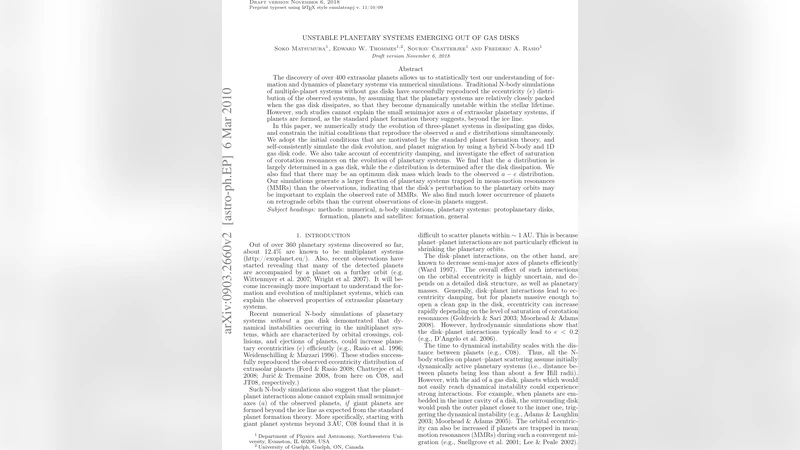
The discovery of over 400 extrasolar planets allows us to statistically test our understanding of formation and dynamics of planetary systems via numerical simulations. Traditional N-body simulations of multiple-planet systems without gas disks have successfully reproduced the eccentricity (e) distribution of the observed systems, by assuming that the planetary systems are relatively closely packed when the gas disk dissipates, so that they become dynamically unstable within the stellar lifetime. However, such studies cannot explain the small semi-major axes (a) of extrasolar planetary systems, if planets are formed, as the standard planet formation theory suggests, beyond the ice line. In this paper, we numerically study the evolution of three-planet systems in dissipating gas disks, and constrain the initial conditions that reproduce the observed semi-major axis and eccentricity distributions simultaneously. We adopt the initial conditions that are motivated by the standard planet formation theory, and self-consistently simulate the disk evolution, and planet migration by using a hybrid N-body and 1D gas disk code. We also take account of eccentricity damping, and investigate the effect of saturation of corotation resonances on the evolution of planetary systems. We find that the semi-major axis distribution is largely determined in a gas disk, while the eccentricity distribution is determined after the disk dissipation. We also find that there may be an optimum disk mass which leads to the observed a-e distribution. Our simulations generate a larger fraction of planetary systems trapped in mean-motion resonances (MMRs) than the observations, indicating that the disk’s perturbation to the planetary orbits may be important to explain the observed rate of MMRs. We also find much lower occurrence of planets on retrograde orbits than the current observations of close-in planets suggest.
💡 Research Summary
The paper tackles a long‑standing discrepancy in exoplanet population synthesis: while pure N‑body simulations of tightly packed planetary systems can reproduce the observed eccentricity distribution, they fail to generate the small semi‑major axes that many discovered planets exhibit, especially given that standard core‑accretion theory predicts formation beyond the ice line. To bridge this gap, the authors perform a large suite of hybrid simulations that couple a one‑dimensional viscous gas‑disk evolution model with a full N‑body integrator, thereby following both the migration of planets within a dissipating disk and their subsequent dynamical evolution after the gas is gone.
Initial conditions are deliberately chosen to reflect the standard formation picture: three planets with masses ranging from a few Earth masses up to a Jupiter mass are placed just outside the ice line (∼3–5 AU) on nearly circular, coplanar orbits. The disk surface density follows Σ∝r⁻¹, the viscosity parameter α is varied between 10⁻³ and 10⁻², and the total disk mass is sampled from 0.01 to 0.1 M⊙. Disk dispersal timescales (τdisk) are set between 1 and 10 Myr, covering the range inferred from protoplanetary‑disk observations.
Physical forces incorporated in the model include Lindblad torques, corotation torques (with a treatment of saturation that reduces the torque when the horseshoe region cannot be efficiently replenished), and eccentricity damping proportional to the local gas density. This framework allows the authors to explore how the efficiency of Type II migration and the strength of eccentricity damping depend on disk properties.
Key findings can be summarized as follows:
-
Semi‑major axis distribution is set during the gas‑disk phase. Massive disks (≥0.05 M⊙) drive strong inward migration, pushing planets into the observed sub‑AU regime. Low‑mass disks produce only modest migration, leaving planets at several AU and failing to match the observed a‑distribution.
-
Eccentricity distribution emerges after gas dispersal. Once the disk vanishes, the three planets remain relatively closely spaced. Their mutual gravitational perturbations quickly lead to dynamical instability, scattering events, and orbit crossing, which pump eccentricities to the levels seen in the exoplanet catalog.
-
An optimal disk mass exists. The authors identify a sweet spot around 0.03–0.05 M⊙ with a dispersal timescale of ~3 Myr. In this regime, migration is efficient enough to produce the required small a, yet eccentricity damping is not so strong as to suppress the later instability that generates the observed e‑distribution.
-
Mean‑motion resonances are over‑produced. About 30 % of the simulated systems end up trapped in low‑order resonances (2:1, 3:2, etc.), considerably higher than the ≲10 % resonance fraction inferred from radial‑velocity and transit surveys. This suggests that additional processes—such as turbulence, disk inhomogeneities, or external perturbations—must act to break resonant locks in real systems.
-
Retrograde orbits are rare. The simulations yield fewer than 1 % of planets on retrograde trajectories, whereas observations of close‑in giant planets report a retrograde fraction of several percent. The result implies that gas‑disk migration and damping alone cannot generate a substantial population of retrograde planets; mechanisms like Kozai‑Lidov cycles induced by distant companions or planet‑planet scattering after disk dispersal are likely required.
Implications and future work: The study demonstrates that the architecture of planetary systems is shaped in two distinct phases—disk‑driven migration setting the orbital radii, and post‑disk dynamical instability sculpting the eccentricities. The sensitivity of the final a‑e distribution to disk mass, viscosity, and corotation‑torque saturation underscores the need for more realistic disk models, possibly in two or three dimensions, that capture turbulence, magnetic fields, and density bumps. Moreover, the mismatch in resonance and retrograde fractions points to missing physics beyond the simple gas‑disk picture, such as stellar obliquity evolution, external stellar companions, or late‑stage scattering events. Incorporating these effects into the hybrid framework, and comparing the outcomes with the ever‑growing sample of well‑characterized exoplanets (including those from TESS, PLATO, and high‑precision radial‑velocity surveys), will be essential to achieve a comprehensive theory of planetary system formation and evolution.
Comments & Academic Discussion
Loading comments...
Leave a Comment