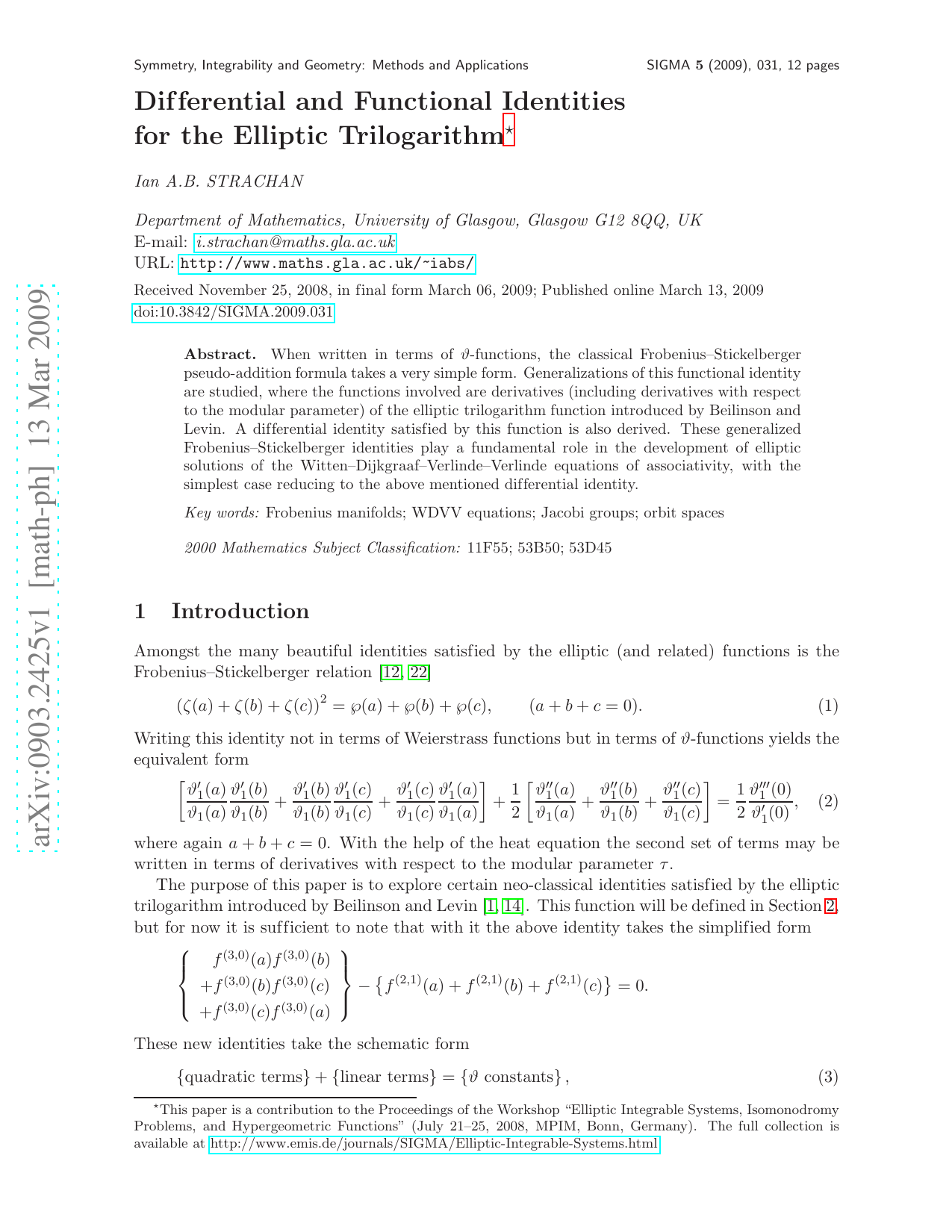
When written in terms of $\vartheta$-functions, the classical Frobenius-Stickelberger pseudo-addition formula takes a very simple form. Generalizations of this functional identity are studied, where the functions involved are derivatives (including derivatives with respect to the modular parameter) of the elliptic trilogarithm function introduced by Beilinson and Levin. A differential identity satisfied by this function is also derived. These generalized Frobenius-Stickelberger identities play a fundamental role in the development of elliptic solutions of the Witten-Dijkgraaf-Verlinde-Verlinde equations of associativity, with the simplest case reducing to the above mentioned differential identity.
Deep Dive into Differential and Functional Identities for the Elliptic Trilogarithm.
When written in terms of $\vartheta$-functions, the classical Frobenius-Stickelberger pseudo-addition formula takes a very simple form. Generalizations of this functional identity are studied, where the functions involved are derivatives (including derivatives with respect to the modular parameter) of the elliptic trilogarithm function introduced by Beilinson and Levin. A differential identity satisfied by this function is also derived. These generalized Frobenius-Stickelberger identities play a fundamental role in the development of elliptic solutions of the Witten-Dijkgraaf-Verlinde-Verlinde equations of associativity, with the simplest case reducing to the above mentioned differential identity.
Amongst the many beautiful identities satisfied by the elliptic (and related) functions is the Frobenius-Stickelberger relation [12,22]
Writing this identity not in terms of Weierstrass functions but in terms of ϑ-functions yields the equivalent form
where again a + b + c = 0. With the help of the heat equation the second set of terms may be written in terms of derivatives with respect to the modular parameter τ . The purpose of this paper is to explore certain neo-classical identities satisfied by the elliptic trilogarithm introduced by Beilinson and Levin [1,14]. This function will be defined in Section 2, but for now it is sufficient to note that with it the above identity takes the simplified form f (3,0) (a)f (3,0) (b) +f (3,0) (b)f (3,0) (c) +f (3,0) (c)f (3,0) (a) 1) (a) + f (2,1) (b) + f (2,1) (c) = 0.
These new identities take the schematic form
where the linear terms contain one more τ -derivative than the total number of τ -derivatives in each part in the quadratic term. Before these identities are discussed (Section 4) a differential equation satisfied by this function f (z, τ ) will be derived in Section 3. Applications of these new identities are then discussed in Section 5. We begin by defining the elliptic polylogarithm.
The classical polylogarithm is defined, for |z| < 1, by
Li
and by analytic continuation elsewhere. A first attempt at an elliptic analogue of this function might be
However this series diverges, but by using the inversion formula (11) and ζ-function regularization one can arrive at the following definition of the elliptic polylogarithm function [1,14]:
A real-valued version of this function had previously been studied by Zagier [23]. With this the function f may be defined.
Definition 1. The function f (z, τ ), where z ∈ C, τ ∈ H, is defined to be:
The function f (n,m) that appear in the introduction are the derivatives
It immediately follows from the definition that
and
Thus the elliptic-trilogarithm may be thought of as a classical function (or, at least, a neoclassical function) as it may be obtained from classical elliptic functions via nested integration and other standard procedures. It does, however, provide a systematic way to deal with the arbitrary functions that would appear this way.
The following proposition describes the fundamental transformation properties of the function: these will be used in subsequent section to prove the various differential and functional identities. The precise definitions and normalizations of the various objects used here are given in Appendix A. Also, the notation F ≃ G will be used if the functions F and G differ by a quadratic function in the variables z and τ . These quadratic terms may be easily derived, but will play no part in the rest of the paper.
Proposition 1. The function f has the following transformation properties:
The function also has the alternative expansions:
and
The first of these imply the following the transformation property:
Proof . The first three relation follow immediately from the definition. The fourth used the inversion formula for polylogarithms (11). The proof of ( 5) and ( 6) just involves some careful resumming. Consider the first two terms in the definition of f :
From this series (6) follows immediately. To obtain (5) one rearranges the terms. The s = 0 term cancels in the final expression and the remaining terms may be re-expressed in terms of Eisenstein series (for s > 1) or the Dedekind function (for s = 1). Finally, using the result
one may obtain a series for Li 3 e 2πiz . Putting all these parts together gives the series (5).
3 Dif ferential identities Theorem 1. The function f satisfies the equation
Proof . We denote the left hand side of the differential equation by ∆(f )(z, τ ) and study its transformation properties. It follows from Proposition 1 that the third derivatives of f are invariant under the transformation z → z + 1 and that under the transformation z → z + τ one has:
It immediately follows that combination ∆(f ) is a doubly periodic function (even though individual components are not). From the Laurent expansions of f , the only term with a pole is f (3,0) , which has a simple pole at z = 0, but this cancels with the zero at z = 0 of the term f (1,2) . Thus ∆(f ) is a doubly period function with no poles, and hence must be independent of z, i.e. a ϑ-constant.
Using the series expansion in Proposition 1 one finds that
and hence the result follows on using the Ramanujan identity
An alternative proof is to study the modularity properties of ∆ under τ → -τ -1 . One finds that ∆ must be a modular form of degree 4, and hence must be a multiple of E 4 , the constant of proportionality being straightforward to calculated. Note, one could easily redefine f , using (4), so that ∆ = 0.
This differential identity contains much information. Using the z-expansion of the function f it is equivalent to an infinite family of identities between the Eisenst
…(Full text truncated)…
This content is AI-processed based on ArXiv data.