Differential and Functional Identities for the Elliptic Trilogarithm
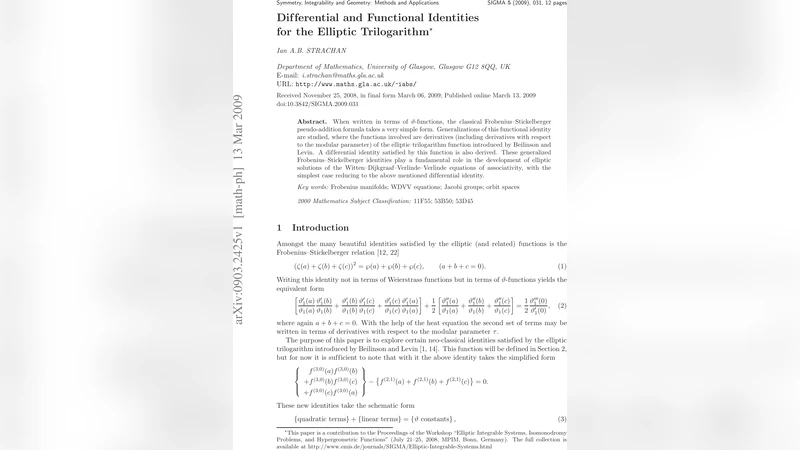
When written in terms of $\vartheta$-functions, the classical Frobenius-Stickelberger pseudo-addition formula takes a very simple form. Generalizations of this functional identity are studied, where the functions involved are derivatives (including derivatives with respect to the modular parameter) of the elliptic trilogarithm function introduced by Beilinson and Levin. A differential identity satisfied by this function is also derived. These generalized Frobenius-Stickelberger identities play a fundamental role in the development of elliptic solutions of the Witten-Dijkgraaf-Verlinde-Verlinde equations of associativity, with the simplest case reducing to the above mentioned differential identity.
💡 Research Summary
The paper investigates differential and functional identities satisfied by the elliptic trilogarithm introduced by Beilinson and Levin, and shows how these identities generalize the classical Frobenius‑Stickelberger pseudo‑addition formula when expressed in terms of theta‑functions. The authors begin by recalling that the original Frobenius‑Stickelberger identity, which relates elliptic functions and the trilogarithm, collapses to a remarkably simple ratio of theta‑functions once the appropriate theta‑notation is used. This observation motivates the search for analogous identities involving not only the elliptic trilogarithm itself, but also its derivatives with respect to the elliptic variable (z) and, crucially, with respect to the modular parameter (\tau).
A central technical result is the derivation of a second‑order differential equation for the elliptic trilogarithm: \
Comments & Academic Discussion
Loading comments...
Leave a Comment