We consider N=2 supersymmetric extensions of the Camassa-Holm and Hunter-Saxton equations. We show that they admit geometric interpretations as Euler equations on the superconformal algebra of contact vector fields on the 1|2-dimensional supercircle. We use the bi-Hamiltonian formulation to derive Lax pairs. Moreover, we present some simple examples of explicit solutions. As a by-product of our analysis we obtain a description of the bounded traveling-wave solutions for the two-component Hunter-Saxton equation.
Deep Dive into On the N=2 Supersymmetric Camassa-Holm and Hunter-Saxton Equations.
We consider N=2 supersymmetric extensions of the Camassa-Holm and Hunter-Saxton equations. We show that they admit geometric interpretations as Euler equations on the superconformal algebra of contact vector fields on the 1|2-dimensional supercircle. We use the bi-Hamiltonian formulation to derive Lax pairs. Moreover, we present some simple examples of explicit solutions. As a by-product of our analysis we obtain a description of the bounded traveling-wave solutions for the two-component Hunter-Saxton equation.
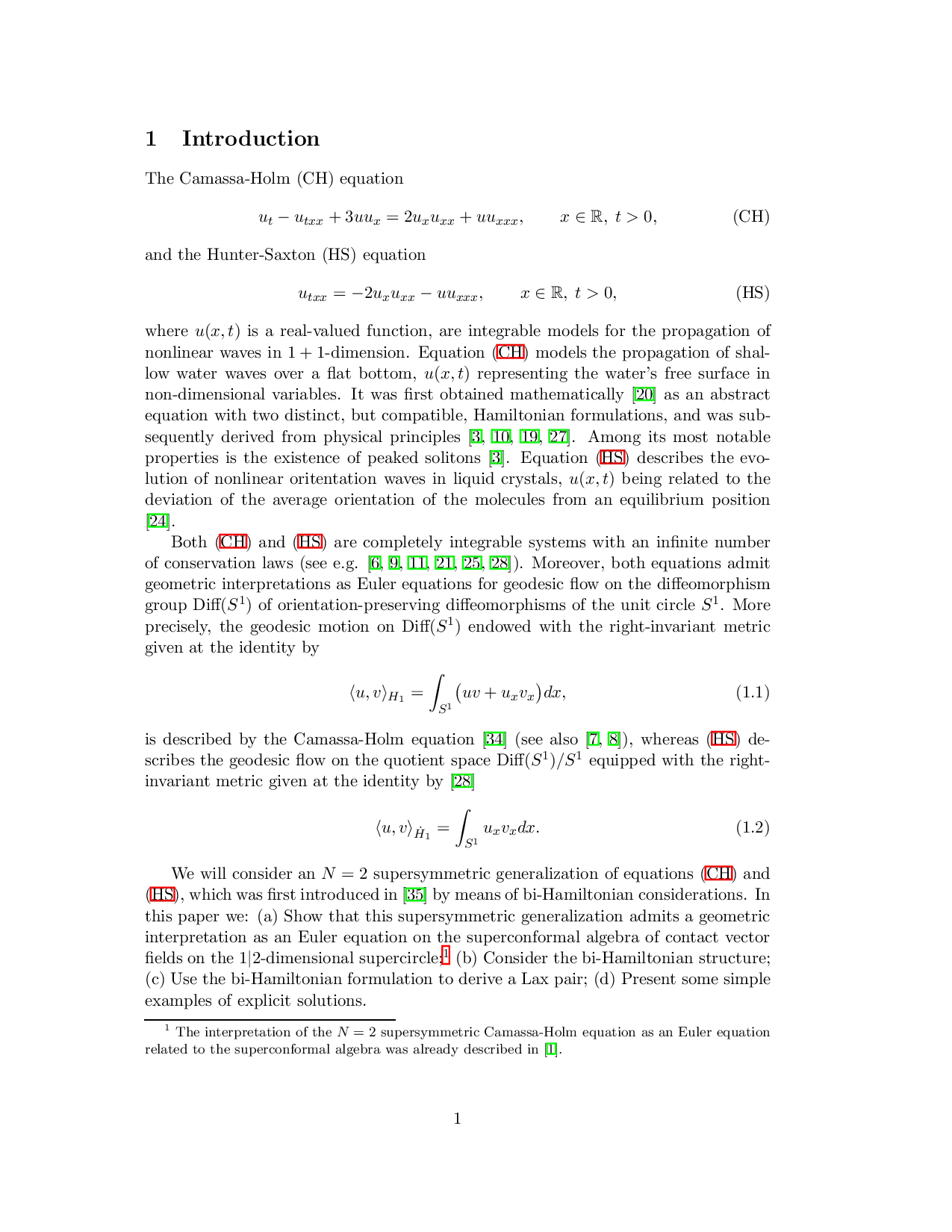
The Camassa-Holm (CH) equation
x ∈ R, t > 0, (CH) and the Hunter-Saxton (HS) equation
where u(x, t) is a real-valued function, are integrable models for the propagation of nonlinear waves in 1 + 1-dimension. Equation (CH) models the propagation of shallow water waves over a flat bottom, u(x, t) representing the water’s free surface in non-dimensional variables. It was first obtained mathematically [20] as an abstract equation with two distinct, but compatible, Hamiltonian formulations, and was subsequently derived from physical principles [3,10,19,27]. Among its most notable properties is the existence of peaked solitons [3]. Equation (HS) describes the evolution of nonlinear oritentation waves in liquid crystals, u(x, t) being related to the deviation of the average orientation of the molecules from an equilibrium position [24]. Both (CH) and (HS) are completely integrable systems with an infinite number of conservation laws (see e.g. [6,9,11,21,25,28]). Moreover, both equations admit geometric interpretations as Euler equations for geodesic flow on the diffeomorphism group Diff(S1 ) of orientation-preserving diffeomorphisms of the unit circle S 1 . More precisely, the geodesic motion on Diff(S 1 ) endowed with the right-invariant metric given at the identity by
is described by the Camassa-Holm equation [34] (see also [7,8]), whereas (HS) describes the geodesic flow on the quotient space Diff(S 1 )/S 1 equipped with the rightinvariant metric given at the identity by [28] u, v Ḣ1 =
We will consider an N = 2 supersymmetric generalization of equations (CH) and (HS), which was first introduced in [35] by means of bi-Hamiltonian considerations. In this paper we: (a) Show that this supersymmetric generalization admits a geometric interpretation as an Euler equation on the superconformal algebra of contact vector fields on the 1|2-dimensional supercircle; 1
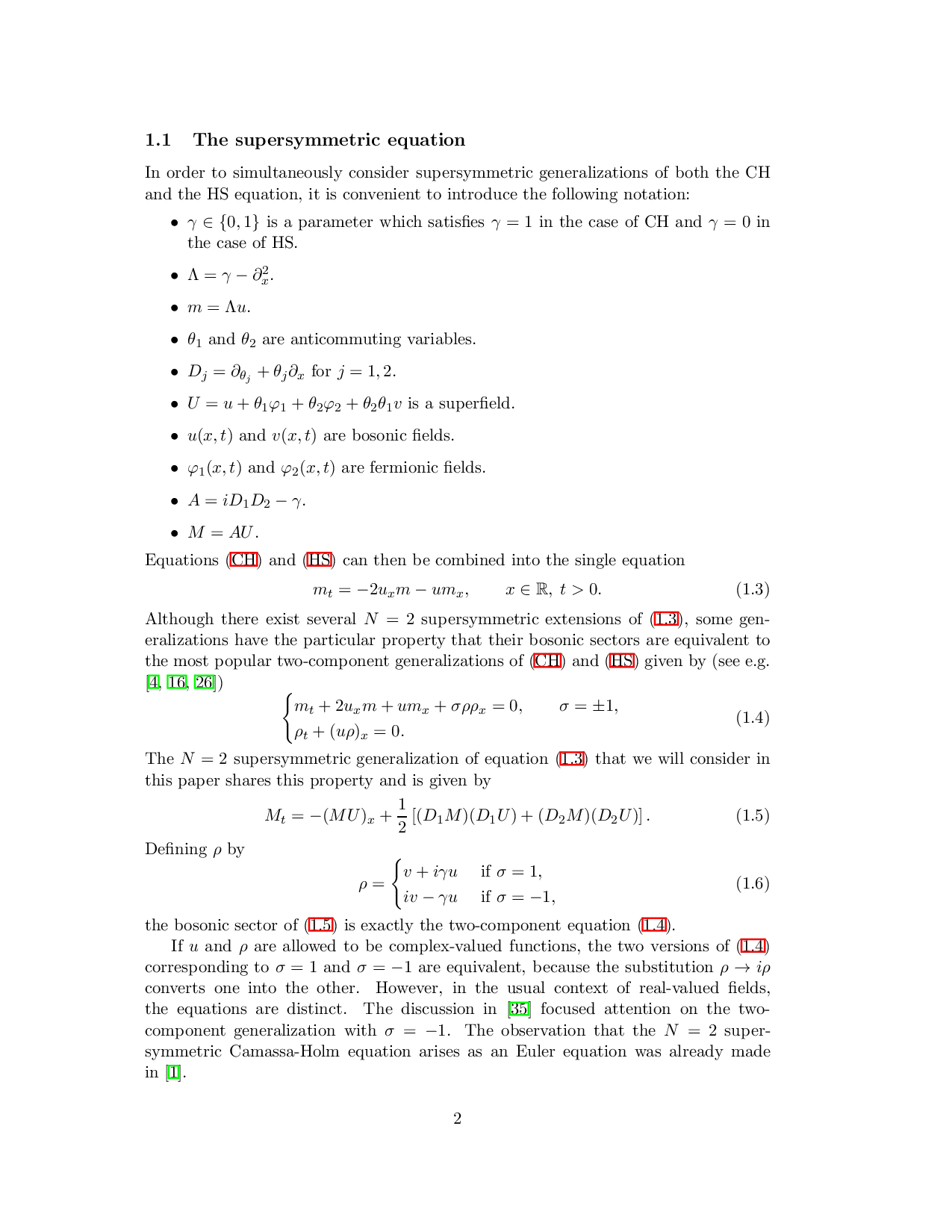
In order to simultaneously consider supersymmetric generalizations of both the CH and the HS equation, it is convenient to introduce the following notation:
• γ ∈ {0, 1} is a parameter which satisfies γ = 1 in the case of CH and γ = 0 in the case of HS.
• θ 1 and θ 2 are anticommuting variables.
• u(x, t) and v(x, t) are bosonic fields.
• ϕ 1 (x, t) and ϕ 2 (x, t) are fermionic fields.
Equations (CH) and (HS) can then be combined into the single equation
Although there exist several N = 2 supersymmetric extensions of (1.3), some generalizations have the particular property that their bosonic sectors are equivalent to the most popular two-component generalizations of (CH) and (HS) given by (see e.g. [4,16,26])
(1.4)
The N = 2 supersymmetric generalization of equation (1.3) that we will consider in this paper shares this property and is given by
Defining ρ by
the bosonic sector of (1.5) is exactly the two-component equation (1.4).
If u and ρ are allowed to be complex-valued functions, the two versions of (1.4) corresponding to σ = 1 and σ = -1 are equivalent, because the substitution ρ → iρ converts one into the other. However, in the usual context of real-valued fields, the equations are distinct. The discussion in [35] focused attention on the twocomponent generalization with σ = -1. The observation that the N = 2 supersymmetric Camassa-Holm equation arises as an Euler equation was already made in [1].
As noted above, equations (CH) and (HS) allow geometric interpretations as equations for geodesic flow related to the group of diffeomorphisms of the circle S 1 endowed with a right-invariant metric. 2 More precisely, using the right-invariance of the metric, the full geodesic equations can be reduced by symmetry to a so-called Euler equation in the Lie algebra of vector fields on the circle together with a reconstruction equation [33] (see also [29,30]). This is how equations (CH) and (HS) arise as Euler equations related to the algebra Vect(S 1 ).
In this section we describe how equation (1.5) similarly arises as an Euler equation related to the superconformal algebra K(S 1|2 ) of contact vector fields on the 1|2-dimensional supercircle S 1|2 . Since K(S 1|2 ) is related to the group of superdiffeomorphisms of S 1|2 , this leads (at least formally) to a geometric interpretation of equation (1.5) as an equation for geodesic flow.
The Lie superalgebra K(S 1|2 ) is defined as follows cf. [15,23]. The supercircle S 1|2 admits local coordinates x, θ 1 , θ 2 , where x is a local coordinate on S 1 and θ 1 , θ 2 are odd coordinates. Let Vect(S 1|2 ) denote the set of vector fields on S 1|2 . An element X ∈ Vect(S 1|2 ) can be written as
where f, f 1 , f 2 are functions on S 1|2 . Let
be the contact form on S 1|2 . The superconformal algebra K(S 1|2 ) consists of all contact vector fields on S 1|2 , i.e.
where L X denotes the Lie derivative in the direction of X.
A convenient description of K(S 1|2 ) is obtained by viewing its elements as Hamiltonian vector fields corresponding to functions on S 1|2 . Indeed, define the Hamiltonian vector field X
…(Full text truncated)…
This content is AI-processed based on ArXiv data.