Bulge formation by the coalescence of giant clumps in primordial disk galaxies
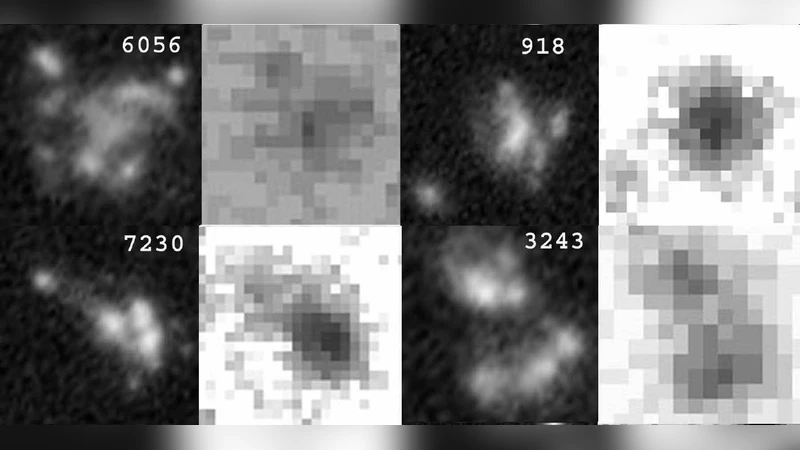
The observations and evolution of clumpy, high-redshift galaxies are reviewed. Models suggest that the clumps form by gravitational instabilities in a gas-rich disk, interact with each other gravitationally, and then merge in the center where they form a bulge. The model requires smooth gas accretion during galaxy growth.
💡 Research Summary
The paper reviews observations of clumpy, high‑redshift galaxies and presents a theoretical framework in which giant star‑forming clumps arise from gravitational instabilities in gas‑rich primordial disks, interact, and eventually coalesce in the galactic centre to build a bulge. The authors begin by summarizing the morphological characteristics of “clump‑cluster” and “chain” galaxies seen at redshifts between roughly one and three. These systems display several massive (10⁸–10⁹ M☉) star‑forming regions a few hundred parsecs across, embedded in a turbulent, gas‑dominated disk. Traditional hierarchical merger models cannot fully account for the prevalence of such clumps, prompting the exploration of an internal instability scenario.
The theoretical backbone relies on the Toomre Q parameter falling below unity in disks where the gas fraction exceeds ~30 %. In this regime, the disk becomes globally unstable, producing a handful of giant clumps rather than a cascade of small fragments. Using high‑resolution three‑dimensional hydrodynamic simulations (both adaptive‑mesh‑refinement and smoothed‑particle‑hydrodynamics codes), the authors explore a range of initial conditions: disk masses of 10¹⁰–10¹¹ M☉, gas fractions of 0.3–0.5, and continuous cold‑flow accretion rates of 10–30 M☉ yr⁻¹. The simulations consistently generate a small number (3–7) of massive clumps that dominate the disk’s mass budget.
Once formed, the clumps experience dynamical friction and mutual gravitational torques, causing them to lose angular momentum and spiral inward. The inward migration timescale depends on clump mass and the background disk density but typically lies between 0.5 and 1 Gyr. During migration, clumps can merge with one another, increasing their mass and triggering bursts of star formation. When the clumps reach the inner kiloparsec, they coalesce into a compact, high‑density stellar component. This component exhibits a Sersic index of roughly 2–4, a half‑light radius of 0.5–2 kpc, and contains about 5–10 % of the total stellar mass—properties that match observed bulges in massive high‑z galaxies.
A crucial assumption of the model is smooth, continuous gas accretion from the cosmic web. The authors argue that without a steady inflow of cold gas, the disk would quickly stabilize, suppressing clump formation and halting bulge growth. The smooth accretion maintains a high gas fraction, fuels ongoing star formation within the clumps, and sustains the gravitational instability over several hundred megayears.
The paper also confronts the model with observational diagnostics. Clumps are predicted to host young stellar populations (ages ≲ 100 Myr) and relatively low metallicities (≈ 0.2 Z☉), whereas the resulting bulge contains older stars (≈ 1 Gyr) and higher metallicities (≈ Z☉). This age‑metallicity gradient is observed in spectroscopic studies of high‑z clumpy galaxies, lending support to the scenario. Moreover, the model naturally explains the high star‑formation surface densities (1–10 M☉ yr⁻¹ kpc⁻²) measured in clumps, as well as the prevalence of massive bulges in galaxies that show little evidence of major mergers.
In the discussion, the authors contrast their “internal‑instability” pathway with the classic merger‑driven bulge formation picture. They argue that the clump‑coalescence route can build bulges more rapidly and with less disruption to the surrounding disk, potentially preserving thin‑disk components that later evolve into present‑day spirals. The model also predicts that galaxies which experience a decline in gas accretion will cease clump formation, allowing the disk to settle and the bulge to age passively.
Finally, the paper outlines future observational tests. High‑resolution integral‑field spectroscopy with JWST, ELT, and ALMA will enable direct measurements of clump kinematics, gas fractions, and metallicity gradients. Mapping cold‑gas inflows (e.g., via CO or
Comments & Academic Discussion
Loading comments...
Leave a Comment