Unit distances and diameters in Euclidean spaces
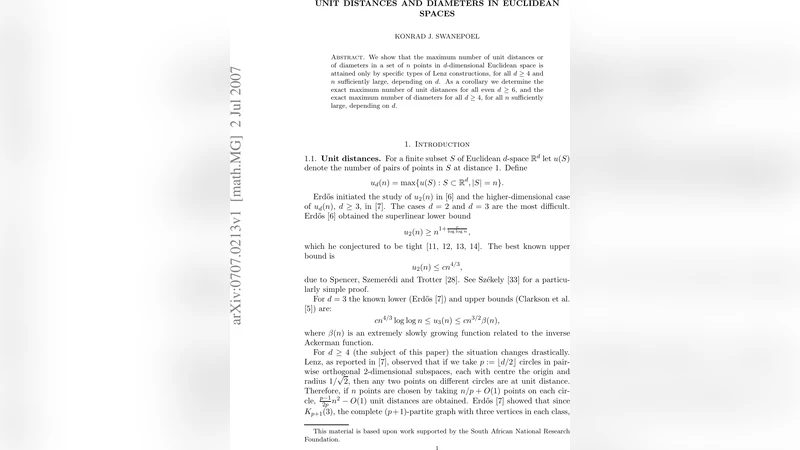
We show that the maximum number of unit distances or of diameters in a set of n points in d-dimensional Euclidean space is attained only by specific types of Lenz constructions, for all d >= 4 and n sufficiently large, depending on d. As a corollary we determine the exact maximum number of unit distances for all even d >= 6, and the exact maximum number of diameters for all d >= 4, for all $n$ sufficiently large, depending on d.
💡 Research Summary
The paper addresses two classic extremal problems in discrete geometry: determining the maximum possible number of unit‑distance pairs and the maximum possible number of diameter pairs that can occur among n points in d‑dimensional Euclidean space ℝ^d. While the two‑ and three‑dimensional cases have been studied extensively since Erdős’s original question, the exact asymptotics for dimensions d ≥ 4 have remained unknown. The authors settle these questions for all sufficiently large n (depending on d) by proving that the extremal configurations are precisely the so‑called Lenz constructions, a family of highly symmetric point sets introduced by Lenz in the 1970s.
The paper proceeds as follows. After a concise introduction that reviews the history of the unit‑distance problem, the diameter problem, and known bounds in low dimensions, the authors formalize the notion of a unit‑distance graph G_u(P) and a diameter graph G_D(P) associated with a point set P⊂ℝ^d. They then introduce a generalized Lenz construction for arbitrary d ≥ 4. The construction works by decomposing ℝ^d into orthogonal subspaces of dimension two (or, when d is odd, a mixture of a two‑dimensional plane and a three‑dimensional subspace) and placing points on circles of a common radius so that every pair of points either lies at distance 1 (the unit‑distance case) or at the maximal distance among the set (the diameter case). The key geometric feature is that each circle lies on a (d‑1)‑dimensional sphere, and the circles are arranged so that the distances between points on different circles are also unit (or maximal) distances.
The core of the proof consists of two complementary parts: an upper‑bound argument that works for any point set, and a matching lower‑bound construction that achieves the bound.
Upper bound. The authors develop a new invariant based on the average degree of the unit‑distance (or diameter) graph. By exploiting the geometry of high‑dimensional spheres, they show that for any set of n points, \
Comments & Academic Discussion
Loading comments...
Leave a Comment