📝 Original Info
- Title: On the energetics of stratified turbulent mixing, irreversible thermodynamics, Boussinesq models, and the ocean heat engine controversy
- ArXiv ID: 0903.1938
- Date: 2009-03-11
- Authors: Remi Tailleux
📝 Abstract
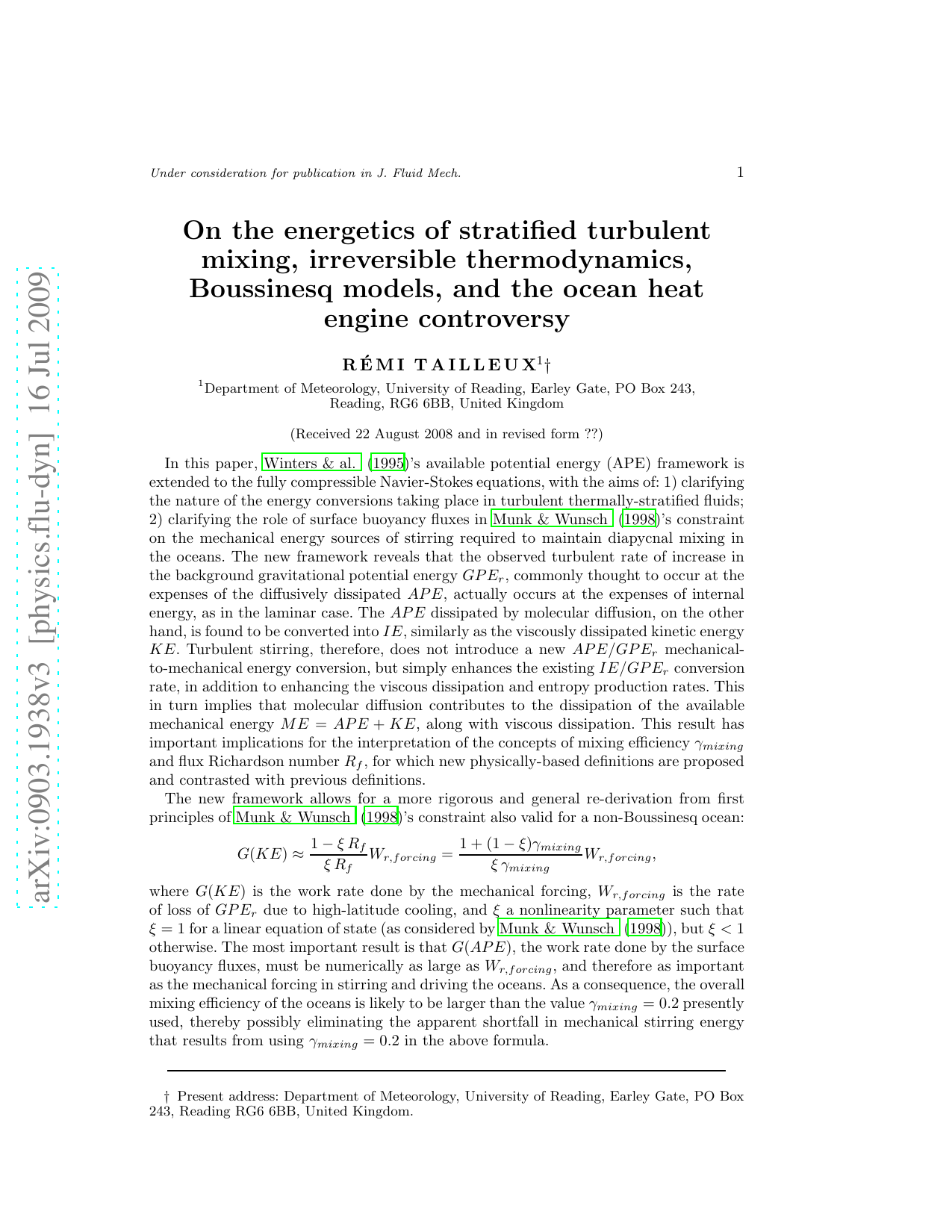
A key issue in stratified turbulence theory concerns the nature of the link between D(APE), the dissipation rate of available potential energy APE, and W_{r,turbulent}, the turbulent rate of change of background gravitational potential energy GPE_r, which are both controlled by molecular diffusion. For Boussinesq fluids with a linear equation of state, this link is simply W_{r,turbulent}=D(APE), widely interpreted as implying that GPE_r increases at the expense of APE, in contrast with the laminar case where GPE_r increases at the expense of internal energy (IE). This idea is revisited here by regarding IE as the sum of three distinct subcomponents: available internal energy (AIE), exergy (IE_{exergy}), and dead internal energy (IE_0). In this new view, D(APE) is the dissipation rate of APE into IE_0, while both W_{r,laminar} and W_{r,turbulent} convert IE_{exergy} into GPE_r. The equality W_{r,turbulent}=D(APE) thus states that IE_{exergy} is converted into GPE_r at the same rate as APE is dissipated into IE_0. For non-Boussinesq fluids, the equality D(APE)=W_{r,turbulent} is at best a good approximation, for W_{r,turbulent} is generally smaller than D(APE), and sometimes even negative for a strongly nonlinear equation of state. In a second step, the link between stirring and mixing is examined for a wind-and buoyancy-driven thermally stratified ocean to determine whether these constrain the mechanical sources of stirring, as recently advocated. It is established that the coupling between stirring and mixing cannot refute the traditional buoyancy-driven view of the so-called meridional overturning circulation, in contrast to recent claims. In fact, the buoyancy forcing appears to be as important as the mechanical forcing in stirring and driving the large-scale ocean circulation.
💡 Deep Analysis
Deep Dive into On the energetics of stratified turbulent mixing, irreversible thermodynamics, Boussinesq models, and the ocean heat engine controversy.
A key issue in stratified turbulence theory concerns the nature of the link between D(APE), the dissipation rate of available potential energy APE, and W_{r,turbulent}, the turbulent rate of change of background gravitational potential energy GPE_r, which are both controlled by molecular diffusion. For Boussinesq fluids with a linear equation of state, this link is simply W_{r,turbulent}=D(APE), widely interpreted as implying that GPE_r increases at the expense of APE, in contrast with the laminar case where GPE_r increases at the expense of internal energy (IE). This idea is revisited here by regarding IE as the sum of three distinct subcomponents: available internal energy (AIE), exergy (IE_{exergy}), and dead internal energy (IE_0). In this new view, D(APE) is the dissipation rate of APE into IE_0, while both W_{r,laminar} and W_{r,turbulent} convert IE_{exergy} into GPE_r. The equality W_{r,turbulent}=D(APE) thus states that IE_{exergy} is converted into GPE_r at the same rate as A
📄 Full Content
As is well known, stirring by the velocity field greatly enhances the amount of irreversible mixing due to molecular diffusion in turbulent stratified fluid flows, as compared with the laminar case. A rigorous proof of this result exists for thermally-driven Boussinesq fluids for which boundary conditions are either of no-flux or fixed temperature. In that case, it is possible to show that
i.e., the ratio of the entropy production (in the Boussinesq limit) of the stirred state over that of the corresponding purely conductive non-stirred state is always greater than unity, where T and T c are the temperature of the stirred and conductive states respectively, the proof being originally due to Zeldovich (1937), and re-derived by Balmforth & Young (2003). The function Φ was introduced by Paparella & Young (2002) as a measure of the strength of the circulation driven by surface buoyancy fluxes. However, because Φ is analogous to an average Cox number (the local turbulent effective diffusivity normalised by the background diffusivity) e.g. Osborn & Cox (1972); Gregg (1987), it is also representative of the amount of turbulent diapycnal mixing taking place in the fluid.
Reversible stirring and irreversible mixing, e.g., see Eckart (1948), occur in relation with physically distinct types of forces at work in the fluid. Stirring works against buoyancy forces by lifting and pulling relatively heavier and lighter parcels respectively, thus causing a reversible conversion between kinetic energy (KE) and available potential energy (AP E). Mixing, on the other hand, is the byproduct of the work done by the generalised thermodynamic forces associated with molecular viscous and diffusive processes that relax the system toward thermodynamic equilibrium, e.g. de Groot & Mazur (1962); Kondepudi & Prigogine (1998); Ottinger (2005). Thus, stirring enhances the work rate done by the viscous stress against the velocity field, resulting in enhanced dissipation of KE into internal energy (IE). Similarly, stirring also enhances the thermal entropy production rate associated with the heat transfer imposed by the second law of thermodynamics, which results in a diathermal effective diffusive heat flux that is increased by the ratio (A turbulent /A laminar ) 2 (another measure of the Cox number), where A turbulent and A laminar refer to the “turbulent” and “laminar” area of a given isothermal surface, see Winters & d’Asaro (1996) and Nakamura (1996). In the laminar regime, the generalised thermodynamic forces associated with molecular diffusion are known to cause the conversion of IE into background gravitational potential energy (GP E r ). From a thermodynamic viewpoint, it would be natural to expect the stirring to enhance the IE/GP E r conversion, but in fact, the existing literature usually accounts for the observed turbulent increase in GP E r as the result of a “new” energy conversion irreversibly converting AP E into GP E r . Clarifying this controversial issue is a key objective of this paper.
The most rigorous existing theoretical framework to understand the interactions between the different forces at work in a turbulent stratified fluid is probably the available potential energy framework introduced by Winters & al. (1995), for being the only one so far that rigourously separates reversible effects due to stirring from the irreversible effects due to mixing (see also Tseng & Ferziger (2001)). As originally proposed by Lorenz (1955), such a framework separates the potential energy P E (i.e., the sum of the gravitational po-tential energy GP E and internal energy IE) into its available (AP E = AGP E + AIE) and non-available (P E r = GP E r + IE r ) components, with the IE component being neglected for a Boussinesq fluid, the case considered by Winters & al. (1995). The usefulness of such a decomposition stems from the fact that the background reference state is by construction only affected by diabatic and/or irreversible processes, so that understanding how the reference state evolves provides insight into how much mixing takes place in the fluid.
In the case of a freely-decaying turbulent Boussinesq stratified fluid with an equation of state linear in temperature, referred to as the L-Boussinesq model thereafter, Winters & al. (1995) show that the evolution equations for KE, AP E = AGP E, and GP E r take the form:
where C(AP E, KE) = -C(KE, AP E) is the so-called “buoyancy flux” measuring the reversible conversion between KE and AP E, D(AP E) is the diffusive dissipation of AP E, which is related to the dissipation of temperature variance χ, e.g. Holloway (1986); Zilitinkevich & al. (2008), while W r,mixing is the rate of change in GP E r induced by molecular diffusion, which is commonly decomposed into a laminar W r,laminar and turbulent W r,turbulent contribution. All these terms are explicitly defined in Appendix A for the L-Boussinesq model, as well for a Boussinesq fluid whose thermal expansion increases with tempe
…(Full text truncated)…
📸 Image Gallery
Reference
This content is AI-processed based on ArXiv data.