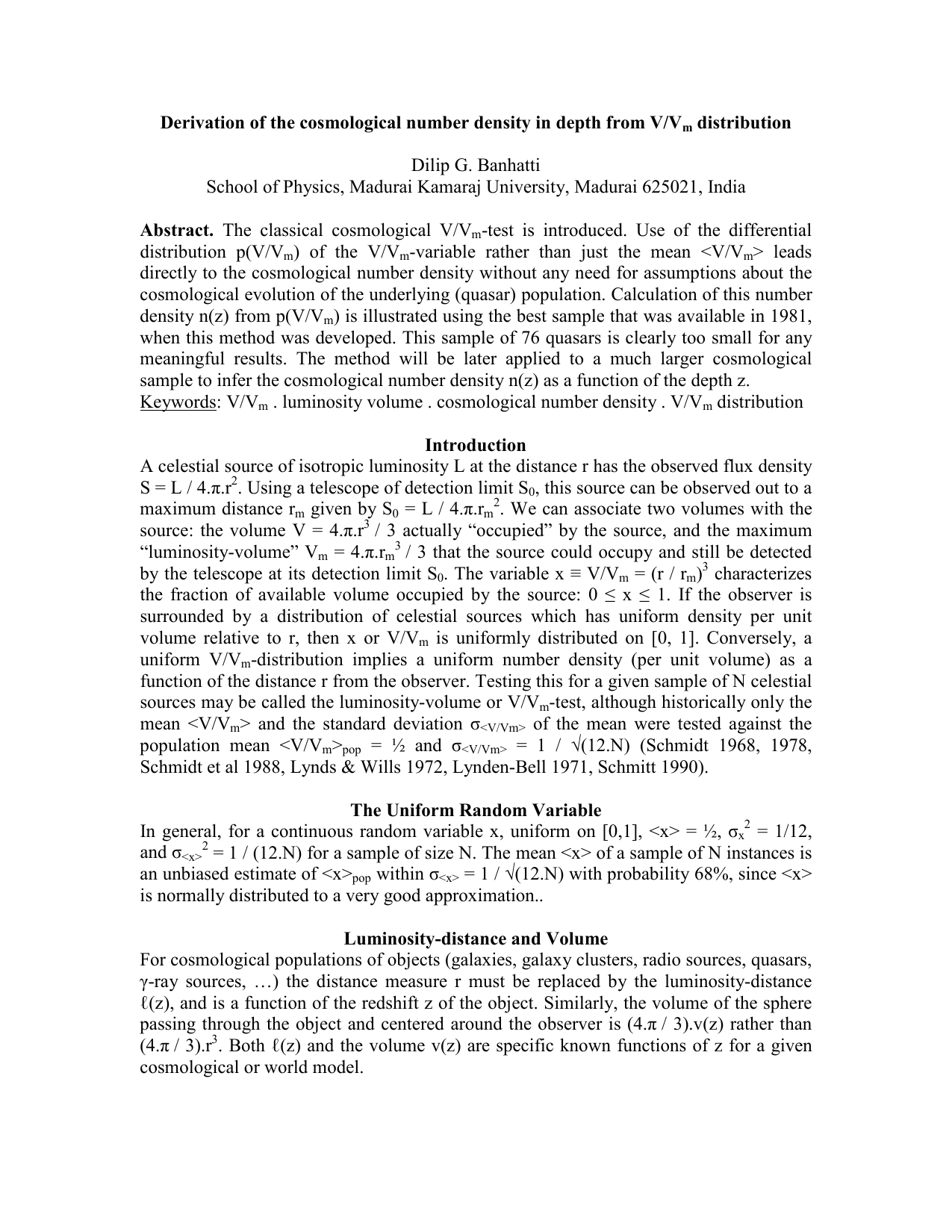
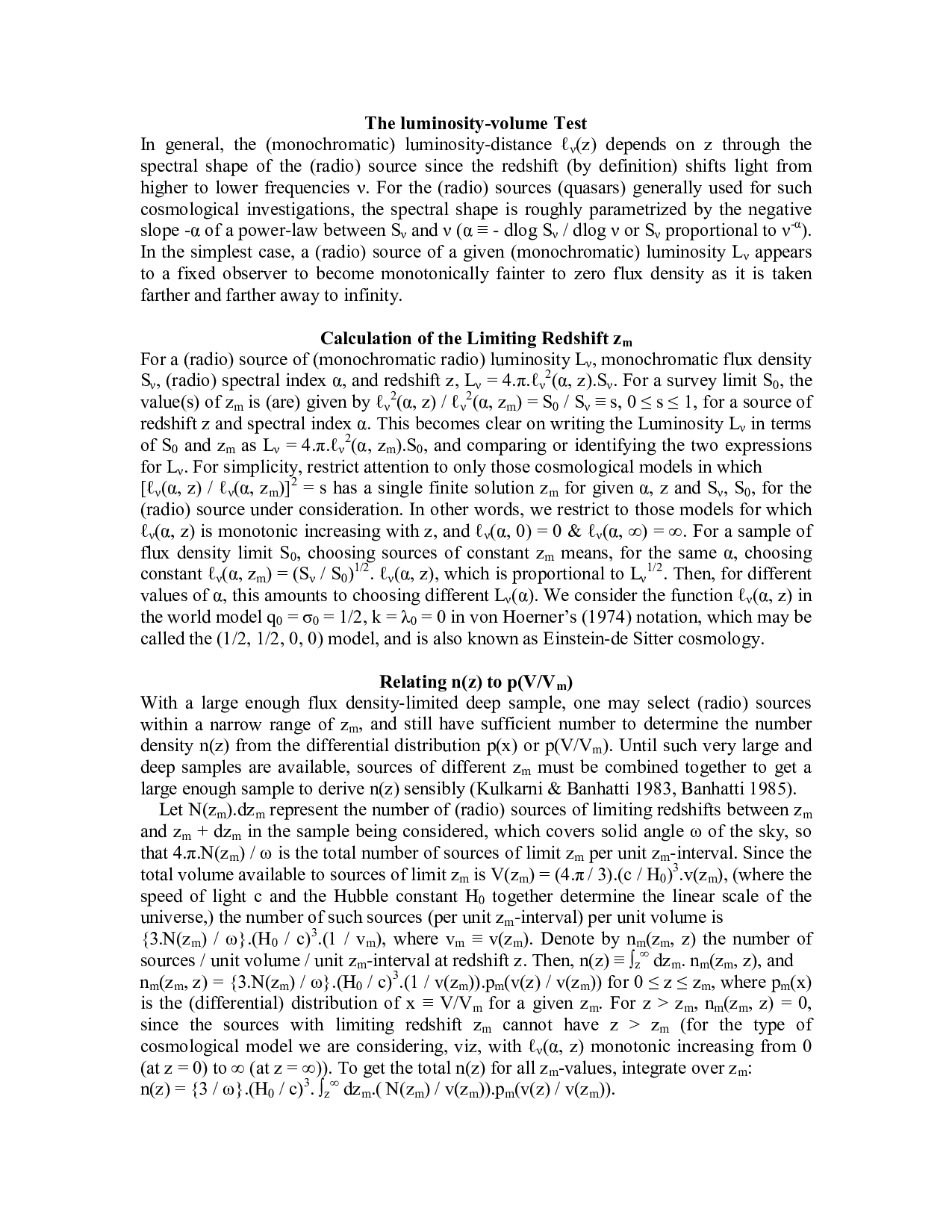
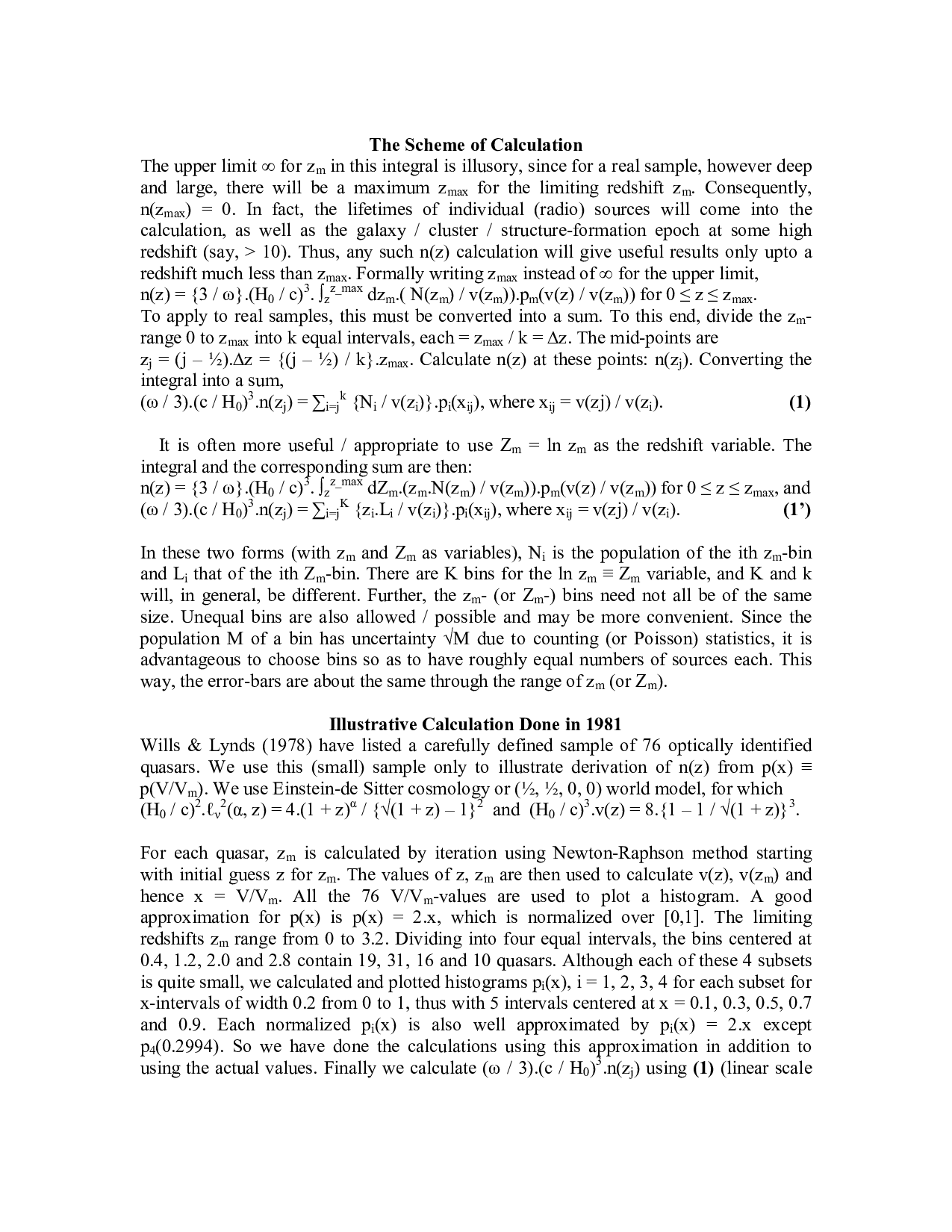
= 1 / √(12.N) (Schmidt 1968, 1978, Schmidt et al 1988, Lynds & Wills 1972, Lynden-Bell 1971, Schmitt 1990).In general, for a continuous random variable x, uniform on [0,1], = ½, σ x 2 = 1/12, and σ 2 = 1 / (12.N) for a sample of size N. The mean of a sample of N instances is an unbiased estimate of pop within σ = 1 / √(12.N) with probability 68%, since is normally distributed to a very good approximation..
For cosmological populations of objects (galaxies, galaxy clusters, radio sources, quasars, γ-ray sources, …) the distance measure r must be replaced by the luminosity-distance ℓ(z), and is a function of the redshift z of the object. Similarly, the volume of the sphere passing through the object and centered around the observer is (4.π / 3).v(z) rather than (4.π / 3).r 3 . Both ℓ(z) and the volume v(z) are specific known functions of z for a given cosmological or world model.
In general, the (monochromatic) luminosity-distance ℓ ν (z) depends on z through the spectral shape of the (radio) source since the redshift (by definition) shifts light from higher to lower frequencies ν. For the (radio) sources (quasars) generally used for such cosmological investigations, the spectral shape is roughly parametrized by the negative slope -α of a power-law between S ν and ν (α ≡ -dlog S ν / dlog ν or S ν proportional to ν -α ). In the simplest case, a (radio) source of a given (monochromatic) luminosity L ν appears to a fixed observer to become monotonically fainter to zero flux density as it is taken farther and farther away to infinity.
For a (radio) source of (monochromatic radio) luminosity L ν , monochromatic flux density S ν , (radio) spectral index α, and redshift z, L ν = 4.π.ℓ ν 2 (α, z).S ν . For a survey limit S 0 , the value(s) of z m is (are) given by ℓ ν 2 (α, z) / ℓ ν 2 (α, z m ) = S 0 / S ν ≡ s, 0 ≤ s ≤ 1, for a source of redshift z and spectral index α. This becomes clear on writing the Luminosity L ν in terms of S 0 and z m as L ν = 4.π.ℓ ν 2 (α, z m ).S 0 , and comparing or identifying the two expressions for L ν . For simplicity, restrict attention to only those cosmological models in which [ℓ ν (α, z) / ℓ ν (α, z m )] 2 = s has a single finite solution z m for given α, z and S ν , S 0 , for the (radio) source under consideration. In other words, we restrict to those models for which ℓ ν (α, z) is monotonic increasing with z, and ℓ ν (α, 0) = 0 & ℓ ν (α, ∞) = ∞. For a sample of flux density limit S 0 , choosing sources of constant z m means, for the same α, choosing constant ℓ ν (α, z m ) = (S ν / S 0 ) 1/2 . ℓ ν (α, z), which is proportional to L ν 1/2 . Then, for different values of α, this amounts to choosing different L ν (α). We consider the function ℓ ν (α, z) in the world model q 0 = σ 0 = 1/2, k = λ 0 = 0 in von Hoerner’s (1974) notation, which may be called the (1/2, 1/2, 0, 0) model, and is also known as Einstein-de Sitter cosmology.
Relating n(z) to p(V/V m ) With a large enough flux density-limited deep sample, one may select (radio) sources within a narrow range of z m , and still have sufficient number to determine the number density n(z) from the differential distribution p(x) or p(V/V m ). Until such very large and deep samples are available, sources of different z m must be combined together to get a large enough sample to derive n(z) sensibly (Kulkarni & Banhatti 1983, Banhatti 1985).
Let N(z m ).dz m represent the number of (radio) sources of limiting redshifts between z m and z m + dz m in the sample being considered, which covers solid angle ω of the sky, so that 4.π.N(z m ) / ω is the total number of sources of limit z m per unit z m -interval. Since the total volume available to sources of limit z m is V(z m ) = (4.π / 3).(c / H 0 ) 3 .v(z m ), (where
…(Full text truncated)…