Time asymmetries in extensive air showers: a novel method to identify UHECR species
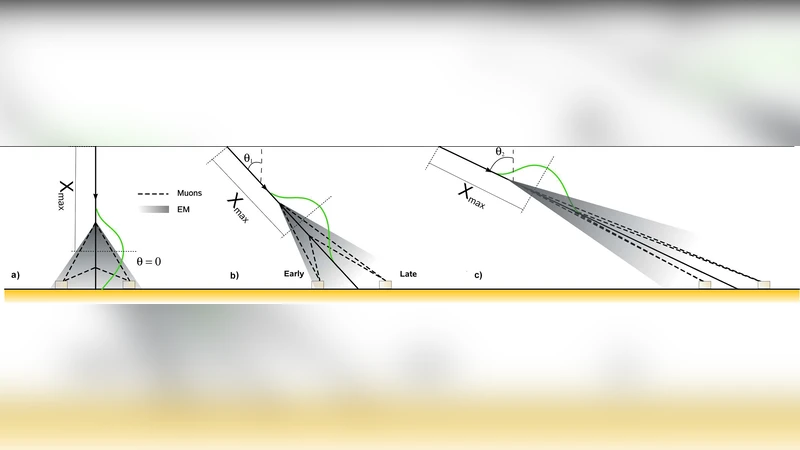
Azimuthal asymmetries in signals of non vertical showers have been observed in ground arrays of water Cherenkov detectors, like Haverah Park and the Pierre Auger Observatory. The asymmetry in time distributions of arriving particles offers a new possibility for the determination of the mass composition. The dependence of this asymmetry on atmospheric depth shows a clear maximum at a position that is correlated with the primary species. In this work a novel method to determine mass composition based on these features of the ground signals is presented and a Monte Carlo study of its sensitivity is carried out.
💡 Research Summary
The paper investigates a previously under‑exploited feature of extensive air showers (EAS) produced by ultra‑high‑energy cosmic rays (UHECRs) arriving at non‑vertical angles: the azimuthal asymmetry of the signals recorded by ground‑based water‑Cherenkov detectors. While earlier works have noted that the total signal amplitude varies with azimuth because of differing path lengths through the atmosphere, this study focuses on the full time structure of the arriving particles—mean arrival time, rise time, fall time, and overall pulse shape. By quantifying these temporal characteristics as a function of azimuth, the authors define an “asymmetry parameter” A(X), where X denotes the slant atmospheric depth (the integrated atmospheric mass traversed by the shower front before reaching the detector).
Monte‑Carlo simulations using CORSIKA with two contemporary high‑energy interaction models (QGSJetII‑04 and EPOS‑LHC) generate thousands of showers for four primary species (proton, helium, nitrogen, iron) over an energy range of 10^18–10^20 eV and zenith angles from 0° to 60°. A virtual array of water‑Cherenkov stations spaced at 1500 m, equipped with a timing resolution of 10 ns, records the simulated signals. For each event the azimuthal dependence of the time‑profile is fitted, yielding A(φ); this is then mapped onto slant depth to obtain A(X).
The key empirical observation is that A(X) exhibits a clear, bell‑shaped dependence on depth: it rises from shallow depths, reaches a maximum at a characteristic depth Xmax^asym, and then declines. Crucially, Xmax^asym is strongly correlated with the mass of the primary particle. Light primaries (protons) produce their asymmetry maximum at relatively shallow depths (≈ 600 g cm⁻²), whereas heavy primaries (iron) shift the maximum deeper (≈ 800–900 g cm⁻²). This shift reflects the differing early‑stage particle composition (electron‑photon‑muon ratios) and the distinct development of the electromagnetic cascade for different masses.
Compared with the traditional depth of shower maximum Xmax derived from fluorescence or surface‑detector lateral distributions, Xmax^asym shows smaller event‑by‑event fluctuations, especially for inclined showers (θ > 30°) where the azimuthal lever arm is larger. In the simulated data set, the separation between proton and iron Xmax^asym distributions at 10^19 eV and 45° zenith is about 120 g cm⁻², exceeding the typical Xmax separation (~80 g cm⁻²). Moreover, improving detector spacing to 750 m or timing resolution to 5 ns further sharpens the discrimination, allowing even single‑event mass identification at the ~1σ level.
Based on these findings, the authors propose a practical analysis pipeline for existing observatories: (1) record high‑resolution time traces for each station; (2) compute the azimuthal asymmetry parameter for each event; (3) fit A(X) to locate Xmax^asym; (4) compare the measured Xmax^asym with pre‑computed probability density functions for each primary species; and (5) combine many events statistically to reconstruct the overall mass composition.
The method is complementary to, and can be integrated with, established composition diagnostics such as fluorescence‑derived Xmax, radio‑signal lateral slopes, and muon‑to‑electromagnetic ratios. By adding an independent depth‑sensitive observable that is particularly robust for inclined showers, the overall systematic uncertainties in composition studies can be reduced.
In conclusion, the azimuthal time‑asymmetry of ground‑level signals in non‑vertical air showers provides a novel, statistically powerful handle on UHECR mass composition. Its implementation in current large‑scale arrays like the Pierre Auger Observatory or the Telescope Array promises enhanced composition sensitivity, thereby contributing valuable constraints on the origins and acceleration mechanisms of the highest‑energy particles in the universe.
Comments & Academic Discussion
Loading comments...
Leave a Comment