Limits of Gaudin Systems: Classical and Quantum Cases
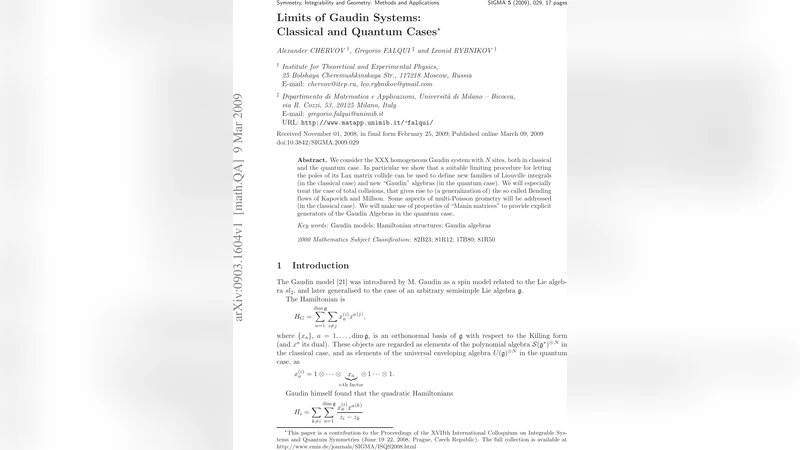
We consider the XXX homogeneous Gaudin system with $N$ sites, both in classical and the quantum case. In particular we show that a suitable limiting procedure for letting the poles of its Lax matrix collide can be used to define new families of Liouville integrals (in the classical case) and new “Gaudin” algebras (in the quantum case). We will especially treat the case of total collisions, that gives rise to (a generalization of) the so called Bending flows of Kapovich and Millson. Some aspects of multi-Poisson geometry will be addressed (in the classical case). We will make use of properties of “Manin matrices” to provide explicit generators of the Gaudin Algebras in the quantum case.
💡 Research Summary
The paper investigates the homogeneous XXX Gaudin model with N sites in both its classical and quantum incarnations, focusing on a limiting procedure in which the poles of the Lax matrix are forced to collide. In the classical setting the Lax matrix is
(L(z)=\sum_{i=1}^{N}\frac{A_i}{z-z_i})
with (A_i\in\mathfrak{sl}2) representing the spin at site i. By moving the distinct points (z_i) towards a single point (z_0) the authors obtain a new Lax matrix of the form
(\widetilde L(z)=\sum{k=0}^{m-1}\frac{B_k}{(z-z_0)^{k+1}}+\text{regular part})
where the coefficients (B_k) are symmetric combinations of the original residues (A_i). They prove that the residues of (\operatorname{tr}\widetilde L(z)^2) at the higher‑order pole generate a family of Liouville integrals that are independent of the usual Gaudin Hamiltonians (H_i=\operatorname{Res}_{z=z_i}\operatorname{tr}L(z)^2). The most dramatic case is the total collision (m=N); here the (B_k) encode the full symmetric tensor powers of the total spin and the resulting flows coincide with the “bending flows” introduced by Kapovich and Millson. The authors place these flows in the broader context of multi‑Poisson geometry, showing that the Poisson brackets of the new integrals close and that the whole hierarchy can be interpreted as a deformation of a multi‑symplectic structure on the product of coadjoint orbits.
In the quantum regime the Lax matrix is promoted to a non‑commutative object. The key technical tool is the theory of Manin matrices, which are matrices with non‑commuting entries satisfying specific row‑exchange relations that guarantee the existence of a well‑behaved quantum determinant. By rewriting the quantum Lax matrix as a Manin matrix, the authors are able to construct central elements of the enveloping algebra in the form (\operatorname{tr}\widetilde L(z)^k) (k∈ℕ). After a suitable regularization they define a new “Gaudin algebra” (\mathcal G_{\text{lim}}) generated by these elements. This algebra is shown to be maximal commutative, to contain the original Gaudin algebra as a proper subalgebra, and to possess a spectrum that reflects the higher‑order pole structure introduced by the collision limit. Moreover, the Bethe Ansatz equations for the original Gaudin model deform into a set of equations involving the new generators, hinting at a modified Bethe Ansatz for the limiting algebra.
The paper also discusses several auxiliary results. It establishes that the limiting procedure preserves integrability: the Poisson brackets of the new classical integrals are still in involution, and the quantum commutators of the new generators vanish. It provides explicit formulas for the (B_k) in terms of the original (A_i) and for the quantum generators using the quantum determinant of the Manin matrix. Finally, the authors comment on possible extensions, such as applying the same limiting scheme to higher‑rank algebras, to trigonometric or elliptic Gaudin models, and to connections with Hitchin systems.
Overall, the work demonstrates that colliding the poles of the Gaudin Lax matrix is not a singular degeneration but a fruitful avenue for generating new integrable structures. In the classical case it yields a hierarchy of Liouville integrals that generalize the bending flows, while in the quantum case it produces a new maximal commutative subalgebra of the universal enveloping algebra, with explicit generators supplied by Manin‑matrix technology. These results open up new directions for the study of integrable spin chains, multi‑Poisson geometry, and the representation theory of quantum Gaudin algebras.
Comments & Academic Discussion
Loading comments...
Leave a Comment