Multiwavelength View of the Inner Spiral of NGC 1365
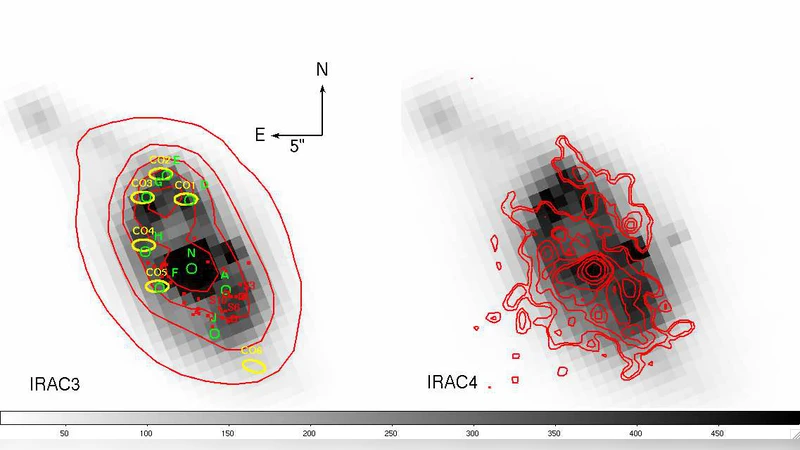
We study the extended nuclear emission of the starburst galaxy NGC 1365. A weak obscured AGN and a strong starburst both contribute to the observed X-ray, optical, infrared, and radio emission in the inner 2kpc. The X-ray emission is spatially resolved, allowing comparison with multiwavelength data that highlights the structures dominating the nuclear region: the AGN, the nuclear spiral, the circumnuclear starburst ring, and nuclear outflow. The ultrasoft X-ray emission below 0.5keV is spatially coincident with the conical outflow traced by higher excitation optical emission lines like [O III] and [Ne III]. The strong starburst concentrated in super-star clusters in a circumnuclear ring with radius ~1kpc dominates the 0.5-1.5keV emission and is visible in radio, molecular CO, and infrared maps of the central kiloparsec. The hard (2-10keV) emission is dominated by the obscured AGN, but also contributes to the emission from relatively old (~7Myr) but still enshrouded in dust and extremely massive (10^7Msun) super-star clusters (Galliano 2008), hidden from view in the optical and soft X-ray bands. In the Appendix we present the X-ray spectroscopy and photometry of BL Lac MS 0331.3-3629, a high-energy peaked BL Lac candidate at z=0.308, serendipitously detected in one Chandra and five XMM-Newton observations of NGC1365.
💡 Research Summary
This paper presents a comprehensive multi‑wavelength study of the inner 2 kpc of the starburst galaxy NGC 1365, focusing on how a weak, heavily obscured active galactic nucleus (AGN) and an intense circumnuclear starburst jointly shape the observed emission from X‑ray to radio wavelengths. Using high‑resolution Chandra ACIS‑S and XMM‑Newton EPIC‑pn data, the authors resolve the X‑ray morphology into distinct energy bands and compare it with Hubble optical line maps, Spitzer/Herschel infrared images, and radio/molecular line observations from ATCA, VLA, and ALMA.
The softest X‑ray component (≤ 0.5 keV) is found to be co‑spatial with a conical outflow traced by high‑excitation optical lines such as
Comments & Academic Discussion
Loading comments...
Leave a Comment