The Brown Dwarf-Exoplanet Connection
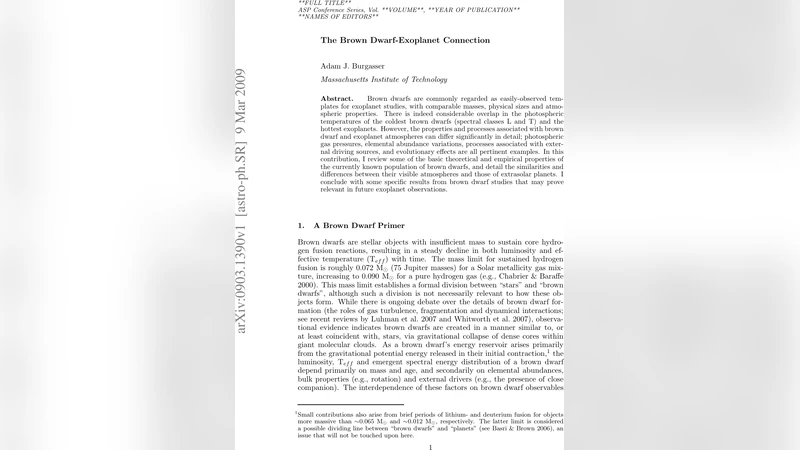
Brown dwarfs are commonly regarded as easily-observed templates for exoplanet studies, with comparable masses, physical sizes and atmospheric properties. There is indeed considerable overlap in the photospheric temperatures of the coldest brown dwarfs (spectral classes L and T) and the hottest exoplanets. However, the properties and processes associated with brown dwarf and exoplanet atmospheres can differ significantly in detail; photospheric gas pressures, elemental abundance variations, processes associated with external driving sources, and evolutionary effects are all pertinent examples. In this contribution, I review some of the basic theoretical and empirical properties of the currently known population of brown dwarfs, and detail the similarities and differences between their visible atmospheres and those of extrasolar planets. I conclude with some specific results from brown dwarf studies that may prove relevant in future exoplanet observations.
💡 Research Summary
The paper surveys the relationship between brown dwarfs and exoplanets, focusing on how the former serve as empirical templates for the latter while also highlighting critical differences. Brown dwarfs of spectral types L and T have photospheric temperatures between roughly 500 K and 1500 K, overlapping the temperature range of many hot Jupiters, warm Neptunes, and directly‑imaged giant exoplanets. This overlap means that the same molecular absorbers (H₂O, CH₄, CO) and condensate clouds (silicates, iron) appear in both classes, allowing atmospheric models calibrated on brown dwarfs to be applied to exoplanets.
However, the paper stresses four major axes of divergence. First, photospheric pressure: brown dwarf atmospheres typically reside at 1–10 bar, whereas the observable layers of exoplanets are at lower pressures, shifting chemical equilibria and altering the CH₄/CO and NH₃/N₂ ratios. Second, elemental abundances: brown dwarfs reflect the average Galactic metallicity, while exoplanets inherit the localized composition of their natal protoplanetary disks, which can strongly affect cloud opacity and radiative transfer. Third, external energy sources: brown dwarfs radiate internal heat generated by gradual contraction, whereas exoplanets are dominated by stellar irradiation, tidal heating, magnetic interactions, and episodic flares, all of which drive atmospheric dynamics and non‑equilibrium chemistry. Fourth, evolutionary pathways: brown dwarfs cool and contract over billions of years in a relatively smooth fashion, while exoplanets experience rapid early contraction followed by long‑term irradiation‑driven evolution, producing distinct temperature‑pressure histories.
Observationally, brown dwarfs benefit from high‑signal‑to‑noise infrared spectroscopy and direct imaging, enabling precise constraints on cloud particle size distributions, vertical structure, and non‑equilibrium chemistry. These constraints have produced concrete results such as the L‑T transition cloud‑clearing mechanism, the CO–CH₄ quench chemistry, and the detection of conductive iron clouds at high pressure. The author argues that these empirically validated models can be transplanted to exoplanet studies, provided that additional corrections are made for external drivers (e.g., strong UV flux, tidal forcing).
The paper concludes that leveraging brown dwarf atmospheric physics will sharpen the interpretation of upcoming JWST, ELT, and Ariel observations of exoplanet atmospheres. By using brown dwarf‑derived cloud, chemistry, and radiative‑transfer frameworks as a baseline, researchers can isolate the unique signatures of stellar irradiation and dynamical forcing in exoplanet spectra. Ultimately, the synergy between the two populations promises a more unified picture of substellar atmospheric physics, informing theories of planet formation, migration, and long‑term evolution.
Comments & Academic Discussion
Loading comments...
Leave a Comment