Structure and Dynamics of the Milky Way: an Astro2010 Science White Paper
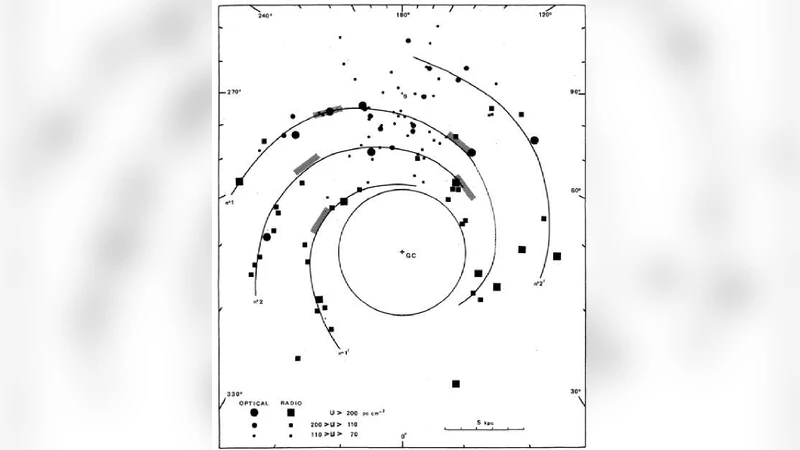
Recent advances in radio astrometry with the VLBA have resulted in near micro-arcsecond accurate trigonometric parallax and proper motion measurements for masers in star forming regions. We are now poised to directly measure the full 3-dimensional locations and motions of every massive star forming region in the Milky Way and for the first time to map its spiral structure. Such measurements would also yield the full kinematics of the Milky Way and determine its fundamental parameters (Ro and To) with 1% accuracy. Coupled with other observations this would yield the distribution of mass among the various components (including dark matter) of the Milky Way.
💡 Research Summary
The white paper outlines a transformative research program that leverages recent breakthroughs in very‑long‑baseline interferometry (VLBI) to map the Milky Way’s three‑dimensional structure and dynamics with unprecedented precision. Historically, the Galaxy’s spiral architecture and fundamental dynamical parameters—most notably the distance from the Sun to the Galactic centre (R₀) and the circular rotation speed at the Sun’s orbit (Θ₀)—have been inferred from indirect methods such as optical distance ladders, gas‑kinematic models, and assumptions about the symmetry of the rotation curve. These approaches suffer from large systematic uncertainties, especially in the heavily obscured inner disk where dust extinction hampers optical observations.
The authors argue that the advent of micro‑arcsecond astrometry using the Very Long Baseline Array (VLBA) fundamentally changes this landscape. By targeting bright radio masers (primarily methanol and water) associated with massive star‑forming regions, the VLBA can simultaneously measure trigonometric parallaxes and proper motions for dozens to hundreds of sources across the Galactic plane. Multi‑epoch observations, combined with sophisticated phase‑referencing techniques, yield distance uncertainties of a few percent and proper‑motion accuracies better than 1 km s⁻¹.
The program is organized into four interlocking stages. First, a systematic survey of maser sources will produce a dense grid of precise distances and three‑dimensional velocity vectors. Second, these data will be assembled into a comprehensive map of the Milky Way’s spiral arms, allowing the authors to determine arm pitch angles, widths, and inter‑arm separations with an accuracy previously unattainable. Third, the measured motions will be fitted directly to a Galactic rotation model, providing R₀ and Θ₀ with ≤1 % uncertainties—an order‑of‑magnitude improvement over current estimates. Because the method is model‑independent (it relies on direct geometric measurements rather than indirect kinematic tracers), the resulting parameters are robust against many of the systematic biases that plague traditional techniques.
A fourth, equally critical, component addresses non‑circular motions. The VLBA data resolve streaming motions induced by the central bar, spiral density waves, and local perturbations. By quantifying these deviations, the authors can separate the contributions of the stellar disk, the central bar, and the dark‑matter halo to the overall mass distribution. This enables a precise decomposition of the Galaxy’s mass budget, constraining the dark‑matter density profile and testing predictions from ΛCDM simulations.
Looking ahead, the paper emphasizes synergy with next‑generation facilities such as the Square Kilometre Array (SKA) and a next‑generation VLBA (NGVLA). These instruments will dramatically increase sensitivity, allowing detection of weaker masers and extending the survey to the outermost reaches of the disk (beyond 20 kpc). The expanded coverage will close the current gap in our knowledge of the Galaxy’s outer rotation curve, further tightening constraints on the halo’s shape and total mass.
In summary, the white paper presents a clear, technically feasible roadmap to transform our understanding of the Milky Way. By exploiting micro‑arcsecond radio astrometry, it promises to deliver a definitive three‑dimensional map of spiral structure, a 1 %‑level determination of R₀ and Θ₀, and a detailed, empirically grounded model of the Galaxy’s mass distribution—including the elusive dark‑matter component. The resulting dataset will serve as a cornerstone for a broad range of astrophysical investigations, from star‑formation studies to tests of fundamental physics on Galactic scales.
Comments & Academic Discussion
Loading comments...
Leave a Comment