In this paper, an expression for the asymptotic growth rate of the number of small linear-weight codewords of irregular doubly-generalized LDPC (D-GLDPC) codes is derived. The expression is compact and generalizes existing results for LDPC and generalized LDPC (GLDPC) codes. Ensembles with check or variable node minimum distance greater than 2 are shown to be have good growth rate behavior, while for other ensembles a fundamental parameter is identified which discriminates between an asymptotically small and an asymptotically large expected number of small linear-weight codewords. Also, in the latter case it is shown that the growth rate depends only on the check and variable nodes with minimum distance 2. An important connection between this new result and the stability condition of D-GLDPC codes over the BEC is highlighted. Such a connection, previously observed for LDPC and GLDPC codes, is now extended to the case of D-GLDPC codes. Finally, it is shown that the analysis may be extended to include the growth rate of the stopping set size distribution of irregular D-GLDPC codes.
Deep Dive into On the Growth Rate of the Weight Distribution of Irregular Doubly-Generalized LDPC Codes.
In this paper, an expression for the asymptotic growth rate of the number of small linear-weight codewords of irregular doubly-generalized LDPC (D-GLDPC) codes is derived. The expression is compact and generalizes existing results for LDPC and generalized LDPC (GLDPC) codes. Ensembles with check or variable node minimum distance greater than 2 are shown to be have good growth rate behavior, while for other ensembles a fundamental parameter is identified which discriminates between an asymptotically small and an asymptotically large expected number of small linear-weight codewords. Also, in the latter case it is shown that the growth rate depends only on the check and variable nodes with minimum distance 2. An important connection between this new result and the stability condition of D-GLDPC codes over the BEC is highlighted. Such a connection, previously observed for LDPC and GLDPC codes, is now extended to the case of D-GLDPC codes. Finally, it is shown that the analysis may be exten
Doubly-generalized LDPC codes, irregular code ensembles, weight distribution.
Recently, low-density parity-check (LDPC) codes have been intensively studied due to their near-Shannon-limit performance under iterative belief-propagation decoding. Binary regular LDPC codes were first proposed by Gallager in 1963 [1]. In the last decade the capability of irregular LDPC codes to outperform regular ones in the waterfall region of the performance curve and to asymptotically approach (or even achieve) the communication channel capacity has been recognized and deeply investigated (see for instance [2], [3], [4], [5], [6], [7]).
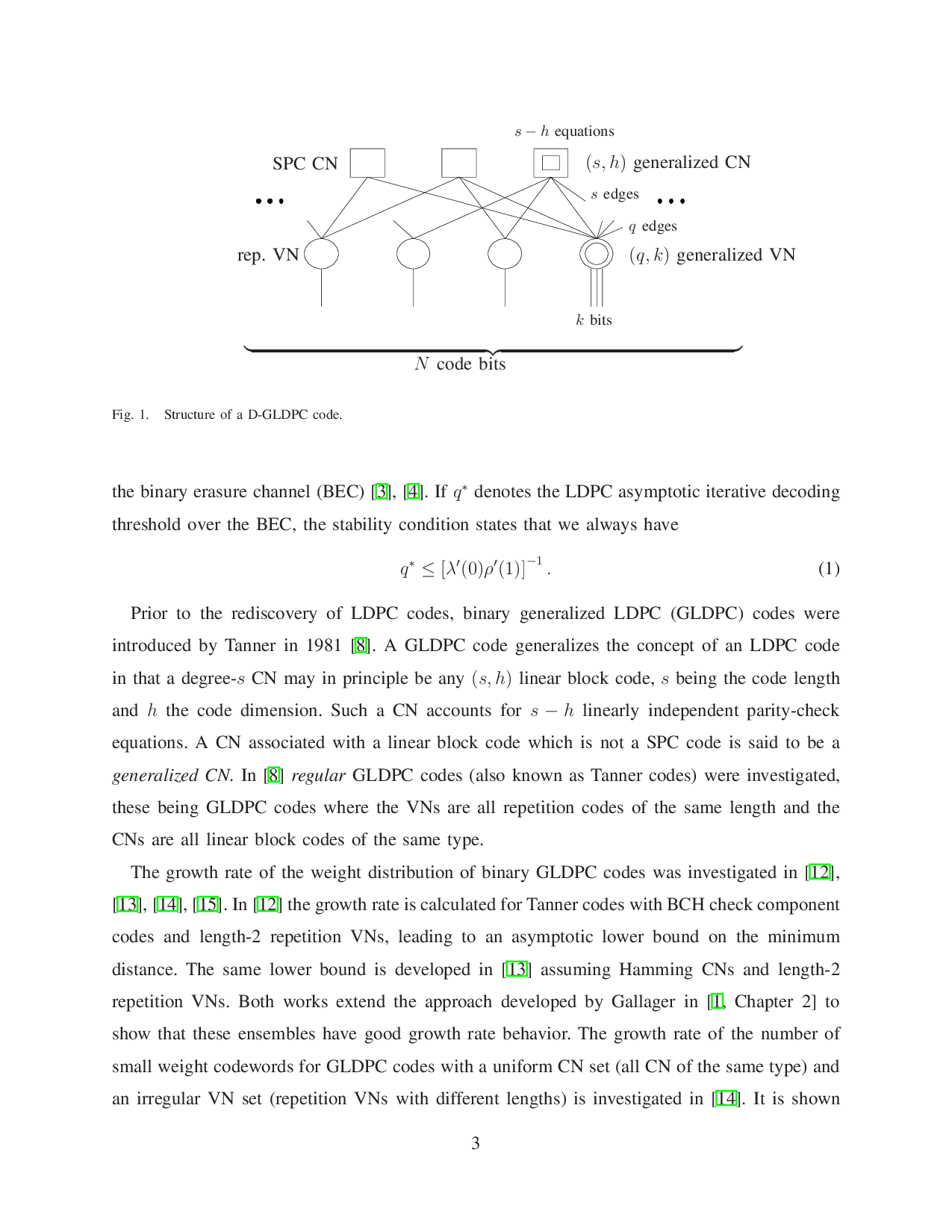
It is usual to represent an LDPC code as a bipartite graph, i.e., as a graph where the nodes are grouped into two disjoint sets, namely, the variable nodes (VNs) and the check nodes (CNs), such that each edge may only connect a VN to a CN. The bipartite graph is also known as a Tanner graph [8]. In the Tanner graph of an LDPC code, a generic degree-q VN can be interpreted as a length-q repetition code, as it repeats q times its single information bit towards the CNs.
Similarly, a degree-s CN of an LDPC code can be interpreted as a length-s single parity-check (SPC) code, as it checks the parity of the s VNs connected to it.
The growth rate of the weight distribution of Gallager’s regular LDPC codes was investigated in [1]. The analysis demonstrated that, provided that the smallest VN degree is at least 3, the ensemble has good growth rate behavior, i.e. a code randomly chosen from the ensemble contains an asymptotically small expected number of small linear-weight codewords.
More recently, the study of the weight distribution of binary LDPC codes has been extended to irregular ensembles. Pioneering works in this area are [9], [10], [11]. In [11] a complete solution for the growth rate of the weight distribution of binary irregular LDPC codes was developed. One of the main results of [11] is a connection between the expected behavior of the weight distribution of a code randomly chosen from the ensemble and the parameter λ ′ (0)ρ ′ (1), λ(x) and ρ(x) being the edge-perspective VN and CN degree distributions, respectively. More specifically, it was shown that for a code randomly chosen from the ensemble, one can expect an exponentially small number of small linear-weight codewords if 0 ≤ λ ′ (0)ρ ′ (1) < 1, and an exponentially large number of small linear-weight codewords if λ ′ (0)ρ ′ (1) > 1.
This result establishes a connection between the statistical properties of the weight distribution of binary irregular LDPC codes and the stability condition of binary irregular LDPC codes over the binary erasure channel (BEC) [3], [4]. If q * denotes the LDPC asymptotic iterative decoding threshold over the BEC, the stability condition states that we always have
Prior to the rediscovery of LDPC codes, binary generalized LDPC (GLDPC) codes were introduced by Tanner in 1981 [8]. A GLDPC code generalizes the concept of an LDPC code in that a degree-s CN may in principle be any (s, h) linear block code, s being the code length and h the code dimension. Such a CN accounts for s -h linearly independent parity-check equations. A CN associated with a linear block code which is not a SPC code is said to be a generalized CN. In [8] regular GLDPC codes (also known as Tanner codes) were investigated, these being GLDPC codes where the VNs are all repetition codes of the same length and the CNs are all linear block codes of the same type.
The growth rate of the weight distribution of binary GLDPC codes was investigated in [12], [13], [14], [15]. In [12] the growth rate is calculated for Tanner codes with BCH check component codes and length-2 repetition VNs, leading to an asymptotic lower bound on the minimum distance. The same lower bound is developed in [13] assuming Hamming CNs and length-2 repetition VNs. Both works extend the approach developed by Gallager in [1, Chapter 2] to
show that these ensembles have good growth rate behavior. The growth rate of the number of small weight codewords for GLDPC codes with a uniform CN set (all CN of the same type) and an irregular VN set (repetition VNs with different lengths) is investigated in [14]. It is shown that the ensemble has good growth rate behavior when either the uniform CN set is composed of linear block codes with minimum distance at least 3, or the minimum length of the repetition VNs is 3. On the other hand, if the minimum distance of the CNs and the minimum length of the repetition VNs are both equal to 2, the goodness or otherwise of the growth rate behavior of the ensemble depends on the sign of the first order coefficient in the growth rate Taylor series expansion. The results developed in [14] were further extended in [15] to GLDPC ensembles with an irregular CN set (CNs of different types). It was there proved that, provided that there exist CNs with minimum distance 2, a parameter λ ′ (0)C, generalizing the parameter λ ′ (0
of LDPC code ens
…(Full text truncated)…
This content is AI-processed based on ArXiv data.