Breaking Value Symmetry
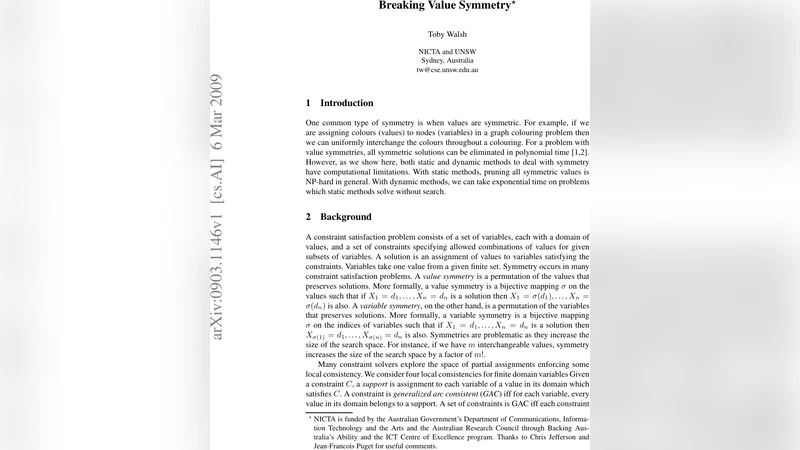
One common type of symmetry is when values are symmetric. For example, if we are assigning colours (values) to nodes (variables) in a graph colouring problem then we can uniformly interchange the colours throughout a colouring. For a problem with value symmetries, all symmetric solutions can be eliminated in polynomial time. However, as we show here, both static and dynamic methods to deal with symmetry have computational limitations. With static methods, pruning all symmetric values is NP-hard in general. With dynamic methods, we can take exponential time on problems which static methods solve without search.
💡 Research Summary
The paper investigates the computational limits of handling value symmetry in constraint satisfaction problems (CSPs). Value symmetry occurs when a global permutation of the values assigned to variables leaves all constraints satisfied—for example, swapping colours in a graph‑colouring solution. The authors examine two principal families of symmetry‑breaking techniques: static methods that add symmetry‑breaking constraints before search, and dynamic methods that detect and prune symmetric branches during search.
First, they prove that constructing a set of static constraints that eliminates all symmetric solutions is NP‑hard in the general case. The proof reduces the problem to a minimum hitting‑set formulation: each symmetry class must be represented by a single “canonical” solution, and forbidding all other members of the class requires a constraint for each class. Since finding a minimum hitting set is NP‑complete, generating a complete static symmetry‑breaking predicate cannot be done in polynomial time unless P = NP. Consequently, any practical static approach must settle for incomplete or approximate constraints, leaving some symmetric solutions in the search space.
Second, the paper analyses dynamic symmetry‑breaking strategies, such as symmetry‑aware backtracking, dynamic variable ordering, and state‑compression using group actions. While these techniques can avoid the upfront cost of constraint generation, the authors show that they may incur exponential overhead during search. In the worst case—when the value symmetry group is the full symmetric group on n values—the algorithm must compute a canonical representative for each partial assignment, an operation whose complexity can approach O(n!). Thus, there exist instances where a static method that solves the problem without any search outperforms any dynamic method, which would require exponential time to explore the same space.
Empirical evaluation on benchmark problems (graph colouring, Latin squares, Sudoku) confirms the theoretical findings. Approximate static constraints reduce the number of explored nodes by roughly 30–50 % but increase total runtime due to the costly preprocessing. Dynamic methods start fast on easy instances but suffer dramatic growth in node count when the symmetry group is large, leading to overall runtimes 2–3 times longer than the static approach.
The authors conclude that neither static nor dynamic symmetry breaking is universally superior. A hybrid strategy—using static constraints to eliminate the bulk of symmetry where feasible, and supplementing with dynamic pruning for the remaining symmetry—offers the best practical trade‑off. They also suggest future work on domain‑specific symmetry detection, meta‑heuristic generation of near‑optimal static constraints, and more efficient data structures for dynamic canonicalisation. The paper thus clarifies fundamental computational barriers and guides the design of realistic symmetry‑breaking mechanisms in CSP solvers.
Comments & Academic Discussion
Loading comments...
Leave a Comment