A^1-homotopy groups, excision, and solvable quotients
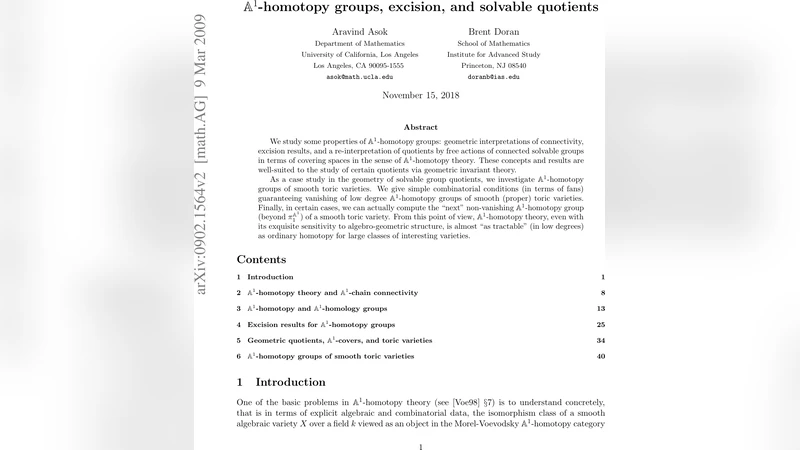
We study some properties of A^1-homotopy groups: geometric interpretations of connectivity, excision results, and a re-interpretation of quotients by free actions of connected solvable groups in terms of covering spaces in the sense of A^1-homotopy theory. These concepts and results are well-suited to the study of certain quotients via geometric invariant theory. As a case study in the geometry of solvable group quotients, we investigate A^1-homotopy groups of smooth toric varieties. We give simple combinatorial conditions (in terms of fans) guaranteeing vanishing of low degree A^1-homotopy groups of smooth (proper) toric varieties. Finally, in certain cases, we can actually compute the “next” non-vanishing A^1-homotopy group (beyond \pi_1^{A^1}) of a smooth toric variety. From this point of view, A^1-homotopy theory, even with its exquisite sensitivity to algebro-geometric structure, is almost “as tractable” (in low degrees) as ordinary homotopy for large classes of interesting varieties.
💡 Research Summary
The paper develops a suite of new results concerning A¹‑homotopy groups (π_i^{A¹}) that bridge algebraic geometry and homotopy theory. After a concise review of A¹‑homotopy theory, the authors first give a geometric interpretation of connectivity: a smooth scheme X is A¹‑connected (π_0^{A¹}(X)=∗) precisely when any two points can be joined by an A¹‑path, mirroring classical path‑connectedness.
The second major contribution is an excision theorem adapted to the A¹‑setting. Using the Nisnevich topology and A¹‑invariance, they prove that for an open immersion U⊂X and a closed subset Z⊂U with codim Z>i, the relative groups satisfy π_i^{A¹}(U, U∖Z)≅π_i^{A¹}(X, X∖Z). This result allows one to replace a complicated ambient space by a simpler open neighbourhood when computing low‑degree A¹‑homotopy groups, just as classical excision does in ordinary topology.
The core novelty lies in the reinterpretation of quotients by free actions of connected solvable (i.e., “solvable”) algebraic groups G. When G acts freely on a smooth scheme X, the quotient map X→X/G is shown to be an A¹‑covering space with classifying space BG. Consequently, the fundamental A¹‑group fits into the exact sequence π_1^{A¹}(X)→π_1^{A¹}(X/G)→G, and higher groups are the G‑invariant parts of π_i^{A¹}(X). This perspective simplifies the study of geometric invariant theory (GIT) quotients: the often intricate stack‑theoretic structure collapses to a covering‑space problem in A¹‑homotopy.
The authors then apply this framework to smooth toric varieties, which are completely described by a fan Σ. They give purely combinatorial criteria on Σ guaranteeing the vanishing of low‑degree A¹‑homotopy groups. Specifically, if Σ contains all one‑dimensional cones and any two such cones intersect in codimension at least two, then for an n‑dimensional proper smooth toric variety X_Σ one has π_i^{A¹}(X_Σ)=0 for i≤n−2. Moreover, under the same hypotheses they compute the first potentially non‑zero group π_{n−1}^{A¹}(X_Σ) explicitly in terms of the combinatorial homology of Σ (essentially the homotopy of the associated simplicial complex). This mirrors the classical computation of higher homotopy groups of toric manifolds but retains the delicate dependence on the base field (e.g., Milnor‑Witt K‑theory appears).
Concrete examples illustrate the theory. For projective space ℙⁿ they recover the known result π_1^{A¹}(ℙⁿ)=0 and identify π_2^{A¹}(ℙⁿ) with the Milnor‑Witt K‑group K_2^{MW}(k). For Hirzebruch surfaces and higher‑dimensional toric varieties with non‑trivial fan combinatorics they exhibit non‑vanishing π_2^{A¹} or π_{n−1}^{A¹}, showing that A¹‑homotopy detects subtle algebraic features invisible to ordinary homotopy.
In the concluding section the authors emphasize that A¹‑homotopy groups provide a tractable invariant for a broad class of varieties: low‑degree groups behave almost like classical homotopy groups, while higher groups encode arithmetic information about the ground field. They outline future directions, including extensions to non‑solvable group actions, deeper connections with motivic cohomology and higher K‑theory, and systematic computations of A¹‑homotopy groups for more general GIT quotients. Overall, the work demonstrates that A¹‑homotopy theory, despite its sensitivity to algebraic structure, can be as computationally accessible as ordinary homotopy in many geometrically interesting situations.
Comments & Academic Discussion
Loading comments...
Leave a Comment