Science with a lunar low-frequency array: from the dark ages of the Universe to nearby exoplanets
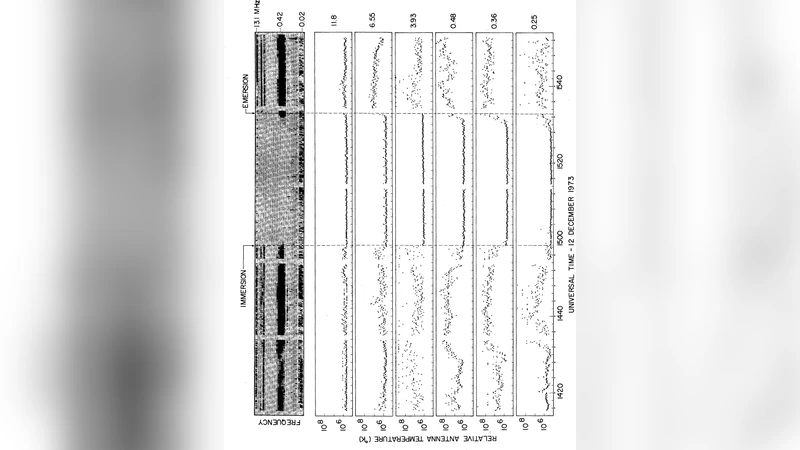
Low-frequency radio astronomy is limited by severe ionospheric distortions below 50 MHz and complete reflection of radio waves below 10-30 MHz. Shielding of man-made interference from long-range radio broadcasts, strong natural radio emission from the Earth’s aurora, and the need for setting up a large distributed antenna array make the lunar far side a supreme location for a low-frequency radio array. A number of new scientific drivers for such an array, such as the study of the dark ages and epoch of reionization, exoplanets, and ultra-high energy cosmic rays, have emerged and need to be studied in greater detail. Here we review the scientific potential and requirements of these and other new scientific drivers and discuss the constraints for various lunar surface arrays. In particular we describe observability constraints imposed by the interstellar and interplanetary medium, calculate the achievable resolution, sensitivity, and confusion limit of a dipole array using general scaling laws, and apply them to various scientific questions. Whichever science is deemed most important, pathfinder arrays are needed to test the feasibility of these experiments in the not too distant future. Lunar low-frequency arrays are thus a timely option to consider, offering the potential for significant new insights into a wide range of today’s crucial scientific topics. This would open up one of the last unexplored frequency domains in the electromagnetic spectrum.
💡 Research Summary
**
Low‑frequency radio astronomy below 50 MHz is fundamentally limited on Earth by the ionosphere, which refracts, absorbs, and ultimately reflects radio waves below about 10–30 MHz. In addition, terrestrial radio‑frequency interference (RFI) from broadcast stations, military radars, and natural auroral emissions creates a noise floor that dwarfs the faint cosmological signals of interest. The far side of the Moon offers a uniquely pristine environment: it is shielded from Earth‑originated RFI, free from ionospheric distortion, and its cold, vacuum surface provides a low system temperature. Consequently, it is the only realistic site where the “dark ages” 21 cm line (redshifts z ≈ 30–100) and the subsequent epoch of reionization (EoR, z ≈ 6–12) can be observed directly, as well as a host of other low‑frequency phenomena such as magnetospheric radio bursts from nearby exoplanets and radio signatures of ultra‑high‑energy cosmic rays (UHECRs).
The paper develops a set of scaling laws that link array geometry, antenna effective area, observing bandwidth, integration time, and system temperature to three key performance metrics: angular resolution (θ ≈ λ/D), sensitivity (σ ≈ k T_sys/(A_eff √(Δν t_int))), and confusion limit (the flux density at which source crowding dominates). Using these relations, the authors evaluate a range of plausible lunar array configurations, from modest 1 km² pathfinders to ambitious 300 km‑diameter “cosmic dawn” instruments. They find that a 300 km array, operating at 15 MHz with a total effective collecting area of ~10⁶ m², could reach sub‑mJy sensitivities after several thousand hours of integration, sufficient to detect the global 21 cm absorption trough predicted for the dark ages. For the EoR, a 100 km array would already achieve the required sensitivity and angular resolution (≈5 arcmin) to map large‑scale ionization structures.
Exoplanetary magnetospheric emission is another high‑impact science case. Theoretical models predict cyclotron‑maser emission in the 10–30 MHz band with flux densities of 1–10 mJy for nearby (≤10 pc) hot Jupiters. The authors show that a 30 km array, combined with 10 h of integration per target, can detect such signals, opening a new window on planetary magnetic fields, interior dynamics, and star‑planet interactions. For UHECRs, the radio pulse generated when a >10²⁰ eV particle strikes the lunar regolith propagates across the lunar surface and can be captured by a distributed network of dipoles covering >1000 km². Detecting these rare events requires a self‑deploying swarm of autonomous rovers equipped with low‑power transmitters and a real‑time data‑fusion hub, a concept the paper sketches in detail.
Technical challenges are addressed comprehensively. Power must be supplied by a combination of solar panels, high‑efficiency batteries, and possibly small radio‑isotope generators to survive the two‑week lunar night. Data downlink is envisioned via laser communication to an orbiting relay satellite, avoiding the bandwidth bottlenecks of traditional RF links. The harsh lunar environment—extreme temperature swings, abrasive regolith, and micrometeoroid impacts—necessitates ruggedized dipole designs, dust‑mitigation coatings, and fault‑tolerant networking. The authors argue that incremental development is essential: a “Lunar Pathfinder Array” (LPA) of ~1 km² would validate system temperature estimates, quantify residual RFI from the Moon’s own plasma environment, and test autonomous deployment algorithms. Results from the LPA would feed directly into cost and risk models for the full‑scale science array.
In summary, the paper makes a compelling case that a low‑frequency radio array on the lunar far side can uniquely address several of the most profound questions in modern astrophysics: how the first stars and galaxies formed, whether exoplanets possess protective magnetic fields, and how the highest‑energy particles in the Universe are generated. By grounding the scientific ambitions in realistic engineering analyses and proposing a clear, staged roadmap—from pathfinder missions to a 300 km “cosmic‑dawn” instrument—the authors demonstrate that the technical hurdles are surmountable within the next two decades. The lunar low‑frequency array thus represents a timely, high‑impact opportunity to open the last largely unexplored window of the electromagnetic spectrum.
Comments & Academic Discussion
Loading comments...
Leave a Comment