Equivariant K-theory of finite dimensional real vector spaces
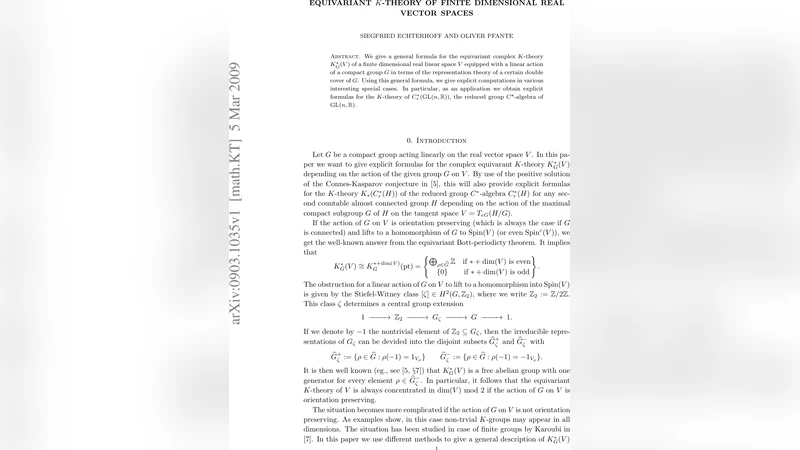
We give a general formula for the equivariant complex $K$-theory $K_G^(V)$ of a finite dimensional real linear space $V$ equipped with a linear action of a compact group $G$ in terms of the representation theory of a certain double cover of $G$. Using this general formula, we give explicit computations in various interesting special cases. In particular, as an application we obtain explicit formulas for the $K$-theory of $C_r^(GL(n,\RR))$, the reduced group C*-algebra of $GL(n,\RR)$.
💡 Research Summary
The paper establishes a complete and explicit description of the equivariant complex K‑theory (K_G^(V)) for a finite‑dimensional real vector space (V) equipped with a linear action of a compact group (G). The central idea is to replace the original group (G) by a canonical double cover (\widetilde G) (a central (\mathbb Z_2)‑extension) and to express (K_G^(V)) in terms of the graded representation ring of (\widetilde G).
The authors begin by recalling that, after complexifying (V), the (G)‑action becomes a complex representation. However, the Clifford algebra (C\ell(V)) attached to the quadratic form on (V) naturally carries a (\mathbb Z_2)‑grading, and its spinor module is a projective representation of (G). Lifting this projective representation yields a genuine linear representation of a double cover (\widetilde G). Consequently, the equivariant K‑theory of (V) can be identified with the K‑theory of the graded (C^*)-algebra (C\ell(V)\rtimes G), which in turn is isomorphic to the graded representation ring (R_{\mathbb Z_2}(\widetilde G)).
The main theorem states that, writing (R_{\mathrm{even}}(\widetilde G)) and (R_{\mathrm{odd}}(\widetilde G)) for the subgroups generated by even‑ and odd‑graded virtual representations, one has
\
Comments & Academic Discussion
Loading comments...
Leave a Comment