The Suslinian number and other cardinal invariants of continua
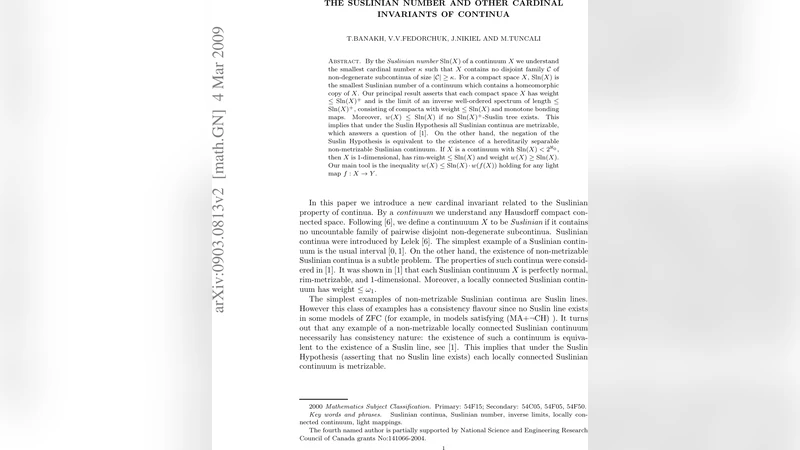
By the {\em Suslinian number} $\Sln(X)$ of a continuum $X$ we understand the smallest cardinal number $\kappa$ such that $X$ contains no disjoint family $\C$ of non-degenerate subcontinua of size $|\C|\ge\kappa$. For a compact space $X$, $\Sln(X)$ is the smallest Suslinian number of a continuum which contains a homeomorphic copy of $X$. Our principal result asserts that each compact space $X$ has weight $\le\Sln(X)^+$ and is the limit of an inverse well-ordered spectrum of length $\le \Sln(X)^+$, consisting of compacta with weight $\le\Sln(X)$ and monotone bonding maps. Moreover, $w(X)\le\Sln(X)$ if no $\Sln(X)^+$-Suslin tree exists. This implies that under the Suslin Hypothesis all Suslinian continua are metrizable, which answers a question of \cite{DNTTT1}. On the other hand, the negation of the Suslin Hypothesis is equivalent to the existence of a hereditarily separable non-metrizable Suslinian continuum. If $X$ is a continuum with $\Sln(X)<2^{\aleph_0}$, then $X$ is 1-dimensional, has rim-weight $\le\Sln(X)$ and weight $w(X)\ge\Sln(X)$. Our main tool is the inequality $w(X)\le\Sln(X)\cdot w(f(X))$ holding for any light map $f:X\to Y$.
💡 Research Summary
The paper introduces a new cardinal invariant for continua, the Suslinian number Sln (X), defined as the smallest cardinal κ such that X contains no disjoint family C of non‑degenerate subcontinua with |C| ≥ κ. For a compact space X, Sln (X) is the minimal Suslinian number among all continua that embed a homeomorphic copy of X. The authors’ principal achievement is a structural theorem: every compact space X satisfies weight w(X) ≤ Sln (X)^+, and X can be represented as the inverse limit of a well‑ordered spectrum of length ≤ Sln (X)^+. Each factor in the spectrum is a compactum of weight ≤ Sln (X) and the bonding maps are monotone.
A key technical tool is the inequality w(X) ≤ Sln (X)·w(f(X)) for any light map f : X → Y (a continuous map whose point‑preimages are zero‑dimensional). This inequality allows the authors to control the weight of X by the weight of its image under a light map and the Suslinian number of X. Using this, they prove that if there is no Sln (X)^+‑Suslin tree, then in fact w(X) ≤ Sln (X).
The set‑theoretic consequences are striking. Under the Suslin Hypothesis (SH)—which asserts that no ℵ₁‑Suslin tree exists—every Suslinian continuum (i.e., Sln ≤ ℵ₀) must be metrizable. This resolves a question posed in earlier work (DNTTT1). Conversely, the failure of SH is equivalent to the existence of a hereditarily separable, non‑metrizable Suslinian continuum. Thus the metrizability of Suslinian continua is exactly tied to the existence of Suslin trees.
Further, the authors examine the case where Sln (X) < 2^{ℵ₀}. They show that such a continuum X must be one‑dimensional, its rim‑weight does not exceed Sln (X), and its weight satisfies w(X) ≥ Sln (X). Hence a small Suslinian number forces strong dimensional and weight restrictions.
The paper proceeds as follows. After motivating the definition of Sln and reviewing relevant background (Suslinian continua, cardinal invariants, light maps), Section 2 establishes the fundamental inequality w(X) ≤ Sln (X)·w(f(X)) for light maps, using classical dimension theory and properties of monotone maps. Section 3 constructs the inverse spectrum: starting from X, a transfinite recursion builds a chain of monotone quotients whose fibers are “small” (weight ≤ Sln (X)). The recursion stops after ≤ Sln (X)^+ steps because at each stage the Suslinian number drops or the weight stabilizes. The limit of this spectrum is homeomorphic to X, yielding the main structural theorem.
Section 4 translates the topological results into set‑theoretic corollaries. Assuming SH, any Suslinian continuum has Sln ≤ ℵ₀ and therefore weight ≤ ℵ₀, i.e., it is metrizable. The authors also give an explicit construction (via a Suslin tree) of a non‑metrizable Suslinian continuum when SH fails, showing that the converse holds. Section 5 deals with the “small Suslinian number” regime (Sln < 2^{ℵ₀}), proving the 1‑dimensionality and rim‑weight bounds, and discussing how these results interact with classical invariants such as cellularity and π‑weight.
The paper concludes with several open problems: (1) determining precise relationships between Sln and other cardinal invariants (e.g., cellularity, π‑weight); (2) exploring whether the inequality w(X) ≤ Sln (X)·w(f(X)) can be sharpened for broader classes of maps; (3) investigating the behavior of Sln in higher‑dimensional continua and its interaction with homological properties. Overall, the work provides a deep synthesis of continuum theory, cardinal invariants, and set‑theoretic topology, opening new avenues for understanding how combinatorial set theory influences the fine structure of compact spaces.
Comments & Academic Discussion
Loading comments...
Leave a Comment