Gamma-Ray Line Studies of Nuclei in the Cosmos
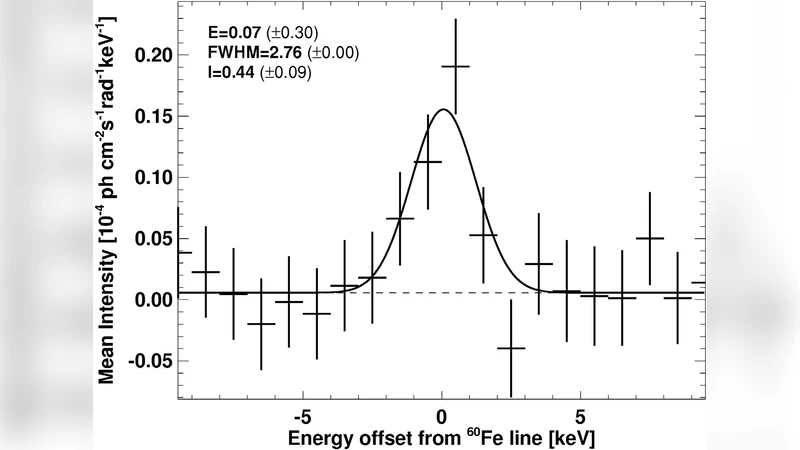
Gamma-ray line studies are capable of identifying radioactive tracer isotopes generated in cosmic nucleosynthesis events. Pioneering measurements were made 30 years ago with HEAO-C1, detecting the first interstellar gamma-ray line from 26Al, then with SMM and numerous balloon experiments, among their results the detection of radioactivity from supernova SN1987A, and with the Compton Observatory and its OSSE and COMPTEL instruments in 1991-2000, which performed sky surveys in 26Al and 511 keV annihilation emission and the detection of the Cas A supernova remnant in 44Ti radioactivity. The SPI high-resolution Ge spectrometer on INTEGRAL was launched in 2002 and continues to collect data on astrophysically-important gamma-ray lines from decays of 44Ti, 26Al, 60Fe, and positron annihilation. 44Ti decay lines from Cas A have been observed with both INTEGRAL telescopes, and constrain the expansion dynamics of the ejecta. The lack of other 44Ti remnants is a mystery. The 26Al gamma-ray line is now measured throughout the Galaxy, tracing the kinematics of interstellar gas near massive stars, and highlighting special regions of interest therein, such as groups of massive stars in Cygnus and even more nearby regions. The detection of 60Fe radioactivity lines at the level of 15% of the 26Al flux presents a challenge both for observers and models. Positron annihilation emission from the nucleosynthesis regions within the Galactic plane appears to be mainly from 26Al and other supernova radioactivity, while the bulge’s positron annihilation brightness remains puzzling.
💡 Research Summary
Gamma‑ray line astronomy provides a uniquely direct probe of radioactive isotopes that are forged in cosmic nucleosynthesis events. Because the photons are emitted at well‑defined energies during the decay of nuclei such as ¹⁶Al, ⁴⁴Ti, ⁶⁰Fe and the positron‑annihilation line at 511 keV, they travel through the interstellar medium essentially unattenuated, allowing us to map the sites of recent nucleosynthesis across the entire Galaxy. The paper reviews the three‑decade evolution of this field, from the first detection of the 1.809 MeV ¹⁶Al line by HEAO‑C1 in 1978, through the pioneering SMM and balloon experiments that captured the ⁵⁶Co/⁵⁷Co lines from SN 1987A, to the all‑sky surveys performed by COMPTEL and OSSE on the Compton Gamma‑Ray Observatory (1991‑2000). Those missions established the large‑scale distribution of ¹⁶Al and the 511 keV annihilation radiation, and revealed the first Galactic supernova remnant (Cas A) emitting the ⁴⁴Ti decay lines.
Since 2002 the high‑resolution Ge spectrometer SPI aboard INTEGRAL has been the work‑horse for gamma‑ray line studies. Its observations have confirmed the ⁴⁴Ti lines from Cas A with both SPI and the coded‑mask imager IBIS, allowing a measurement of the line width and Doppler shift that constrain the ejecta expansion velocity (≈ 5 000 km s⁻¹) and reveal asymmetries in the explosion. Strikingly, no other ⁴⁴Ti‑bright remnants have been found, despite model predictions that a few such objects should be visible in the Galaxy. This “missing ⁴⁴Ti” problem points to a strong dependence of ⁴⁴Ti production on the details of the supernova mechanism—such as jet‑driven explosions, large‑scale convection, rotation, and magnetic fields—rather than a simple, isotropic yield.
The ¹⁶Al line is now mapped across the Milky Way, showing a smooth Galactic‑disk component plus pronounced enhancements in massive‑star complexes such as Cygnus, Carina, and Orion. Small shifts in the line centroid (± 0.2 keV) trace the kinematics of the interstellar gas that is being stirred by stellar winds and supernova shocks, providing an independent measurement of Galactic rotation and of localized outflows. The detection of ⁶⁰Fe at 1.173 MeV and 1.332 MeV, with a flux about 15 % of that of ¹⁶Al, offers a stringent test of massive‑star nucleosynthesis. The observed ⁶⁰Fe/¹⁶Al ratio is lower than most theoretical predictions, implying that key nuclear reaction rates (e.g., ⁵⁹Fe(n,γ)⁶⁰Fe) or the treatment of internal mixing in massive stars need revision.
Positron annihilation at 511 keV is now known to be dominated in the Galactic plane by the decay of radioactive isotopes (mainly ¹⁶Al, but also ⁴⁴Ti and ⁶⁰Fe). However, the bulge exhibits a surprisingly bright, roughly spherical annihilation glow that cannot be explained by the relatively low star‑formation activity there. Proposed explanations include dark‑matter particle decay or annihilation, past outbursts of the central supermassive black hole, a population of low‑mass X‑ray binaries or microquasars, or transport of positrons from the disk into the bulge. None of these scenarios has yet achieved consensus, making the bulge positron excess one of the most compelling open questions in high‑energy astrophysics.
The paper also discusses instrumental limitations and future prospects. While SPI’s energy resolution (~2 keV) and sensitivity have enabled the detections described above, deeper surveys for faint ⁴⁴Ti remnants and more precise ⁶⁰Fe measurements will require next‑generation missions such as AMEGO or e‑ASTROGAM, which promise broader energy coverage and order‑of‑magnitude improvements in sensitivity. Complementary laboratory work to refine neutron‑capture cross sections on iron‑group nuclei, together with three‑dimensional stellar evolution and supernova simulations, will be essential to reconcile observations with theory.
In summary, gamma‑ray line astronomy has transformed our understanding of where and how the elements are forged, providing direct, quantitative constraints on massive‑star yields, supernova explosion dynamics, and Galactic gas flows. Yet the scarcity of observable ⁴⁴Ti sources, the tension in the ⁶⁰Fe/¹⁶Al ratio, and the enigmatic bulge positron annihilation signal highlight the need for improved instrumentation, refined nuclear physics inputs, and more sophisticated astrophysical modeling. The continued synergy between observations, experiments, and theory will be crucial for resolving these outstanding puzzles and for fully exploiting gamma‑ray lines as tracers of cosmic nucleosynthesis.
Comments & Academic Discussion
Loading comments...
Leave a Comment