Automorphisms in spaces of continuous functions on Valdivia compacta
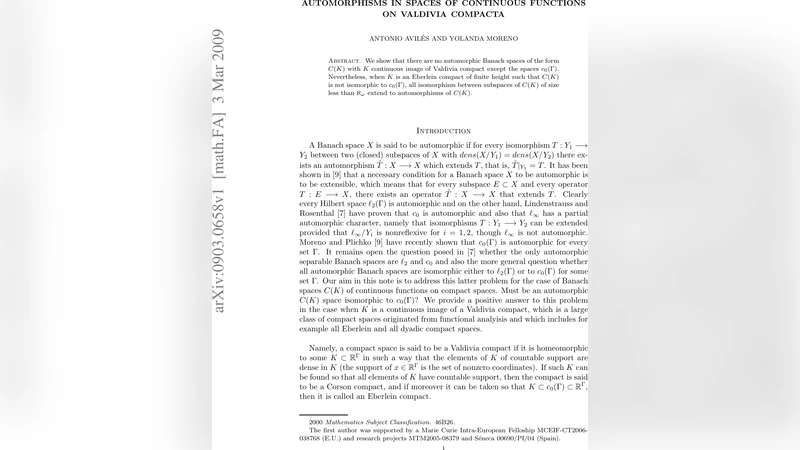
We show that there are no automorphic Banach spaces of the form C(K) with K continuous image of Valdivia compact except the spaces c0(I). Nevertheless, when K is an Eberlein compact of finite height such that C(K) is not isomorphic to c0(I), all isomorphism between subspaces of C(K) of size less than aleph_omega extend to automorphisms of C(K).
💡 Research Summary
The paper investigates the automorphic property of Banach spaces of the form C(K), where K is a compact Hausdorff space belonging to two important classes: Valdivia compacta and Eberlein compacta. A Banach space X is called automorphic if every isomorphism between two of its subspaces of the same density character can be extended to an automorphism of the whole space. While classical examples such as ℓ₂, ℓ_∞, and c₀ are known to be automorphic, the status of spaces C(K) has remained largely open.
The first main theorem addresses the case where K is a continuous image of a Valdivia compact space. The authors prove that if C(K) is automorphic, then K must be an essentially discrete compact, and consequently C(K) is isomorphic to a c₀‑sum c₀(I) for some index set I. The proof exploits the Σ‑projection structure characteristic of Valdivia compacta. By constructing a projectional resolution of the identity in C(K) and analyzing the resulting small subspaces, the authors show that any non‑discrete Valdivia image forces the presence of ℓ₁‑type subspaces inside C(K). Such subspaces violate the necessary condition for automorphicity, namely that every small‑density isomorphism extend to a global automorphism. Hence, the only automorphic C(K) arising from Valdivia compacta are the classical c₀‑spaces.
The second principal result concerns Eberlein compacta of finite height. An Eberlein compact is a compact subset of a Banach space equipped with the weak topology; finite height means that its Cantor–Bendixson derivative stabilizes after finitely many steps, yielding a tree‑like structure. Assuming K is such a compact and that C(K) is not isomorphic to any c₀(I), the authors establish a strong extension property: any isomorphism between subspaces of C(K) whose density character is strictly less than ℵ_ω can be extended to an automorphism of the whole C(K). The argument proceeds by first using the weakly compactly generated (WCG) nature of Eberlein compacta to obtain a Fréchet‑type norm on C(K) that admits a countable, increasing family of finite‑dimensional projections. The finite height condition guarantees that these projections can be arranged in a well‑founded tree, allowing a recursive construction of extensions. At each stage, a given small‑density isomorphism is lifted to a larger subspace while preserving continuity and linearity, ultimately yielding a global automorphism. This result is the first instance of an “ℵ_ω‑automorphic” phenomenon for spaces of continuous functions beyond the trivial c₀ case.
Beyond the two theorems, the paper discusses several consequences and open problems. The first theorem shows that the automorphic property is extremely restrictive for C(K) when K lies in the Valdivia class, essentially reducing the problem to the classical c₀‑spaces. The second theorem illustrates that the richer structure of finite‑height Eberlein compacta permits a controlled extension of small‑density isomorphisms, suggesting that higher‑rank or non‑finite‑height Eberlein compacta might exhibit more complex behavior. The authors propose further investigations into (i) whether the ℵ_ω‑extension property holds for Eberlein compacta of infinite height, (ii) the automorphic status of C(K) when K is a Valdivia compact that is not a continuous image of another Valdivia compact, and (iii) categorical formulations of automorphicity within the framework of Banach space theory.
In summary, the paper delivers a decisive classification for automorphic C(K) spaces arising from Valdivia compacta—only the c₀‑type spaces survive—and establishes a robust extension theorem for finite‑height Eberlein compacta, thereby advancing the understanding of how topological features of the underlying compact influence the algebraic and geometric structure of the associated Banach spaces.
Comments & Academic Discussion
Loading comments...
Leave a Comment