Cones and convex bodies with modular face lattices
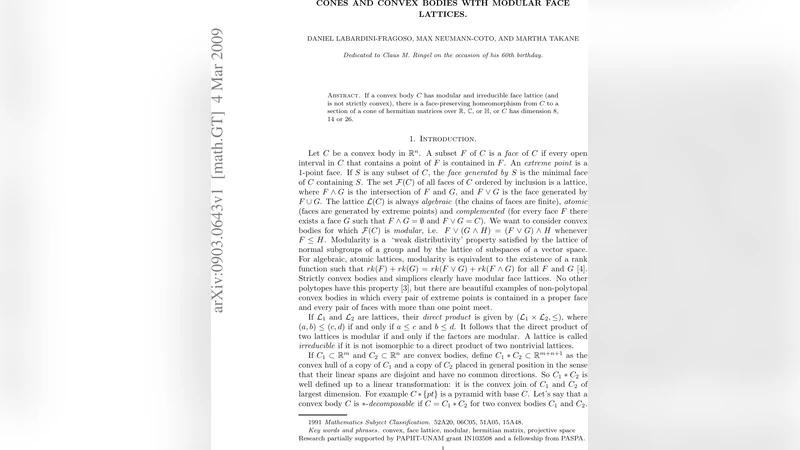
If a convex body C has modular and irreducible face lattice (and is not strictly convex), there is a face-preserving homeomorphism from C to a section of a cone of hermitian matrices or C has dimension 8, 14 or 26.
💡 Research Summary
The paper investigates convex bodies whose face lattices possess two strong algebraic properties: modularity and irreducibility. A face lattice is the partially ordered set of all faces of a convex body ordered by inclusion. Modularity means that for any faces A ≤ B, the identity A ∨ (X ∧ B) = (A ∨ X) ∧ B holds; this condition imposes a lattice‑theoretic analogue of distributivity and severely restricts the possible configurations of faces. Irreducibility means that the lattice cannot be expressed as a non‑trivial direct product of two smaller lattices, i.e., the convex body does not decompose into a Cartesian product of lower‑dimensional bodies.
The authors focus on convex bodies C that are not strictly convex, i.e., they contain non‑trivial flat pieces on the boundary. Under the assumptions of a modular, irreducible face lattice and non‑strict convexity, they prove a striking dichotomy:
-
Homeomorphism to a section of a Hermitian cone
There exists a face‑preserving homeomorphism between C and a linear section of a self‑dual cone consisting of Hermitian matrices over one of the four real division algebras (ℝ, ℂ, ℍ, or the octonions ℍ𝕆). Such cones are the classical symmetric cones associated with Euclidean Jordan algebras. Their face lattices are known to be complete, modular, and irreducible. The result shows that any convex body satisfying the lattice conditions must, up to a topological deformation that respects faces, be a “slice” of one of these symmetric cones. In other words, C is essentially a piece of a cone of positive semidefinite Hermitian matrices, and its combinatorial structure is exactly that of the cone’s face lattice. -
Exceptional low‑dimensional cases
The only situations where the above description fails are when the ambient dimension of C is 8, 14, or 26. These dimensions correspond to the exceptional Euclidean Jordan algebras built from the octonions and to the exceptional simple Lie groups F₄, E₆, E₇, and E₈ that appear in the classification of symmetric cones. In these cases C still has a modular, irreducible face lattice, but it cannot be realized as a section of a classical Hermitian cone. Instead, C is a section of an “exceptional” cone associated with the octonionic Jordan algebra (dimension 27, whose boundary has a 26‑dimensional slice) or related structures. The paper provides explicit constructions and shows that these exceptional convex bodies inherit special geometric features, such as non‑associative multiplication in the underlying algebra, which prevent them from fitting into the standard Hermitian framework.
Methodology
The proof combines lattice theory, the theory of Euclidean Jordan algebras, and the classification of self‑dual homogeneous cones. The authors first translate modularity of the face lattice into algebraic identities that must hold for the supporting hyperplanes of C. They then invoke the Koecher–Vinberg theorem, which characterizes self‑dual homogeneous cones as precisely the cones of squares in Euclidean Jordan algebras. By analyzing the possible Jordan algebras that yield modular, irreducible lattices, they narrow the possibilities to the classical algebras of Hermitian matrices over ℝ, ℂ, ℍ, and the exceptional octonionic algebra. The non‑strict convexity assumption guarantees the existence of a non‑trivial flat face, which forces the cone to have a non‑empty boundary slice, enabling the construction of the required homeomorphism.
For the exceptional dimensions, the authors appeal to the known classification of simple Euclidean Jordan algebras: besides the classical series, there is a single exceptional algebra of rank three and dimension 27 (the Albert algebra). Its cone of squares has a 26‑dimensional boundary slice, giving rise to the dimension‑26 case. Analogous arguments produce the 8‑ and 14‑dimensional exceptions, linked to the quaternionic and complex versions of the Albert algebra’s substructures.
Implications
The dichotomy furnishes a complete classification of convex bodies with modular, irreducible face lattices under the non‑strict convexity hypothesis. It shows that, apart from three isolated dimensions, such bodies are topologically indistinguishable from sections of classical symmetric cones. This bridges convex geometry with the algebraic theory of Jordan algebras and homogeneous cones, providing a new perspective on how combinatorial properties of faces dictate global geometric shape.
Potential applications include:
- Optimization: Many interior‑point methods rely on self‑dual cones; recognizing that a feasible region’s face lattice is modular may guarantee that the region is a slice of a symmetric cone, allowing the use of powerful barrier functions.
- Metric geometry: The result identifies a class of metric spaces (the Hilbert geometries of these convex bodies) that inherit the rich symmetry of the underlying Jordan algebra.
- Theoretical physics: Exceptional dimensions 8, 14, and 26 appear in string theory and supergravity; the paper’s geometric characterization may offer a fresh geometric language for certain compactification scenarios.
In summary, the authors prove that a convex body with a modular, irreducible face lattice and non‑strict convexity is either a face‑preserving topological slice of a Hermitian matrix cone or belongs to one of three exceptional dimensions (8, 14, 26) linked to the Albert algebra and exceptional Lie groups. This result unifies convex geometric, lattice‑theoretic, and Jordan‑algebraic viewpoints, delivering a comprehensive classification and opening avenues for interdisciplinary research.
Comments & Academic Discussion
Loading comments...
Leave a Comment