We consider a charged Brownian particle in an asymmetric bistable electrostatic potential biased by an externally applied or induced time periodic electric field. While the amplitude of the applied field is independent of frequency, that of the one induced by a magnetic field is. Borrowing from protein channel terminology, we define the open probability as the relative time the Brownian particle spends on a prescribed side of the potential barrier. We show that while there is no peak in the open probability as the frequency of the applied field and the bias (depolarization) of the potential are varied, there is a narrow range of low frequencies of the induced field and a narrow range of the low bias of the potential where the open probability peaks. This manifestation of stochastic resonance is consistent with experimental results on the voltage gated Iks and KCNQ1 potassium channels of biological membranes and on cardiac myocytes.
Deep Dive into Stochastic resonance with applied and induced fields: the case of voltage-gated ion channels.
We consider a charged Brownian particle in an asymmetric bistable electrostatic potential biased by an externally applied or induced time periodic electric field. While the amplitude of the applied field is independent of frequency, that of the one induced by a magnetic field is. Borrowing from protein channel terminology, we define the open probability as the relative time the Brownian particle spends on a prescribed side of the potential barrier. We show that while there is no peak in the open probability as the frequency of the applied field and the bias (depolarization) of the potential are varied, there is a narrow range of low frequencies of the induced field and a narrow range of the low bias of the potential where the open probability peaks. This manifestation of stochastic resonance is consistent with experimental results on the voltage gated Iks and KCNQ1 potassium channels of biological membranes and on cardiac myocytes.
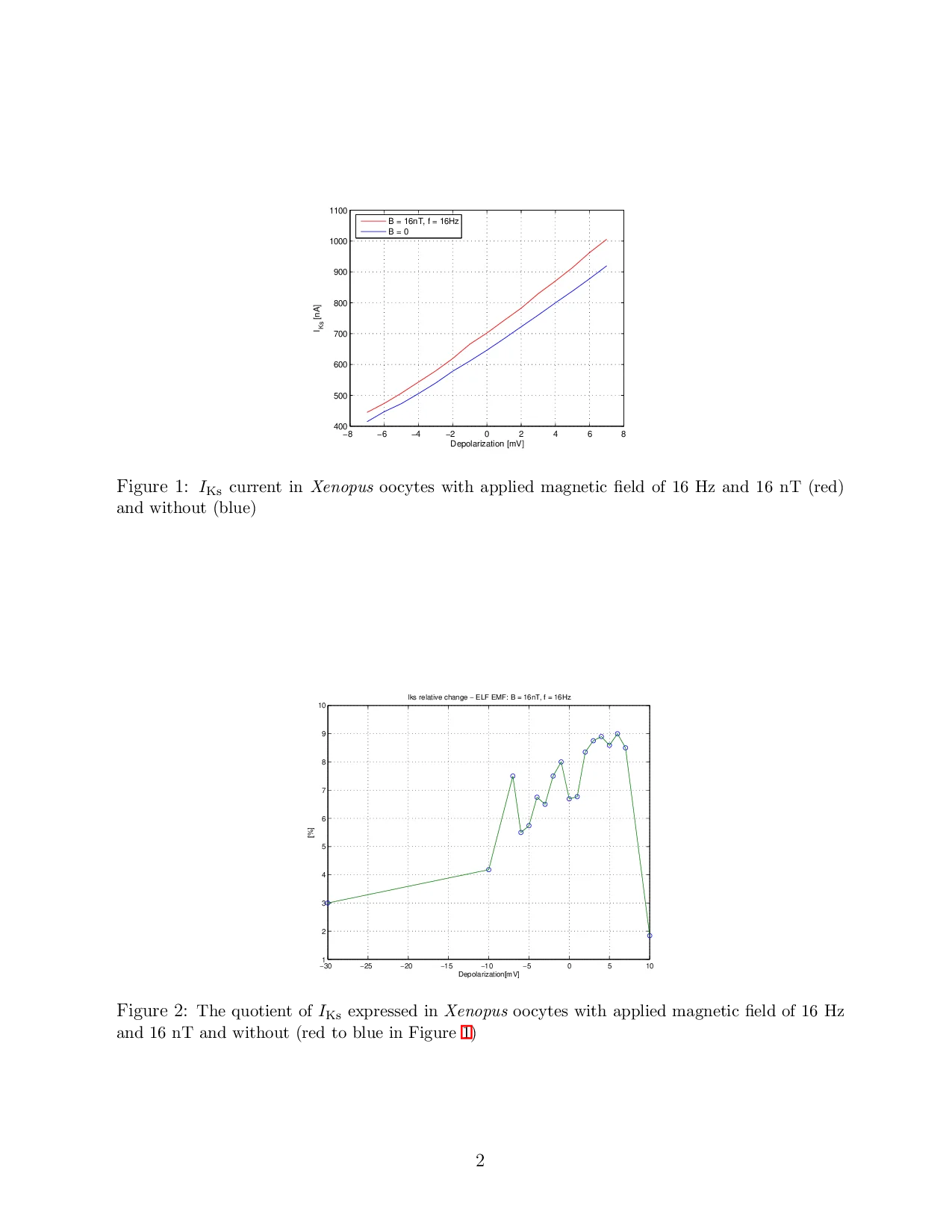
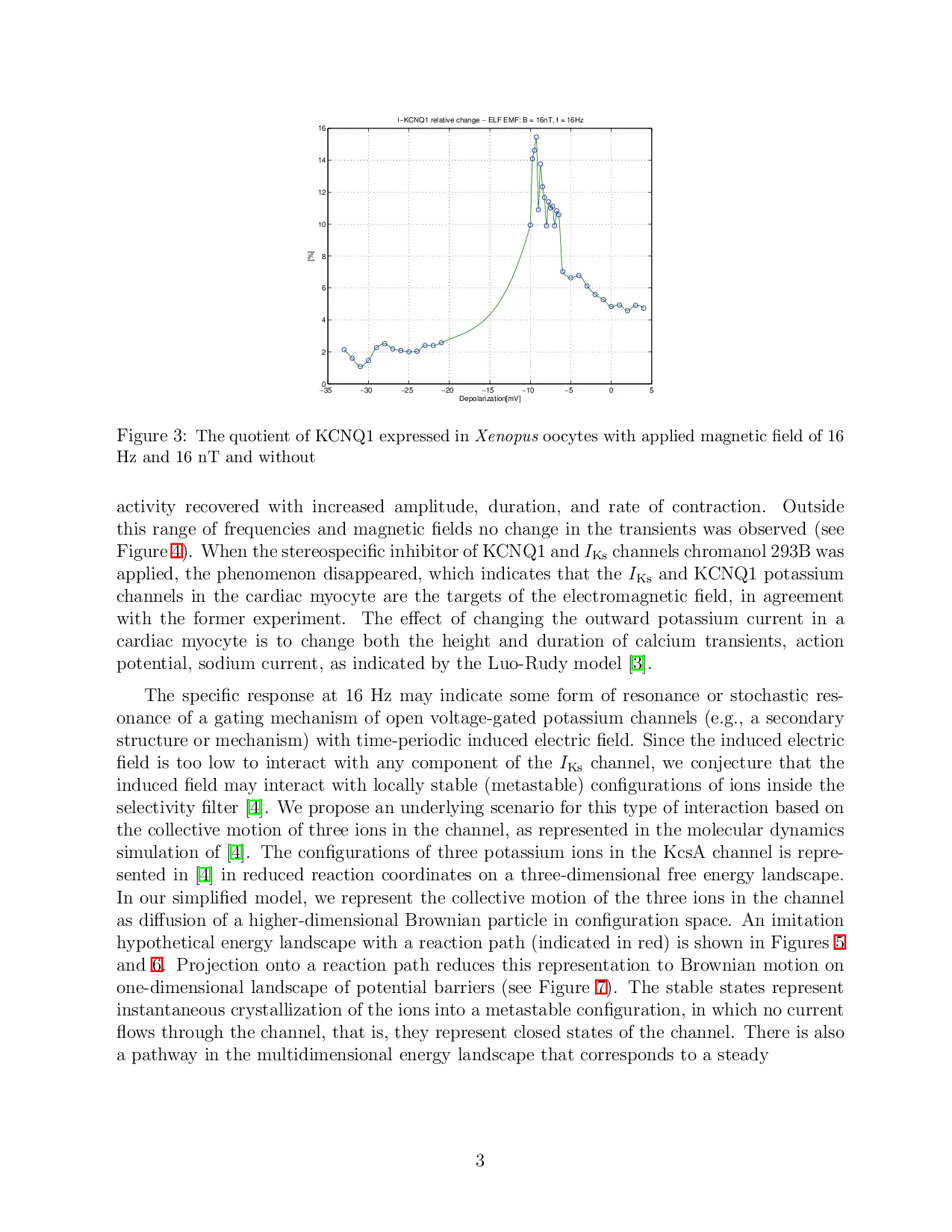
Our recent experimental findings show unusual non-thermal biological effects of a periodic electromagnetic field (EMF) of frequency 16 Hz and amplitude 16 nT (nano Tesla) on the potassium current in human I Ks and KCNQ1 channels [1]. More specifically, we expressed the I Ks channel in Xenopus oocytes and varied the membrane depolarization between -100 mV and +100 mV and measured the membrane potassium current. The current with applied EMF peaked above that without applied EMF at membrane depolarizations between 0 mV and 8 mV to a maximum of about 9% (see Figures 1 and2). A similar measurement of the potassium current in the KCNQ1 channel protein, expressed in an oocyte, gave a maximal increase of 16% at the same applied EMF and at membrane depolarizations between -10 mV and -3 mV (see Figure 3). Similar experiments with L-type calcium channels showed no response to the electromagnetic field at any frequency between 0.05 and 50 Hz.
In a related experiment [2], we applied electromagnetic fields at frequencies 15 Hz, 15.5 Hz, 16 Hz, 16.5 Hz and amplitudes of the magnetic field from below 16 pT and up to 160 nT, to neonatal rat cardiac myocytes in cell culture. In the range 16 pT -16 nT, we observed that both stimulated and spontaneous activity of the myocytes changed at frequency 16 Hz: the height and duration of cytosolic calcium transients began decreasing significantly about 2 minutes after the magnetic field was applied and kept decreasing for about 30 minutes until it stabilized at about 30% of its initial value and its width decreased to approximately 50%. About 10 minutes following cessation of the magnetic field the myocyte (spontaneous) activity recovered with increased amplitude, duration, and rate of contraction. Outside this range of frequencies and magnetic fields no change in the transients was observed (see Figure 4). When the stereospecific inhibitor of KCNQ1 and I Ks channels chromanol 293B was applied, the phenomenon disappeared, which indicates that the I Ks and KCNQ1 potassium channels in the cardiac myocyte are the targets of the electromagnetic field, in agreement with the former experiment. The effect of changing the outward potassium current in a cardiac myocyte is to change both the height and duration of calcium transients, action potential, sodium current, as indicated by the Luo-Rudy model [3].
The specific response at 16 Hz may indicate some form of resonance or stochastic resonance of a gating mechanism of open voltage-gated potassium channels (e.g., a secondary structure or mechanism) with time-periodic induced electric field. Since the induced electric field is too low to interact with any component of the I Ks channel, we conjecture that the induced field may interact with locally stable (metastable) configurations of ions inside the selectivity filter [4]. We propose an underlying scenario for this type of interaction based on the collective motion of three ions in the channel, as represented in the molecular dynamics simulation of [4]. The configurations of three potassium ions in the KcsA channel is represented in [4] in reduced reaction coordinates on a three-dimensional free energy landscape. In our simplified model, we represent the collective motion of the three ions in the channel as diffusion of a higher-dimensional Brownian particle in configuration space. An imitation hypothetical energy landscape with a reaction path (indicated in red) is shown in Figures 5 and6. Projection onto a reaction path reduces this representation to Brownian motion on one-dimensional landscape of potential barriers (see Figure 7). The stable states represent instantaneous crystallization of the ions into a metastable configuration, in which no current flows through the channel, that is, they represent closed states of the channel. There is also a pathway in the multidimensional energy landscape that corresponds to a steady E,F,G,H). Times are measure in seconds from the moment of application of the magnetic field.
current flowing in the channel, e.g., an unobstructed trough in the energy landscape. Transitions from the latter into the former represent gating events. In our scenario the motion between closed states is simplified to one-dimensional Brownian motion, e.g., in a trough obstructed with barriers, while the interruptions in the current correspond to exits from the unobstructed trough into the obstructed one. Activated transitions over barriers separating two closed states in the obstructed trough (see Figure 8) affect the probability of transition from closed to open states. Stochastic resonance between two closed states may change the transition rates between them, thus affecting the open (or closed) probability of the channel (see Section 4).
We investigate the stochastic resonance (SR) in our mathematical model of a Brownian particle in an asymmetric bistable potential with an induced electric field. The difference between this problem and that of the extensively studied
…(Full text truncated)…
This content is AI-processed based on ArXiv data.