📝 Original Info
- Title: Digital Ecosystems in the Clouds: Towards Community Cloud Computing
- ArXiv ID: 0903.0694
- Date: 2009-03-04
- Authors: Gerard Briscoe, Alexandros Marinos
📝 Abstract
Cloud Computing is rising fast, with its data centres growing at an unprecedented rate. However, this has come with concerns of privacy, efficiency at the expense of resilience, and environmental sustainability, because of the dependence on Cloud vendors such as Google, Amazon, and Microsoft. Community Cloud Computing makes use of the principles of Digital Ecosystems to provide a paradigm for Clouds in the community, offering an alternative architecture for the use cases of Cloud Computing. It is more technically challenging to deal with issues of distributed computing, such as latency, differential resource management, and additional security requirements. However, these are not insurmountable challenges, and with the need to retain control over our digital lives and the potential environmental consequences, it is a challenge we must pursue.
💡 Deep Analysis
Deep Dive into Digital Ecosystems in the Clouds: Towards Community Cloud Computing.
Cloud Computing is rising fast, with its data centres growing at an unprecedented rate. However, this has come with concerns of privacy, efficiency at the expense of resilience, and environmental sustainability, because of the dependence on Cloud vendors such as Google, Amazon, and Microsoft. Community Cloud Computing makes use of the principles of Digital Ecosystems to provide a paradigm for Clouds in the community, offering an alternative architecture for the use cases of Cloud Computing. It is more technically challenging to deal with issues of distributed computing, such as latency, differential resource management, and additional security requirements. However, these are not insurmountable challenges, and with the need to retain control over our digital lives and the potential environmental consequences, it is a challenge we must pursue.
📄 Full Content
The recent development of Cloud Computing provides a compelling value proposition for organisations to outsource their Information and Communications Technology (ICT) infrastructure [1]. However, there are growing concerns over the control ceded to large Cloud vendors, including the lack of information privacy [2]. Also, the data centres required for Cloud Computing are growing exponentially [3], creating an ever-increasing carbon footprint, raising environmental concerns [4], [5].
The social paradigms and technologies of Digital Ecosystems, including the community ownership of digital infrastructure, can remedy these concerns. So, Cloud Computing combined with the principles of Digital Ecosystems provides a compelling socio-technical conceptualisation for sustainable distributed computing, utilising the spare resources of networked personal computers to provide the facilities of a virtual data centre to form collectively a Community Cloud.
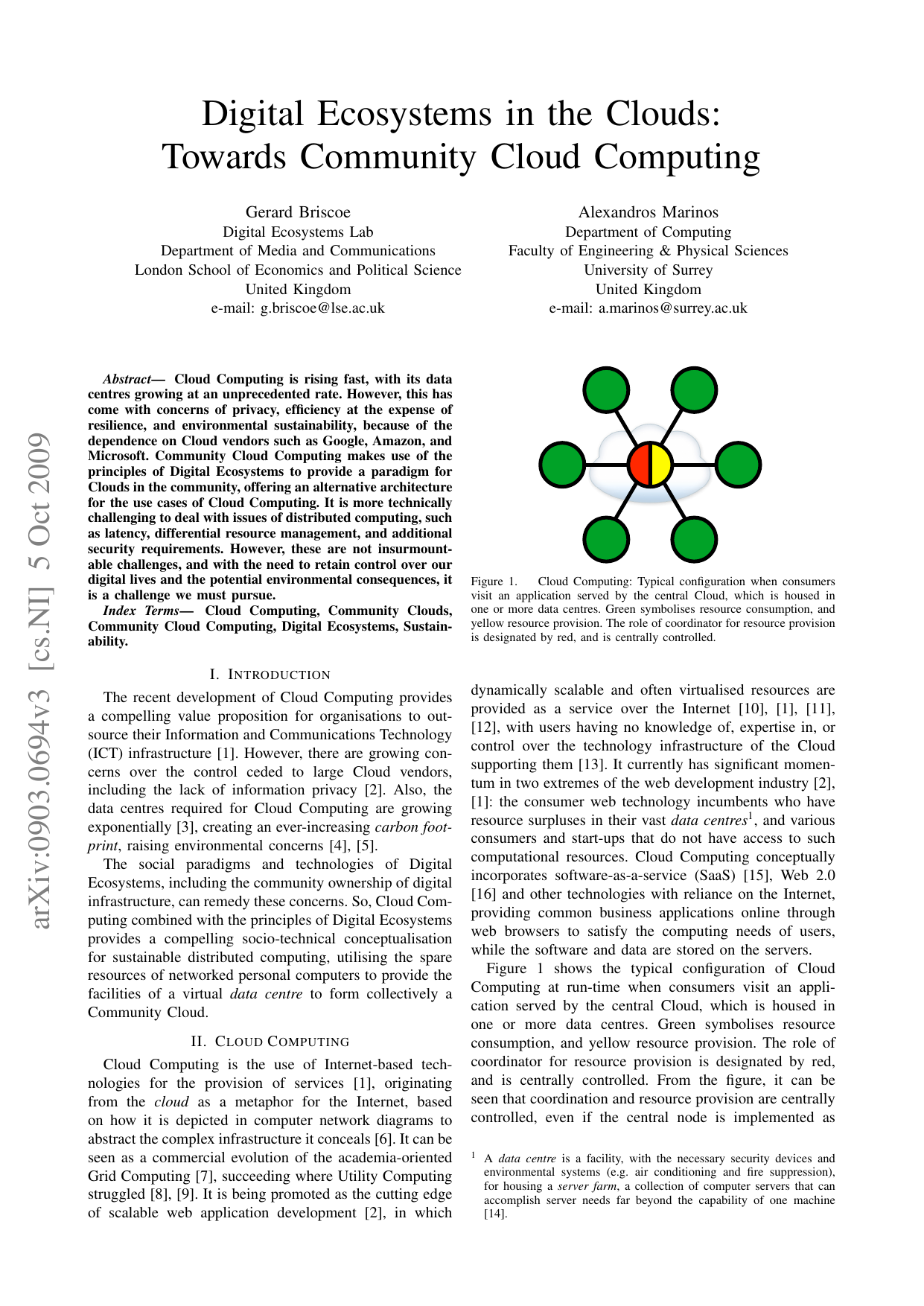
Cloud Computing is the use of Internet-based technologies for the provision of services [1], originating from the cloud as a metaphor for the Internet, based on how it is depicted in computer network diagrams to abstract the complex infrastructure it conceals [6]. It can be seen as a commercial evolution of the academia-oriented Grid Computing [7], succeeding where Utility Computing struggled [8], [9]. It is being promoted as the cutting edge of scalable web application development [2], in which Cloud Computing: Typical configuration when consumers visit an application served by the central Cloud, which is housed in one or more data centres. Green symbolises resource consumption, and yellow resource provision. The role of coordinator for resource provision is designated by red, and is centrally controlled. dynamically scalable and often virtualised resources are provided as a service over the Internet [10], [1], [11], [12], with users having no knowledge of, expertise in, or control over the technology infrastructure of the Cloud supporting them [13]. It currently has significant momentum in two extremes of the web development industry [2], [1]: the consumer web technology incumbents who have resource surpluses in their vast data centres1 , and various consumers and start-ups that do not have access to such computational resources. Cloud Computing conceptually incorporates software-as-a-service (SaaS) [15], Web 2.0 [16] and other technologies with reliance on the Internet, providing common business applications online through web browsers to satisfy the computing needs of users, while the software and data are stored on the servers.
Figure 1 shows the typical configuration of Cloud Computing at run-time when consumers visit an application served by the central Cloud, which is housed in one or more data centres. Green symbolises resource consumption, and yellow resource provision. The role of coordinator for resource provision is designated by red, and is centrally controlled. From the figure, it can be seen that coordination and resource provision are centrally controlled, even if the central node is implemented as a distributed grid, which is the usual incarnation of a data centre. Providers, who are also the controllers, are usually companies with other web activities that require large computing resources, and in their efforts to scale their primary businesses they have gained considerable expertise and hardware. For them, Cloud Computing is a way to resell these as a new product while expanding into a new market. Consumers include everyday users, Small and Medium sized Enterprises (SMEs), and ambitious startups whose innovation potentially threatens the incumbent providers.
There is a significant buzz [17] around Cloud Computing, but there is little clarity about which offerings actually qualify and their interrelation. The key to resolving this confusion is by realising that the various offerings fall into different levels of abstraction, as shown in Figure 2, aimed at different market segments.
Infrastructure as a Service (IaaS) [18]: At the most basic level of the Cloud Computing offerings, there are providers such as Amazon [19] and Mosso [20], who provide machine instances to developers. These instances essentially behave like dedicated servers that are controlled by the developers, who therefore have full responsibility for their operation. So, once a machine reaches its performance limits, the developers have to manually instantiate another machine and scale their application out to it. This service is intended for developers who can write arbitrary software on top of the infrastructure with only small compromises in their development methodology.
Platform as a Service (PaaS) [21]: One level of abstraction above, services like Google App Engine [22] provide a programming environment that abstracts machine instances and other technical details from developers. The programs are executed over data centres, not concerning the developers with matters of
…(Full text truncated)…
📸 Image Gallery
Reference
This content is AI-processed based on ArXiv data.