Introduction to Millimeter/Sub-Millimeter Astronomy
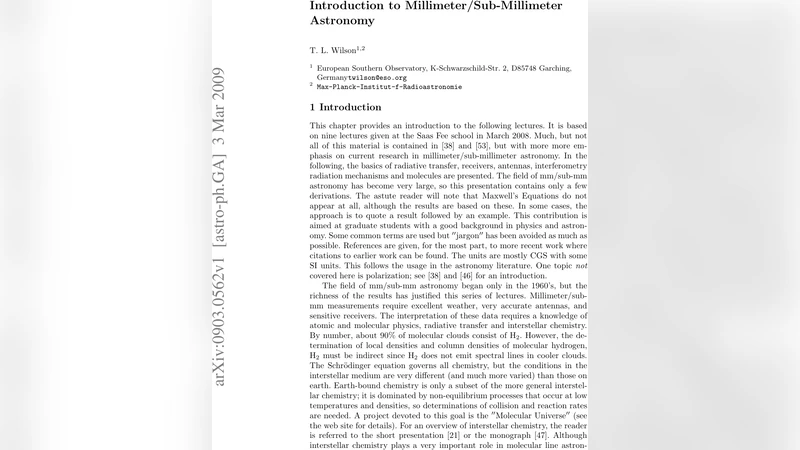
This is an introduction to the basic elements needed for the measurements and interpretation of data in the millimeter and sub-mm wavelength range. A more complete version will be published in the proceedings of the Saas Fee Winter School 2008.
💡 Research Summary
**
The paper serves as a comprehensive primer for astronomers who wish to work in the millimeter and sub‑millimeter (mm/sub‑mm) regime, roughly 0.3–3 mm in wavelength (30–1000 GHz). It begins by positioning this spectral window between traditional radio and infrared astronomy and highlighting its unique scientific payoff: rotational transitions of abundant interstellar molecules, thermal emission from warm dust, and the high‑frequency tail of the cosmic microwave background. Because atmospheric absorption is dominated by water vapor, oxygen, and ozone, the authors devote a substantial section to atmospheric transmission. They explain how precipitable water vapor (PWV) determines the opacity at key windows (e.g., 220 GHz, 350 GHz) and describe the use of radiative‑transfer models such as ATM, am, and MERRA‑2 to predict site‑specific transmission. High, dry sites—Atacama, the Chajnantor plateau, the South Pole—are shown to reduce PWV to <0.5 mm, dramatically improving system temperature (Tsys) and enabling long integrations.
The instrumentation review is divided into detectors, amplifiers, and telescopes. For broadband continuum work, the paper discusses superconducting transition‑edge sensors (TES) and kinetic‑inductance detectors (KID). Both operate at sub‑Kelvin temperatures (≈0.1 K) and achieve noise‑equivalent powers (NEP) of 10⁻¹⁸ W Hz⁻¹⁄², making them ideal for mapping dust emission. For high‑resolution spectroscopy, the authors focus on low‑noise HEMT amplifiers and superconducting SIS mixers, which provide system temperatures as low as 30 K across 1–2 GHz IF bandwidths. Detailed design considerations—impedance matching, cold‑load coupling, and cryogenic plumbing—are presented together with equations for Tsys calculation.
Telescope optics are treated with an emphasis on surface accuracy. To maintain efficiency at 300 GHz, a surface rms of ≤λ/20 (≈15 µm) is required, prompting the use of aluminum or carbon‑fiber panels on large paraboloids such as the ALMA 12 m dishes, the Large Millimeter Telescope (50 m), and the JCMT (15 m). The paper also describes the role of cold filters, Lyot stops, and microlens arrays in minimizing stray radiation and maximizing signal‑to‑noise. The authors contrast single‑dish (single‑dish) observing with interferometric arrays. While single dishes excel at rapid, wide‑field mapping, they are limited in angular resolution by the primary beam. Interferometers, on the other hand, sample the complex visibility function across the uv‑plane, requiring careful phase calibration, atmospheric phase correction, and closure‑phase techniques to reconstruct high‑fidelity images.
Data reduction and analysis are covered in depth. The authors outline line identification strategies, LTE versus non‑LTE modeling, and the use of radiative‑transfer codes such as RADEX to derive physical conditions (temperature, density, column density) from multi‑transition observations. Rotational diagrams are presented as a quick LTE diagnostic, while more sophisticated Bayesian approaches are recommended for crowded spectra. For continuum, modified black‑body fitting yields dust temperature, emissivity index, and mass. The paper walks the reader through modern pipelines—CASA for interferometric data and GILDAS for single‑dish spectroscopy—detailing flagging, bandpass calibration, imaging (CLEAN, MEM), and primary‑beam correction. Special attention is given to uv‑coverage optimization and weighting schemes (natural, uniform, Briggs) that affect resolution and sensitivity.
In the final section, the authors look ahead to emerging technologies. They anticipate large‑format KID arrays with thousands of pixels, broadband SIS mixers covering 200–900 GHz, and space‑based platforms such as SPICA and the Origins Space Telescope, which will bypass atmospheric limitations altogether. These advances promise to push the detection limits for faint high‑redshift galaxies, trace complex organic chemistry in protostellar cores, and refine measurements of CMB spectral distortions. The paper also stresses the importance of open data archives (e.g., the ALMA Science Archive) and community‑driven software, arguing that collaborative training programs like the Saas‑Fee Winter School are essential for cultivating the next generation of mm/sub‑mm astronomers. Overall, the article delivers a thorough, practical roadmap—from site selection and hardware design to calibration, imaging, and scientific interpretation—enabling newcomers to confidently embark on research in the millimeter and sub‑millimeter universe.
Comments & Academic Discussion
Loading comments...
Leave a Comment