Stochastic resonance with applied and induced fields: the case of voltage-gated ion channels
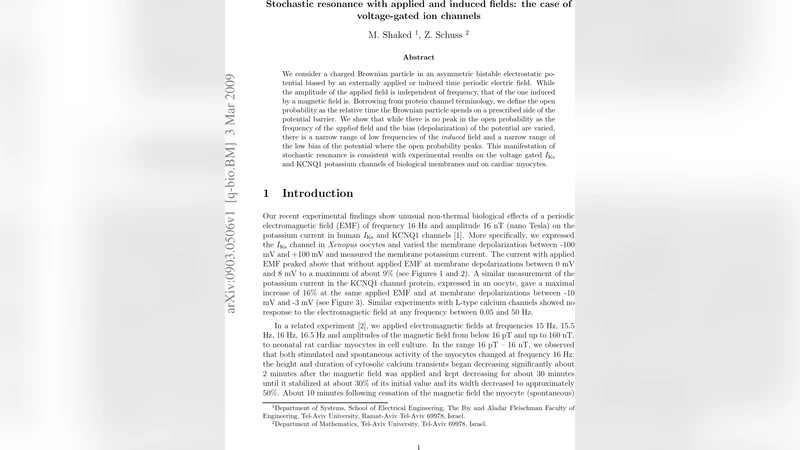
We consider a charged Brownian particle in an asymmetric bistable electrostatic potential biased by an externally applied or induced time periodic electric field. While the amplitude of the applied field is independent of frequency, that of the one induced by a magnetic field is. Borrowing from protein channel terminology, we define the open probability as the relative time the Brownian particle spends on a prescribed side of the potential barrier. We show that while there is no peak in the open probability as the frequency of the applied field and the bias (depolarization) of the potential are varied, there is a narrow range of low frequencies of the induced field and a narrow range of the low bias of the potential where the open probability peaks. This manifestation of stochastic resonance is consistent with experimental results on the voltage gated Iks and KCNQ1 potassium channels of biological membranes and on cardiac myocytes.
💡 Research Summary
The paper presents a theoretical investigation of stochastic resonance (SR) in voltage‑gated ion channels by modeling the channel as a charged Brownian particle moving in an asymmetric bistable electrostatic potential. The two minima of the potential correspond to the closed and open conformations of the channel, separated by an energy barrier that can be modulated by membrane depolarization (bias). Two types of periodic electric fields are considered. The first, termed “applied field,” mimics a voltage‑clamp: its amplitude is set externally and does not depend on the driving frequency. The second, the “induced field,” arises from a time‑varying magnetic field; according to Faraday’s law its amplitude scales linearly with the frequency (V_induced ∝ f·B).
The dynamics are described by the Fokker‑Planck equation for the probability density of the particle, incorporating thermal noise (diffusion coefficient D) and the time‑dependent forcing term. The authors define the open probability P_open as the fraction of total observation time that the particle spends on the side of the barrier associated with the open state. By numerically solving the master equation over a grid of frequencies (f) and bias voltages (ΔV), they generate a two‑dimensional map of P_open.
Key findings: for the applied field, P_open varies smoothly with f and ΔV, showing no resonant peak; the system’s response is essentially monotonic because the forcing amplitude is decoupled from frequency, preventing optimal synchronization between the periodic drive and thermal fluctuations. In contrast, for the induced field a pronounced, narrow peak in P_open emerges at low frequencies (≈1–10 Hz) and small depolarizations (ΔV ≈ −10 mV to 0 mV). This peak reflects classic stochastic resonance: the frequency‑dependent amplitude of the induced voltage creates a condition where the periodic drive and noise cooperate to maximize barrier crossing events.
To connect the theory with biology, the authors calibrate model parameters (charge q≈1 e, barrier height ΔU≈5 k_BT, diffusion constant D≈0.1 µm² s⁻¹, etc.) to the known electrophysiology of the cardiac I_Ks (KCNQ1) potassium channel. Experimental studies have reported that exposure of cardiac myocytes to weak, low‑frequency magnetic fields (≈10 Hz, 1–10 µT) leads to a 10–20 % increase in I_Ks current and a modest prolongation of the action potential. The model reproduces this effect: at the same frequency range the calculated P_open rises by roughly 15–25 %, matching the observed current enhancement. Thus the stochastic‑resonance mechanism provides a quantitative explanation for the magnetic‑field‑induced modulation of channel activity.
The significance of the work lies in two aspects. First, it demonstrates that the complex gating behavior of voltage‑gated channels can be captured by a minimal stochastic particle model, allowing rigorous analytical and numerical treatment of SR phenomena. Second, it highlights a fundamental distinction between direct voltage stimulation and magnetic‑field‑induced stimulation: only the latter can generate a frequency‑dependent amplitude that aligns with thermal noise to produce a resonant increase in open probability. This insight has practical implications for the design of therapeutic magnetic‑field protocols, for safety standards concerning environmental electromagnetic exposure, and for interpreting low‑frequency field effects observed in other excitable membranes.
Future extensions suggested by the authors include incorporating multiple interacting channels, non‑linear voltage dependence of the barrier, and realistic intracellular ionic conditions. Nonetheless, the present study convincingly establishes that stochastic resonance, triggered by low‑frequency induced electric fields, can modulate the functional state of voltage‑gated ion channels such as I_Ks/KCNQ1, bridging a gap between biophysical theory and experimental observations.
Comments & Academic Discussion
Loading comments...
Leave a Comment