Determining role of Krein signature for 3D Arnold tongues of oscillatory dynamos
Using a homotopic family of boundary eigenvalue problems for the mean-field $\alpha^2$-dynamo with helical turbulence parameter $\alpha(r)=\alpha_0+\gamma\Delta\alpha(r)$ and homotopy parameter $\beta \in [0,1]$, we show that the underlying network o…
Authors: Oleg N. Kirillov, Uwe Guenther, Frank Stefani
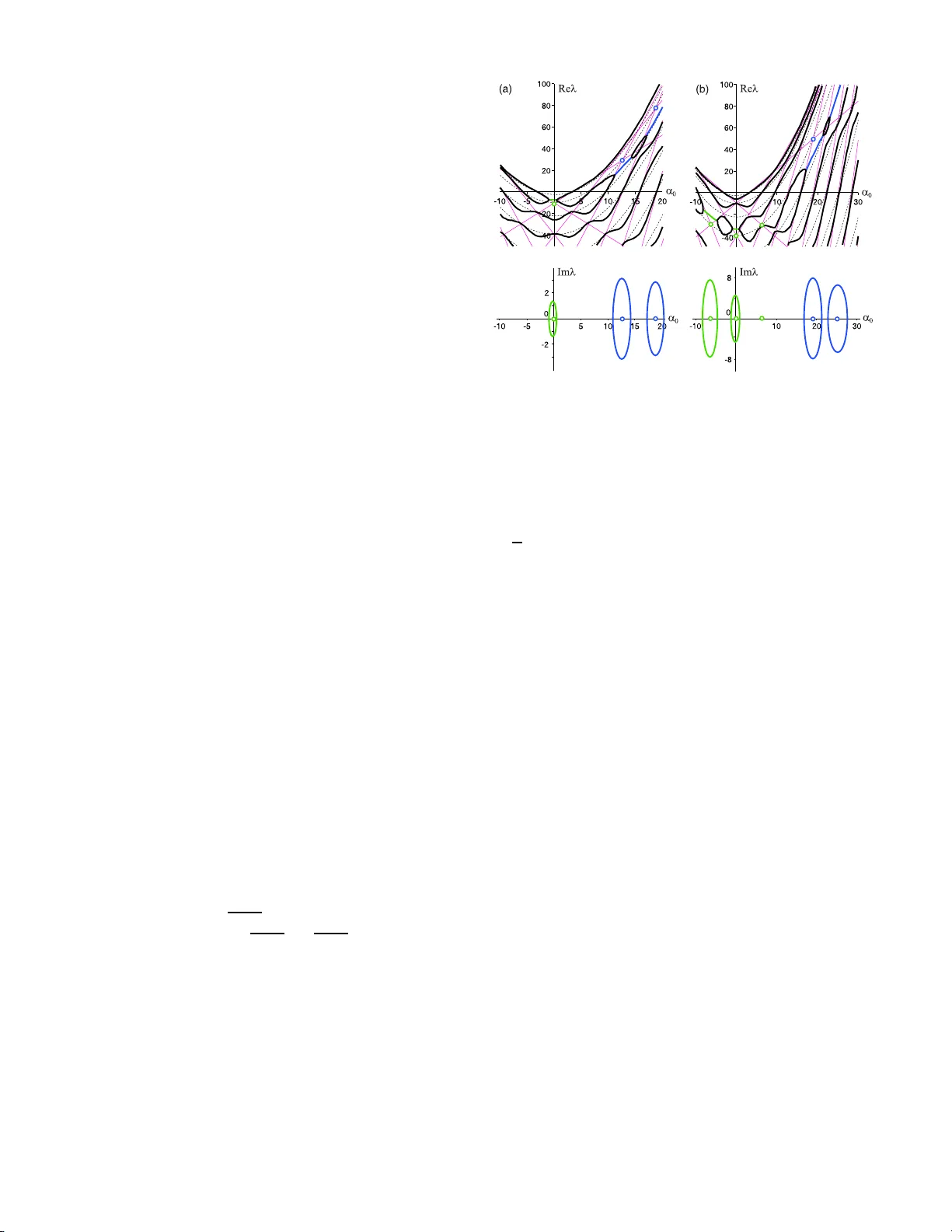
Determining role of Krein signature for three-dimensiona l Arnold tongues of oscillatory dynamos Oleg N. Kirillov, 1 , ∗ Uw e G ¨ un ther, 2 , † and F rank Stefani 2 , ‡ 1 T e chnische Universit¨ at Darmstadt, D-64289 Darmstadt, Germany 2 F orschung szentrum Dr esden- R ossendorf, P.O. Box 510119, D-01314 Dr esden, Germany (Dated: Octob er 29, 2018) Using a homotopic fa mily of b oundary eigenv alue p roblems for the mean-field α 2 -dynamo with helical turbulence parameter α ( r ) = α 0 + γ ∆ α ( r ) and homotop y p arameter β ∈ [0 , 1], we show t hat the un derlying netw ork of diab olical p oints for Dirichlet (idealized, β = 0) b ound ary conditions substantial ly d etermines t h e c horeograph y of eigen v alues and thus t he chara cter of the dyn amo instabilit y for Robin (physical ly realistic, β = 1) b oundary conditions. In the ( α 0 , β , γ ) − space the Arn old tongues of oscillatory solutions at β = 1 end up at t h e diab olical p oints for β = 0. In the vicinity of th e diabolical p oin ts the space orienta tion of the 3D tongues, whic h are cones in fi rst-order approximation, is determined by the Krein signature of th e mo des inv olv ed in the diab olical crossings at the apexes o f the cones. The Krein space induced geometry of th e resonance zones explains the subtleties in finding α -profiles leading to sp ectral exceptional p oints, which are imp ortant ingredients in recent theories of p olarit y revers als of the geomagnetic field. P A CS num bers : 91.25.Cw, 91.25.M f, 02.30.Tb, 02.40.Xx, 05.45.-a I. INTRO DUCTION Polarit y r eversals of the Ear th’s ma g netic field have fascinated geo ph ysicists since their disc overy by Da vid and Brunhes [1] a cen tury ago . While the last reversal o ccurred approximately 7800 00 years a go, the mean re- versal rate (averaged o v er the last few million years) is approximately 4 p er Myr. A t least t w o, but very lik ely three [2] sup erchrons hav e b een identified as ” quiet” p e- rio ds of some tens of millions of y ears showing no rev ersal at all. The rea lit y of reversals is quite complex a nd there is little hop e to understand all their details within a s imple mo del. Recen t computer simulations of the geo dynamo in g eneral and o f reversals in par ticula r [3, 4, 5] hav e pro- gressed muc h since the first fully coupled 3D simulations of a rev ersal b y Glatzma ier and Rob erts in 1995 [6]. Most int erestingly , po larity reversals w ere also obser v ed in one [7] of the recent liquid so dium dynamo exper imen ts whic h hav e flo ur ished during the last decade [8, 9]. How ever, it is imp ortant to note that neither in sim- ulations nor in e xper iments it is p ossible to accommo- date all dimensionless parameter s o f the geo dynamo [10], and many of them are not even well known [1 1]. In an int eresting attempt to bridge the ga p of several orders of magnitude b etw e en realistic and numerically achiev- able pa rameters, Chr is tensen and Aub ert [12] were able to identify remar k able scaling laws for some appropria te non-dimensional num b ers. The us e of appropria te simplified mo dels [13, 1 4, 1 5, 16] repres e nts a nother a ttempt to understa nd b etter the ∗ Electronic address: ki rillov@dyn.tu -darmstadt.de † Electronic address: u. guen ther@fzd.de ‡ Electronic address: f .stefani@fzd.de basic principle and the t ypical features of r ev ersals. Mo st prominent among those features are the distinct as ymme- try (with a slow decay and a fast rec overy phase) [17], the clustering prop erty of reversal ev en ts [18], and the ap- pea rance of sev eral max ima (at multiples of 95 kyr) of the residence time distribution which has been explained in terms of a sto c hastic res onance phenonemon with the Milanko vic cycle of the Earth’s orbit excentricit y [19, 20]. One of the simplest reversal mo dels whic h seems capa- ble to explain a ll those three reversal fea tures in a consis - ten t manner [2 1, 2 2] relies basica lly on the e x istence o f an exceptional p oint in the sp ectrum of the non- s elf-adjoint dynamo op erator, where t wo real eigenv alues coalesce and contin ue as a complex conjugated pair of eigenv alues. The imp ortanc e o f the sp ecific interpla y b et w een oscilla - tory and non-oscillator y modes for the r eversal mecha- nism ha d b een early expressed by Y oshimura [23], Sar- son a nd Jo nes [24], and Gubbins a nd Gibb ons [25]. In the fra mework of a simple mean-field α 2 -dynamo with a spherically symmetric helical turbulence pa rameter α it was p ossible to ident ify r eversals as nois e -triggered relax- ation oscillations in the vicinit y of an exceptional point [26, 27, 2 8]. The key p oint is that the exceptional p oint is asso ciated with a nea rby lo cal maximum of the growth rate situated at a slightly lower magnetic Reyno lds num- ber . It is the neg ativ e slop e o f the g r owth r ate cur v e b e- t ween this lo cal maximum and the exce ptio nal p oint tha t makes stationary dynamos vulnerable to noise. Then, the instantaneous eigenv alue is driven tow a r ds the ex- ceptional point a nd b eyond int o the oscillatory bra nch where the sign change of the dipole p olarity happ ens. Therefore, the existence of an exceptional point is a n essential ingredie nt for reversals, although non-linear dy- namics and the influence of noise m ust b e inv oked for a more detailed understanding of thos e even ts. F rom the spectra l p oin t of view, the reversal phe- nomenon of the geomagnetic field is str o ngly linked to 2 other fields of physics, like v a n-der-Pol like o scillators [29], geometric phases [30], P T - symmetric quantum me- chanics [31, 32], P T -sy mmetric optical wa v eguides [33], microw av e r esonators [3 4], and dissipatio n-induced insta - bilities [3 5, 36, 3 7]. A par ticular pro ble m of all those sy s tems in which ex- ceptional points a re in v olved is a strong sensitivit y of the eigenv alues o n b oundary conditions (BCs). As for the geo dynamo, the p erio dic o ccurr ence o f so-ca lled sup er- chrons is usually attributed to the changing thermal BCs at the core- man tle boundary [2], but the growth of the inner cor e may also pla y a r ole [2 8] b y vir tue of a spectra l resonance phenomeno n [38]. In this context it is worthwhile to note that imp or- tant features of dynamos ar e most easily understand- able when treated with idealized (i.e. non-physical) bo undary co nditions. This w a s the case for explain- ing the famous eigenv alue symmetry b etw een dip ole and quadrup ole mo des as it was done by P ro ctor in 1977 [39, 40]. Standing in this tradition, the present pap er is devoted to a b etter understanding of the int erplay of BCs, the sp ectral resonance pheno menon and os cillatory r egimes in dynamo s. II. MA THEMA TICAL SET TING The mea n field MHD α 2 − dynamo [41] in its kinematic regime is describ ed by a line ar induction equation for the mag netic field. F or s pher ically symmetric α − profiles α ( r ) the vector of the magne tic field is decomp osed into po loidal and to r oidal comp onents and expanded in spher- ical harmonics with degr ee l and order m . After addi- tional time s eparation, the induction equation reduces to a set of l − decoupled b oundary eigenv alue pr oblems [38], which we write in a matrix form, conv enient for the implemen tation of the pe r turbation theory [42, 4 3] Lf := l 0 ∂ 2 r f + l 1 ∂ r f + l 2 f = 0 , Uf = 0 . (1) The matr ices in the differential expressio n L are l 0 = 1 0 − α ( r ) 1 , l 1 = ∂ r l 0 , l 2 = − l ( l +1) r 2 − λ α ( r ) α ( r ) l ( l +1) r 2 − l ( l +1) r 2 − λ ! (2) and U := [ A , B ] ∈ C 4 × 8 in the BCs consists of the blo cks A = 1 0 0 0 0 1 0 0 0 0 0 0 0 0 0 0 , B = 0 0 0 0 0 0 0 0 β l + 1 − β 0 β 0 0 1 0 0 . (3) The v ector-function f ∈ ˜ H = L 2 (0 , 1 ) ⊕ L 2 (0 , 1 ) lives in the Hilb ert spa ce ( ˜ H , ( ., . )) with inner pro duct ( f , g ) = FIG. 1: l = 0: (p ink) sp ectral mesh (11) for γ = 0, β = 0; (dashed) eigenv alue parab olas (12) for γ = 0, β = 1; (blac k) eigenv alue b ranc hes for β = 0 . 3, ∆ α ( r ) = cos(2 π k r ), and (a) k = 1, γ = 2 . 5, (b) k = 2, γ = 3, with resonant o verla ps n ear th e locations of the diab olically crossed mod es having (blue) the same and (green) different K rein signature. R 1 0 g T f dr , where the overbar denotes complex conjuga - tion, and the b oundar y vector f is g iv en as f T := f T (0) , ∂ r f T (0) , f T (1) , ∂ r f T (1) ∈ C 8 . (4) W e ass ume that α ( r ) := α 0 + γ ∆ α ( r ), wher e ∆ α ( r ) is a smo oth r eal function with R 1 0 ∆ α ( r ) dr = 0. F or a fixed ∆ α ( r ) the differential express io n L de p ends on the pa- rameters α 0 and γ , while β interpo lates be tw een idealized ( β = 0) B Cs, corr espo nding to an infinitely c o nducting exterior, a nd ph ysically rea listic ones ( β = 1) corresp ond- ing to a non-conducting exterior o f the dynamo r e g ion [41]. The sp e c tral pr oblem (1) is not selfadjoint in a Hilb ert space, but in c a se of idea lized BCs ( β = 0) the funda- men tal symmetry of the differential expressio n [38, 44] L 0 := L ( λ = 0) = JL † 0 J , J = 0 1 1 0 , (5) makes L 0 selfadjoint in a Kr ein s pa ce ( K , [ ., . ]) [45] with indefinite inner pro duct [ ., . ] = ( J ., . ): [ L 0 f , g ] = [ f , L 0 g ] , f , g ∈ K . (6) F or β 6 = 0 the oper a tor L 0 is not selfadjoint even in a Krein spa ce. II I. FRO M DIABOLIC TO EXCEPTIONAL POINTS In case of constant α − pr o files α ( r ) ≡ α 0 =const and β = 0 the sp ectrum and the eigenv ectors of the op erator 3 matrix L 0 are [3 8] λ ε n = λ ε n ( α 0 ) = − ρ n + εα 0 √ ρ n ∈ R , ε = ± , f ε n = 1 ε √ ρ n f n ∈ R 2 ⊗ L 2 (0 , 1 ) , n ∈ Z + (7) with f n ( r ) b eing normalized Ricca ti- Bessel functions f n ( r ) = (2 r ) 1 / 2 J l + 1 2 ( √ ρ n r ) | J l + 3 2 ( √ ρ n ) | , ( f n ′ , f n ) = δ n ′ n (8) and ρ n > 0 the sq uares of B e ssel function ze ros J l + 1 2 ( √ ρ n ) = 0 , 0 < √ ρ 1 < √ ρ 2 < · · · . (9) The eigenv ectors f + n , f − n ∈ K ± ⊂ K corresp ond to Krein space sta tes of p o sitiv e and neg ative signa tur e ε = ± [ f ± n ′ , f ± n ] = ± 2 √ ρ n δ n ′ n , [ f ± n ′ , f ∓ n ] = 0 . (10) The sp ectral branches λ ± n are rea l-v alued linear functions of the par ameter α 0 with sig nature-defined slop es ± √ ρ n and for m fo r all l = 0 , 1 , 2 , · · · a mesh-like structure in the ( α 0 , ℜ λ ) − plane . Spectr al meshes for neig h bor ing mo de nu mbers l and l + 1 hav e only slightly different slop es of their branches and b ehav e qualitatively simila r under per turbations [38]. Therefore basic sp ectral structures for l = 1 , 2 dip ole and quadrup ole mo des can be illus- trated by the simpler but unphysical l = 0 monop ole mo des which a re given in terms of trigono metric func- tions. The ( l = 0) − mesh built from ρ n = π 2 n 2 is de- picted as pink lines in Fig. 1. The intersection of tw o branches λ δ n ′ , λ ε n with n 6 = n ′ o ccurs at p oints ( α ( ν ) 0 , λ ( ν ) ) with α ( ν ) 0 := ε √ ρ n + δ √ ρ n ′ , λ ( ν ) := σ ( ν ) √ ρ n ρ n ′ , σ ( ν ) := εδ (11) and corre s ponds to double eige n v alues λ ( ν ) = λ ε n = λ δ n ′ with tw o linea rly indep endent eigenv ectors f ε n and f δ n ′ , i.e. to so-called semi-simple eigenv a lue s (diab olical p oints, DPs) of algebraic and geo metric m ultiplicit y t w o [38, 4 3]. F or the ( l = 0) − mesh the diab olical crossing s of the ( εn )th and ( εn + j )th mo des with the same fixed | j | ∈ Z + are lo cated on a parab olic cur v e [3 8] λ ( α 0 ) = 1 4 α 2 0 − π 2 j 2 (12) where α 0 = α ( ν ) 0 = π (2 nε + j ) and λ ( ν ) = λ ( α ( ν ) 0 ) = π 2 n ( n + εj ). O p en cir cles in Fig. 1(a,b) indicate DP s on the par abo las | j | = 2 a nd | j | = 4. The Krein signature s [46] of the intersecting branches define the in tersection index σ ( ν ) = εδ = sign ( λ ( ν ) ) in eqs . (11 ). Branches of different signature δ 6 = ε intersect for b oth signs o f α 0 at λ ( ν ) < 0 (gr een circles in Fig . 1), wherea s in tersections at λ ( ν ) > 0 are induced by s pectra l br anc hes o f coinciding signatures: for ε = δ = + a t α 0 > 0, a nd for ε = δ = − at α 0 < 0 (blue cir cles in Fig. 1). FIG. 2: l = 0, ∆ α ( r ) = cos(4 πr ): (a) linear approximation of the 3D Arnold tongues and (b) their pro jection onto the ( α 0 , β ) − plane indicating the influence of the intersection in- dex σ ( ν ) on th e inclination of the cones. F or γ = 0 and constant α ( r ) = α 0 , the sp ectrum r e- mains purely rea l on the full homotopic family β ∈ [0 , 1 ] and passes smo othly in the ( α 0 , ℜ λ ) − plane from the sp ectral mesh at β = 0 to non- intersecting branches of simple real eigenv alues for mo dels with physically real- istic BCs at β = 1. F or the mono p ole mo del l = 0 the full sp ectral ho motopy is describ ed by the c haracteristic equation (1 − β ) η [cos ( η ) − cos ( α 0 )] + 2 β λ sin ( η ) = 0 , where η ( α 0 , λ ) = p α 2 0 − 4 λ , w hich for ph ysically realis- tic BCs ( β = 1) lea ds to a spe c trum co nsisting o f the countably infinite set o f parab olas (12) labelled b y the index j ∈ Z + and depicted in Fig. 1 as das he d lines. The rea son for the ( β = 0) − DPs (11) to b e lo ca ted on the ( β = 1 ) − parab olas (12) is that the lo ci o f the DPs are fixed points of the homotopy ∀ β ∈ [0 , 1] — a phe- nomenon which indicates on their ‘dee p imprin t’ in the bo undary eigenv alue problem (1 ). The eigenv alue branches with ℜ λ > 0 , ℑ λ 6 = 0 (im- po rtant for the reversal mec hanism [26, 2 8]) can be in- duced by deforming the constant α − pr ofile into an in- homogeneous o ne, α ( r ) = α 0 + γ ∆ α ( r ), with simultane- ous v ariation o f the BCs. This pro cess is governed by a s trong reso nan t corre la tion b e t w een the F ourier mo de nu mber of the inhomog eneous ∆ α ( r ) a nd the parab ola index | j | . This is numerically demonstr a ted in Fig. 1 (black branches) for ∆ α ( r ) = cos(2 πk r ) w hich highly selectively induces complex eigenv alue seg men ts in the vicinity of DPs lo cated on the pa rab ola (12) with index j = 2 k . The underly ing influence o f ’hidden’ DPs on real-to- complex transitions o f the spectra l branches can b e made transpare nt by analyz ing the pertur bativ e unfolding of the DPs [43 ] at the mesh-no des ( α ( ν ) 0 , λ ( ν ) ) under v aria- tion of the parameters α 0 , β , a nd γ . In first-o rder ap- proximation this gives for the ( l = 0) − mo del λ = λ ( ν ) − λ ( ν ) β + α ( ν ) 0 2 ( α 0 − α ( ν ) 0 ) ± π 2 √ D , (13) 4 where α ( ν ) 0 = π ( εn + δ n ′ ), λ ( ν ) = εδ π 2 n ′ n , and D := h ( εn − δ n ′ ) α 0 − α ( ν ) 0 i 2 + n ′ n h ( ε 1 + δ 1) γ A − ( − 1) n + n ′ ( n + n ′ ) β π i 2 − n ′ n h ( ε 1 − δ 1) γ A − ( − 1) n − n ′ ( n − n ′ ) β π i 2 (14) with A := R 1 0 ∆ α ( r ) cos[( εn − δ n ′ ) π r ] dr. F or γ = 0 it holds D ≥ 0, confirming that the eigen- v alues r emain real under v ariation of the parameters α 0 and β o nly . If, additionally , α 0 = α ν 0 , then one of the tw o simple eigenv alues (13) re mains fixed under first-order per turbations with resp ect to β : λ = λ ( ν ) in full accor- dance with the fixed po in t nature of the DP lo ci under the β − homotopy . The s ign of the firs t-order increment of the other eig en v alue λ = λ ( ν ) − 2 λ ( ν ) β dep ends on the sig n of λ ( ν ) and, therefore , via (11) directly on the Krein signa ture of the mo des involv ed in the crossing ( α ( ν ) 0 , λ ( ν ) ). In gener a l, there e x ist parameter combinations yield- ing D < 0 and thus creating complex eigenv alues. E q. (14) implies that in first-order a pproximation the do main of oscillator y solutions with ℜ λ 6 = 0 and ℑ λ 6 = 0 in the ( α 0 , β , γ )-space is b ounded b y the conical surface s D = 0 with ap exes at the DPs ( α ( ν ) 0 , 0 , 0), as shown in Fig. 2. Such domains, esp ecially in c a se of r − p erio dic α − profiles, are in fact Arnold tongues corresp onding to zones of pa rametric reso nance [46] in Mathieu-t yp e equa- tions whose analysis in [47] was motiv ated just by Zel- dovic h’s studies on MHD dyna mos. A t the b oundary D = 0 the eigenv a lues are t wofold degenerate and non- derogator y , that is they hav e Jor- dan chains consisting of an eigenv ector a nd an asso ciated vector. Thus, DPs in the ( α 0 , β , γ )-space unfold into 3D conical sur faces c onsisting of exceptional p oints (EPs). The conical zone s develop accor ding to r esonance selec- tion rules similar to those discovered in [38] for the case β = 0. F o r example, with ∆ α ( r ) = cos(2 π k r ), k ∈ Z , the constant A in (14) yields A = 1 / 2 , 2 k = εn − δ n ′ 0 , 2 k 6 = εn − δ n ′ (15) so that in fir st-order approximation only DPs lo cated on the ( j = 2 | k | ) − para bola (12) show a DP-E P unfolding (in accordance with n umerical r esults in Fig. 1). The cone ap exes corr espo nd to 2 | k | − 1 DPs with negative int ersection index (11) σ ( ν ) = − a nd countably infinite DPs with σ ( ν ) = +. The tw o gr oups are shown in Fig. 2 in gr een and blue, resp ectively . The real parts of the p erturb ed eigenv alues are giv en by ℜ λ = λ ( ν ) (1 − β ) + α ( ν ) 0 α 0 − α ( ν ) 0 / 2 and for fix ed α 0 and increa sing β they are shifted (for b oth g roups) aw a y from the or iginal DP p ositions tow ard the ( ℜ λ = 0) − axis (cf. the numerical results in Fig. 1) — an effect which is simila r to the self-tuning mechanism of field-reversals uncov ered in [26]. FIG. 3: l = 0: numerically calculated Arnold tongues for ∆ α ( r ) = cos(2 π k r ), k = 2, and λ ( ν ) < 0 (green) or λ ( ν ) > 0 (blue) and their approximations (dashed lines) (a) in th e ( α 0 , γ ) − plane and (b) in the ( β , γ ) − plane. Apart from this similarity , the eigenv a lues of the tw o cone-gro ups sho w sig nificant differences. The 2 | k | − 1 cones of the first group hav e non-trivial int ersection with the plane β = 0. In this ( α 0 , γ ) − plane the zones of decay- ing oscillatory mo des are γ ⇋ − γ symmetric and defined by the inequality ( α 0 ± 2 π ( n − | k | )) 2 < γ 2 4 " 1 − n − | k | | k | 2 # , (16) where n = 1 , 2 , . . . , | k | . F o r k = 2 there a re thr ee primary Arnold tongues : 4 α 2 0 < γ 2 and 16 ( α 0 ± 2 π ) 2 < 3 γ 2 . The co ne s of the second group meet the pla ne β = 0 only at the ap exes, having their skirts lo cated in the sectors [ β > 0 , γ sign ( α 0 ) > 0] and [ β < 0 , γ sign ( α 0 ) < 0] (cf. Fig. 2(b)). Therefore, in mo dels with idealiz e d BCs ( β = 0) complex eigenv alues o ccur only in zones (16) in the ( α 0 , γ )-plane. The differen t o scillatory behavior induced by the tw o cone gro ups ha s its origin in the differen t Krein- signature defined inclina tion of the ( D < 0) − cones with res pect to the ( β = 0) − pla ne. Passing from β = 0 to a parallel ( β 6 = 0) − plane, the ( D < 0) − tongues (16), corresp onding to λ ( ν ) < 0 defor m int o cross-sec tions bo unded b y h yperb olic curves (blac k dashed lines in Fig. 3(a)) − 4 k 2 ( α 0 ± 2 π ( n −| k | )) 2 + n (2 | k |− n )( γ ± 2 π ( n −| k | ) β ) 2 > n (2 | k |− n )4 π 2 β 2 k 2 , (17) with n = 1 , 2 , . . . , | k | . Since n ≤ | k | , the lines γ = ± 2 π nβ and γ = ± 2 π ( n − 2 | k | ) β , b ounding the cr oss-sections of the 3D cones by the plane α ( ν ) 0 = ± 2 π ( n − | k | ), always hav e the s lopes of differen t s ign. This allows decaying oscillator y mo des for β = 0 due to v ariation o f γ only . The ( β 6 = 0) − cr oss-sections of the co nes with ( λ ( ν ) > 0) − ap exes ha ve the for m of ellipse s (white dashed lines in Fig. 3(a)) 4 k 2 ( α 0 ± 2 π ( n + | k | )) 2 + n (2 | k | + n ) ( γ ± 2 π ( n + | k | ) β ) 2 < n (2 | k | + n )4 π 2 β 2 k 2 , (18) 5 where n = 1 , 2 , . . . . In the ( β 6 = 0 ) − plane the ellipses are lo cated inside the strip e with boundarie s γ = ( α 0 ± 2 π | k | ) β (pink line s in Fig. 3(a)), while the hyperb olas lie outside this s tripe. Moreover, since in the plane α ( ν ) 0 = ± 2 π ( n + | k | ) the b o undary lines γ = ± 2 π nβ and γ = ± 2 π ( n + 2 | k | ) β hav e slop es of the sa me s ig n, the γ - axis do es not b elong to the instability domains, showing that for gr owing oscillatory mo des the parameter s β and γ hav e to b e taken in a pres cribe d pr opo rtion, see Fig . 3(b). The a mplitude γ of the inhomogeneous p erturbation of the α -pro file γ ∆ α ( r ) is limited b oth fro m below and from ab ov e in the vicinit y of the DPs with σ ( ν ) > 0. How- ever, numerical calculations indicate that this prop ert y can p ersist on the whole interv al β ∈ [0 , 1], see Fig. 3 (b), in ag reement with the earlier findings o f [48]. IV. CONCLUSIONS In s ummary , we hav e found that the under ly ing net- work of DPs and their intersection indices for β = 0 sub- stantially determine the choreogra ph y o f eigenv alues for β = 1 a nd, in particula r, the lo ci of EPs which ar e im- po rtant to explain the r e v ersals of the g eomagnetic field. Although this has b een exemplified for the unphysical monop ole ( l = 0) mode of a s implified spherically sym- metric α 2 dynamo mo del, the g eneral idea is well gener- alizable to physical mo des and to more re alistic dynamo mo dels. W ork in this dir e ction is in pro gress. Ackno wl edgments The re search of O .N.K. was supp orted b y DFG grant HA 10 60/43- 1 a s well as by the Saxon Ministry of Science grant 4 -7531.5 0-04-8 4 4-07/8 and that of U.G. and F.S. by DF G Sonder forsch ung s bere ich 609. [1] B. Brunhes, J. d e Phys. 5 , 705 (1906). [2] V . Courtillot and P . Olson, Earth Planet. Sci. Lett. 260 , 494 (2007). [3] G.A. Glatzmaier, Ann. Rev. Earth Planet. S ci. 30 , 237 (2002). [4] J. Wic ht and P . Olson, Geochem. Geophys. Geosys. 5 , Q03H10 (2004). [5] F. T ak ahashi, M. Matsushima, and Y. H onkura, Science 309 , 459 (2005). [6] G.A. Glatzmaier and P .H. Rob erts, Nature 377 , 203 (1995). [7] M. Berhanu et al., EPL 77 , 59001 (2007). [8] A . Gail itis, O. Lielausis, E. Platacis, G. Gerb eth, an d F. Stefani, Rev . Mod. Phys. 74 , 973 ( 2002). [9] F. Stefani, A. Gailitis, and G. Gerb eth, Z. Angew. Math. Mec h. 88 (12), 930 (2008). [10] D. Gubbins, Nature 452 , 165 (2008). [11] P .H. R ob erts and G.A. Glatzmaier, R ev . Mod. Phys. 72 , 1081 (2000). [12] U .R . Christensen and J. Aub ert, Geophys. J. Int. 166 , 97 (2006). [13] I. Melbourne, M.R.E. Proct or, and A.M. Rucklidge, in Dynamo and Dynamics, a Mathematic al Chal lenge , edited by P . Chossat, D. Armbruster and I . Op rea (Kluw er, Dordrech t, 2001), pp . 363-370. [14] P . Hoyng, M.A.J.H. Ossendrijver, and D . Schmidt, Geo- phys. Astrophys. Fluid Dyn. 94 , 263 (2001). [15] D.A . Ryan and G.R. Sarson, Geophys. Res. Lett. 34 , L02307 (2007). [16] L. Sorriso-V alvo et al., Phys. Earth Planet. Int. 164 , 197 (2007). [17] J.-P . V alet, L. Meynadier, and Y. Guyodo, Nature 435 , 802 (2005). [18] V . Carbone et al., Phys. Rev. Lett. 96 , 128501 ( 2006). [19] G. Consolini and P . De Mic helis, Ph ys. R ev. Lett. 90 , 058501 (2003). [20] S. Lorito, D. Schmitt, G. Consolini, and P . De Mic helis, Astron. N ac hr. 326 , 227 (2005). [21] M. Fischer, G. Gerb eth, and F. S tefani, Eur. Phys. J. B 65 , 547 (2008). [22] M. Fisc her, G. Gerbeth , A. Giesec ke and F. Stefani, arxiv.org/0808 .3310. [23] H Y oshimura, Z. W ang, and F. W u, Astroph ys. J. 283 , 870 (1984). [24] G.R. S arson and C.A. Jones, Ph ys. Earth Planet. Int. 111 , 3 (1999). [25] D. Gubbins and S. Gibb ons, Geophys. Astrophys. Fluid Dyn. 96 , 481 (2002). [26] F. S tefani and G. Gerb eth, Phys. Rev. Lett. 94 , 184506 (2005). [27] F. Stefani, G. Gerb eth, U. G ¨ unther, and M. X u, Earth Planet. S ci. Lett. 243 , 828 (2006). [28] F. S t efani, M. Xu, L. S orriso-V alvo, and U. G ¨ unther, Geophys. Astrophys. Fluid Dy n. 101 , 227 (2007). [29] B. v an der Pol, Phil. Mag. 2 , 978 (1926). [30] A.A. Mailybaev, O.N. Kirillov, and A.P . Sey ranian, Phys. R ev. A 72 , 014104 (2005); U. G¨ unther, I. Rotter, B. Samsono v, J. Phys. A 40 , 8815 (2007). [31] C.M. Bender and S. Bo ettcher, Phys. Rev. Lett. 80 , 5243 (1998); C.M. Bend er, Rep. Progr. Phys. 70 , 947 (2007). [32] E.-M. Graefe, U. G ¨ u n ther, H.-J. Korsc h, and A. Niederle, J. Phys. A 41 , 255206 (2008). [33] Z.H. Musslimani, K.G. Makris, R. El-Ganain y , D.N. Christodoulides, Phys. Rev. Lett. 100 , 030402 (2008); K.G. Makris, R . El-Ganain y , D.N. Christo doulides, Z.H. Musslimani, Ph ys. Rev. Lett. 100 , 1039 04 (2008); S . Klaiman, U. G¨ unther and N. Moise yev, Ph ys. Rev. Lett. 101 , 080402 (2008). [34] C. Dembowski et al., Phys. Rev. Lett. 90 , 0341 01 (2003). [35] O. Bottema, Indagationes Mathematicae 18 , 403 (1956). [36] R. Krechetnik ov, J.E. Marsden, Rev. Mo d. Phys. 79 , 519 (2007); N.M. Bou-Rab ee, J.E. Marsden, L.A. Romero, 6 SIAM R ev. 50 , 325 (2008). [37] O.N . Kirillov, Acta Mech. 174 , 145 (2005); Int. J. Non- Lin. Mech. 42 , 71 (2007); Proc. R. Soc. A 464 , 2321 (2008). [38] U . G ¨ un ther and O.N. Kirillov, J. Phys. A 39 , 10057 (2006). [39] M.R.E. Proctor, Astron. Nachr. 298 , 19 (1977). [40] M.R.E. Proctor, Geophys. Astrophys. Fluid D yn. 8 , 311 (1977). [41] F. Krause and K.-H. R¨ adler, Me an-field magnetohydr o- dynamics and dynamo the ory , (Ak ademie-V erlag, Berlin and Pergamo n Press, Oxford, 1980), chapter 14. [42] M. I. Vishik and L. A. Lyusternik, Russian Math. Sur- veys. 15 , 1 (1960); J. Moro, J. V. Burke, and M. L. Overton, SIAM J. Matrix An al. Appl. 18 , 793 (1997). [43] O.N . K irillo v, A.P . Seyranian, SIAM J. Appl. Math. 64 , 1383 (2004); J. Appl. Math. Mech. 69 , 529 (2005); O.N. Kirill o v, A.A. Mailybaev, A.P . Seyranian, J. Phys. A. Math. Gen. 38 , 5531 (2005); O.N . K irillov. arXiv:0803.22 48 v2 [math-ph] ( 2008). [44] U. G ¨ unther, F. S tefani, J. Math. Ph ys. 44 3097 (2003); U. G¨ unther, F. Stefani, and M. Zno jil, J. Math. Phys. 46 063504 (2005); U. G¨ unther, B. Samsonov and F. Stefani, J. Phys. A 40 , F169 (2007). [45] H. Langer and C. T retter, Czec h. J. Phys. 54 , 1113 (2004). [46] M.G. Krein, D okl. Ak ad. Nauk SSSR 73 445 (1950). [47] V.I. Arnold, Usp ekhi Mat. Nauk 38 , 189 (1983). [48] F. S t efani and G. Gerb eth, Phys. Rev. E 67 , 027302 (2003).
Original Paper
Loading high-quality paper...
Comments & Academic Discussion
Loading comments...
Leave a Comment