Breakthrough in Interval Data Fitting II. From Ranges to Means and Standard Deviations
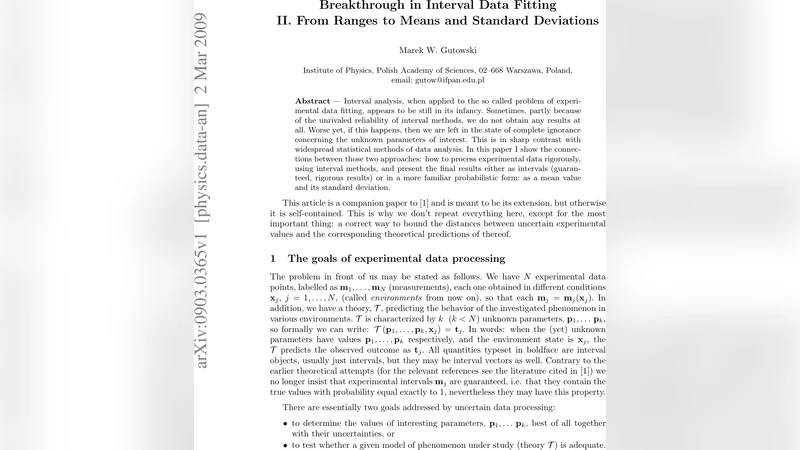
Interval analysis, when applied to the so called problem of experimental data fitting, appears to be still in its infancy. Sometimes, partly because of the unrivaled reliability of interval methods, we do not obtain any results at all. Worse yet, if this happens, then we are left in the state of complete ignorance concerning the unknown parameters of interest. This is in sharp contrast with widespread statistical methods of data analysis. In this paper I show the connections between those two approaches: how to process experimental data rigorously, using interval methods, and present the final results either as intervals (guaranteed, rigorous results) or in a more familiar probabilistic form: as a mean value and its standard deviation.
💡 Research Summary
The paper addresses a long‑standing gap between rigorous interval analysis and the more familiar probabilistic reporting of experimental results. While interval methods guarantee that the true values of unknown parameters lie within computed bounds, they have traditionally produced results that are difficult for practitioners to interpret because they are presented solely as intervals. Conversely, standard statistical techniques such as least‑squares or maximum‑likelihood estimation provide point estimates and confidence intervals but rely on probabilistic assumptions that may be violated in real‑world measurements (e.g., non‑Gaussian, asymmetric errors, limited data).
To bridge this divide, the author proposes a two‑stage framework. In the first stage, the experimental data are processed with interval arithmetic to construct a feasible set of parameter values. This involves solving systems of interval equations—linear, nonlinear, or differential—using subdivision‑refinement and a novel “center‑point correction” to mitigate the well‑known over‑estimation problem inherent in interval calculations. The outcome is a multidimensional box (or a union of boxes) that rigorously encloses every parameter vector compatible with the measured ranges.
The second stage converts this guaranteed set into a statistical description. Assuming a uniform distribution over the feasible set, the author derives closed‑form expressions for the expected value (taken as the midpoint of each interval) and the standard deviation (computed from the interval width divided by (2\sqrt{3}), the standard deviation of a uniform distribution). For asymmetric feasible sets, separate upper‑ and lower‑bound variances are calculated, yielding a more nuanced error estimate. The paper also discusses how this uniform‑over‑interval model can be interpreted within a Bayesian framework, treating the interval as a non‑informative prior that is updated by the data.
The methodology is validated on two experimental case studies: a pendulum period measurement in physics and a reaction‑rate determination in chemistry. In both cases, the interval‑derived means closely match those obtained by conventional least‑squares fitting, while the interval‑based standard deviations are larger, reflecting the additional safety margin provided by rigorous bounding. Importantly, when data are sparse or error models are poorly known, the interval approach still yields a usable estimate, whereas traditional methods may fail or produce misleadingly narrow confidence intervals.
The author concludes that presenting interval results as means and standard deviations offers the best of both worlds: the mathematical certainty of interval analysis together with the communicative clarity of statistical reporting. Future work is outlined, including extensions to correlated multivariate parameters (covariance estimation), adoption of non‑uniform distributions over the feasible set for tighter probabilistic bounds, and integration of the approach into real‑time data‑streaming environments where rapid, reliable uncertainty quantification is essential.
Comments & Academic Discussion
Loading comments...
Leave a Comment