Internal precategories relative to split epimorphisms
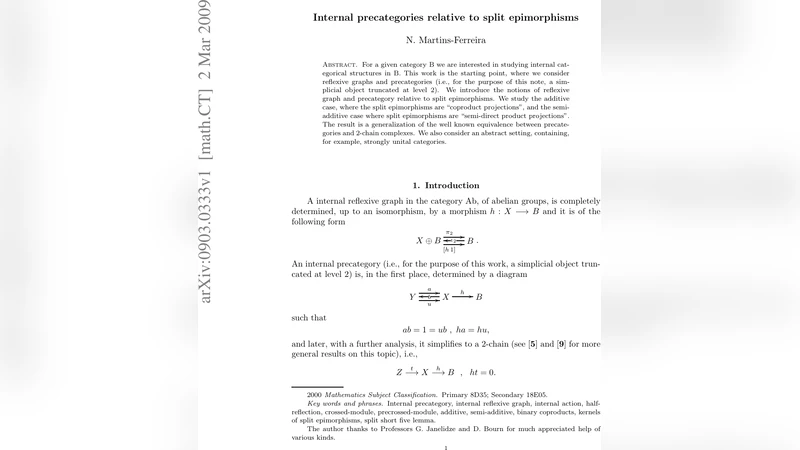
For a given category B we are interested in studying internal categorical structures in B. This work is the starting point, where we consider reflexive graphs and precategories (i.e., for the purpose of this note, a simplicial object truncated at level 2). We introduce the notions of reflexive graph and precategory relative to split epimorphisms. We study the additive case, where the split epimorphisms are “coproduct projections”, and the semi-additive case where split epimorphisms are “semi-direct product projections”. The result is a generalization of the well known equivalence between precategories and 2-chain complexes. We also consider an abstract setting, containing, for example, strongly unital categories.
💡 Research Summary
The paper investigates internal categorical structures in an arbitrary category B by focusing on split epimorphisms as the underlying datum. A split epimorphism is a pair (p : X → Y, s : Y → X) with p ∘ s = idY. Using this pair as a scaffold, the authors redefine internal reflexive graphs and precategories (truncated simplicial objects at level 2) relative to the chosen split epimorphism. The main contribution is a systematic study of two concrete regimes.
In the additive case, B is assumed to be at least additive (often abelian) and the split epimorphisms are taken to be coproduct projections. Concretely, an object X decomposes as a binary coproduct Y ⊕ Z, the projection p is the first coproduct projection π₁, and the section s is the canonical inclusion of Y. A reflexive graph relative to this data consists of two parallel arrows d₀, d₁ : A → B that coincide with π₁ and π₂ respectively, together with a common section. Adding a composition map m yields a precategory. The authors prove that such precategories are precisely 2‑chain complexes (C₁ → C₀ → 0) and thus recover the classical equivalence between precategories and 2‑complexes, now interpreted through the lens of coproduct projections.
The semi‑additive case treats split epimorphisms that arise as semi‑direct product projections. Here B is semi‑additive, objects may be expressed as semi‑direct products Y ⋉ Z, the projection p is the first factor projection, and the section s is the canonical embedding of Y. Reflexive graphs and precategories are defined analogously, but the composition law respects the semi‑direct product action. The paper shows that these precategories correspond to “semi‑direct product 2‑chain complexes”, a natural generalisation of the additive situation.
Beyond these concrete settings, the authors develop an abstract framework that encompasses strongly unital categories and other contexts where split epimorphisms are guaranteed. They demonstrate that the relative definitions of reflexive graphs and precategories remain valid, and the equivalence with suitable chain‑complex‑like structures persists.
Overall, the work provides a unifying perspective: by fixing a class of split epimorphisms (coproduct or semi‑direct product projections) one can reinterpret internal precategories as algebraic data akin to low‑dimensional chain complexes. This not only extends known results but also supplies a flexible toolkit for studying internal categorical objects in a wide variety of categorical environments, ranging from abelian and semi‑additive categories to more exotic strongly unital settings.
Comments & Academic Discussion
Loading comments...
Leave a Comment