The number of weakly compact convex subsets of the Hilbert space
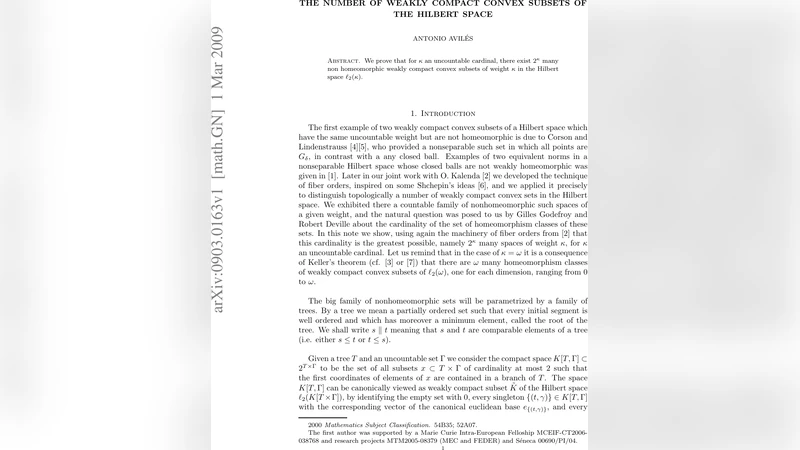
We prove that for k an uncountable cardinal, there exist 2^k many non homeomorphic weakly compact convex subsets of weight k in the Hilbert space of density k.
💡 Research Summary
The paper investigates how many essentially different weakly compact convex subsets can live inside a Hilbert space of a given uncountable density. For a fixed uncountable cardinal κ, the author proves that the Hilbert space ℓ₂(κ) contains 2^κ pairwise non‑homeomorphic weakly compact convex sets, each of weight κ. The construction proceeds in two main stages. First, a family of compact scattered spaces {K_T} indexed by trees T of height κ is built. Each tree T is chosen so that its combinatorial structure (branching numbers at each level, the pattern of splits, etc.) uniquely determines the topological type of K_T; different trees give non‑homeomorphic compact spaces. Second, for each K_T the space P(K_T) of regular probability measures is considered. P(K_T) is weakly compact and convex in the dual Banach space C(K_T), and because C(K_T) has density κ it can be isometrically embedded into ℓ₂(κ). Thus each P(K_T) appears as a weakly compact convex subset of the Hilbert space. The crucial technical point is that the homeomorphism type of P(K_T) encodes the entire tree T: the extreme points of P(K_T) correspond to the points of K_T, and the Cantor–Bendixson derivative hierarchy of these extremes mirrors the levels of T. Consequently, if P(K_T₁) and P(K_T₂) were homeomorphic, the underlying trees would have to be isomorphic, which is ruled out by the initial choice of a 2^κ‑sized family of pairwise non‑isomorphic trees. This yields the desired lower bound of 2^κ distinct weakly compact convex subsets. The result extends the classical separable case, where only continuum many such sets can exist, to the maximal possible cardinality in the non‑separable setting. Moreover, the method showcases a novel interaction between set‑theoretic topology (tree constructions, scattered compacta) and Banach space theory (probability measure spaces, weak compactness). The paper concludes with remarks on possible extensions to other Banach spaces, the independence from additional set‑theoretic axioms, and the broader significance of achieving the maximal diversity of weakly compact convex bodies in high‑density Hilbert spaces.
Comments & Academic Discussion
Loading comments...
Leave a Comment