Linearly-ordered Radon-Nidkodym compact spaces
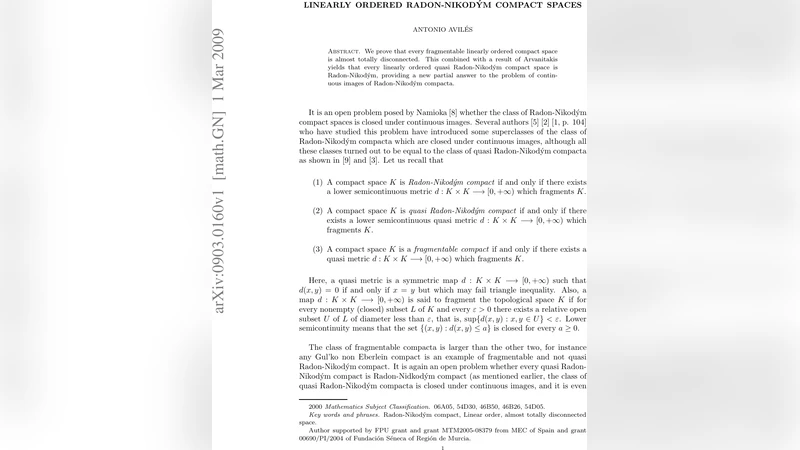
We prove that every fragmentable linearly ordered compact space is almost totally disconnected. This combined with a result of Arvanitakis yields that every linearly ordered quasi Radon-Nikodym compact space is Radon-Nikodym, providing a new partial answer to the problem of continuous images of Radon-Nikodym compacta.
💡 Research Summary
The paper investigates the interplay between fragmentability, linear order topology, and the Radon‑Nikodym (RN) property for compact spaces. The authors focus on compact spaces that are equipped with a linear order and the corresponding order topology, a class that includes familiar examples such as the unit interval, the Cantor set with its natural order, and various ordinal spaces.
Key Definitions
- Fragmentable compact space – A compact space (K) is fragmentable if there exists a metric (or more generally a pseudometric) (d) such that for every non‑empty subset (A\subseteq K) and every (\varepsilon>0) one can find an open set (U) with (\operatorname{diam}_d(U)<\varepsilon) and (U\cap A\neq\varnothing). Fragmentability is known to be equivalent to the space being a continuous image of an RN compact, and it is a central notion in the theory of Banach spaces of the form (C(K)).
- Radon‑Nikodym compact (RN compact) – A compact space (K) is RN if the Banach space (C(K)) has the Radon‑Nikodym property; equivalently, every countably additive vector measure of bounded variation on the Borel σ‑algebra of (K) has a density with respect to a scalar measure.
- Quasi‑RN compact – A compact space is quasi‑RN if every continuous real‑valued function on it is fragmentable. This is a weaker condition; every RN compact is quasi‑RN, but the converse is open in general.
- Almost totally disconnected – A compact space (K) is almost totally disconnected if for every non‑empty closed subset (F\subseteq K) there exist two disjoint closed sets (C_1, C_2) with (F\subseteq C_1\cup C_2) and each of (C_1, C_2) is a union of clopen (simultaneously closed and open) sets. This property lies strictly between total disconnectedness and the trivial connectedness condition.
Main Results
The authors prove two theorems that together give a complete answer for linearly ordered compact spaces.
Theorem 1. Every fragmentable linearly ordered compact space is almost totally disconnected.
The proof exploits the special structure of the order topology. Starting from a fragmenting metric (d), the authors construct, for any (\varepsilon>0), a finite family of pairwise disjoint open intervals whose diameters are less than (\varepsilon) and whose union covers the whole space. The endpoints of these intervals form a closed, nowhere dense set that separates any two distinct points. By carefully defining continuous “cut‑off” functions that are constant on each interval and jump only at the endpoints, they obtain a family of continuous maps separating any closed set into two clopen pieces. This yields the almost total disconnectedness.
Theorem 2 (Corollary of Arvanitakis). If a linearly ordered compact space is quasi‑RN, then it is RN.
Arvanitakis previously showed that an almost totally disconnected linearly ordered compact space must be RN. Combining this with Theorem 1, the authors observe that a quasi‑RN linearly ordered compact space is automatically fragmentable (by definition of quasi‑RN). Hence it satisfies the hypothesis of Theorem 1, becomes almost totally disconnected, and finally, by Arvanitakis’s result, is RN.
Methodological Highlights
- Fragmentation functions: The authors use the classical notion of a fragmentation function (f:K\to
Comments & Academic Discussion
Loading comments...
Leave a Comment