The number of weakly compact sets which generate a Banach space
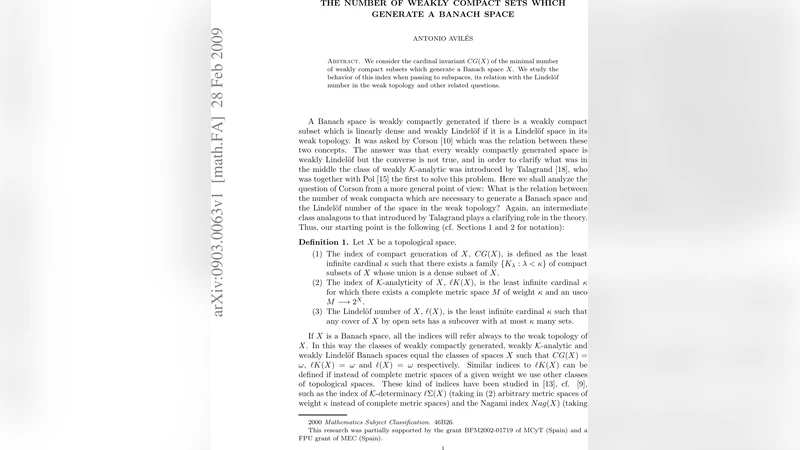
We consider the cardinal invariant CG(X) of the minimal number of weakly compact subsets which generate a Banach space X. We study the behavior of this index when passing to subspaces, its relation with the Lindelof number in the weak topology and other related questions.
💡 Research Summary
The paper introduces a cardinal invariant CG(X) for a Banach space X, defined as the smallest cardinal κ for which there exist weakly compact subsets K_i (i < κ) whose linear span equals X. In other words, X = span ⋃_{i<κ} K_i with each K_i weakly compact in the weak topology. This invariant quantifies the classical notion of a weakly compactly generated (WCG) space: a Banach space is WCG precisely when CG(X) ≤ ℵ₀. The authors systematically investigate how CG behaves under basic operations (subspaces, direct sums, function spaces) and how it relates to other cardinal characteristics such as density d(X), the weak Lindelöf number L_w(X), and the “weakly generated” density dens⁎(X).
Key results include:
-
Basic inequalities. For any Banach space X,
- d(X) ≤ 2^{CG(X)};
- L_w(X) ≤ CG(X)·ℵ₀;
- dens⁎(X) ≤ CG(X)·ℵ₀.
These establish that a small CG forces the space to be “small’’ in several classical senses. -
Subspace monotonicity. If Y is a closed subspace of X, then CG(Y) ≤ CG(X). Moreover, when X is reflexive or Y is 1‑complemented in X, equality holds, showing that CG does not drop dramatically under natural embeddings.
-
Direct sums. For ℓ₁‑direct sums,
\
Comments & Academic Discussion
Loading comments...
Leave a Comment