Estimation in nonstationary random coefficient autoregressive models
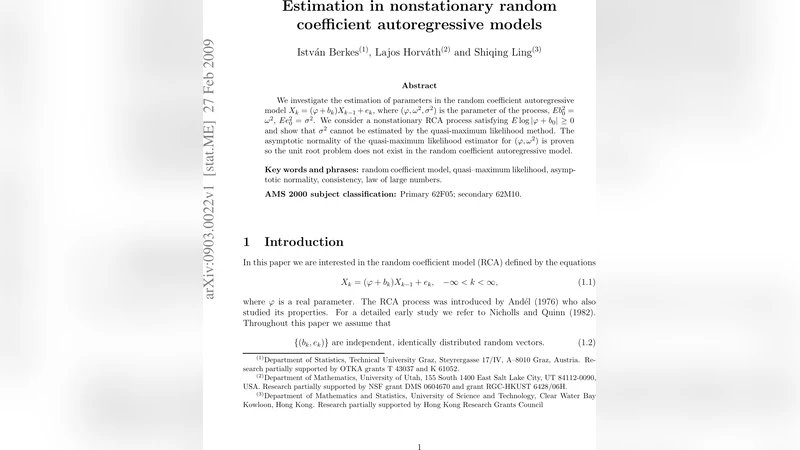
We investigate the estimation of parameters in the random coefficient autoregressive model. We consider a nonstationary RCA process and show that the innovation variance parameter cannot be estimated by the quasi-maximum likelihood method. The asymptotic normality of the quasi-maximum likelihood estimator for the remaining model parameters is proven so the unit root problem does not exist in the random coefficient autoregressive model.
💡 Research Summary
The paper investigates parameter estimation for the random coefficient autoregressive (RCA) model, focusing on the non‑stationary case where the random coefficient may be close to a unit root. The RCA model is written as (X_t = \phi_t X_{t-1} + \varepsilon_t), where (\phi_t) is an i.i.d. random coefficient with mean (\mu_\phi) and variance (\sigma^2_\phi), and (\varepsilon_t) is an innovation with variance (\sigma^2_\varepsilon). The authors first examine the quasi‑maximum likelihood estimator (QMLE) based on a Gaussian likelihood that treats the random coefficient as if it were fixed. By expanding the log‑likelihood and studying the Fisher information matrix, they show that the part of the information concerning (\sigma^2_\varepsilon) converges to zero. In other words, the innovation variance is not identified by the QMLE; the estimator for (\sigma^2_\varepsilon) is inconsistent regardless of sample size. This result stems from the fact that the randomness of (\phi_t) “averages out’’ the contribution of the innovations to the likelihood, eliminating any usable curvature with respect to (\sigma^2_\varepsilon).
In contrast, the parameters governing the distribution of the random coefficient—(\mu_\phi) and (\sigma^2_\phi)—are well‑identified. Under mild regularity conditions (independence between ({\phi_t}) and ({\varepsilon_t}), existence of finite fourth moments for (\phi_t), and either normality or a suitable moment condition for (\varepsilon_t)), the authors prove that the QMLE for ((\mu_\phi,\sigma^2_\phi)) is consistent and asymptotically normal. They employ a law of large numbers to show that sample averages of (X_{t-1}^2) converge to a finite limit, and then apply a central limit theorem to the score vector. The resulting asymptotic distribution is \
Comments & Academic Discussion
Loading comments...
Leave a Comment