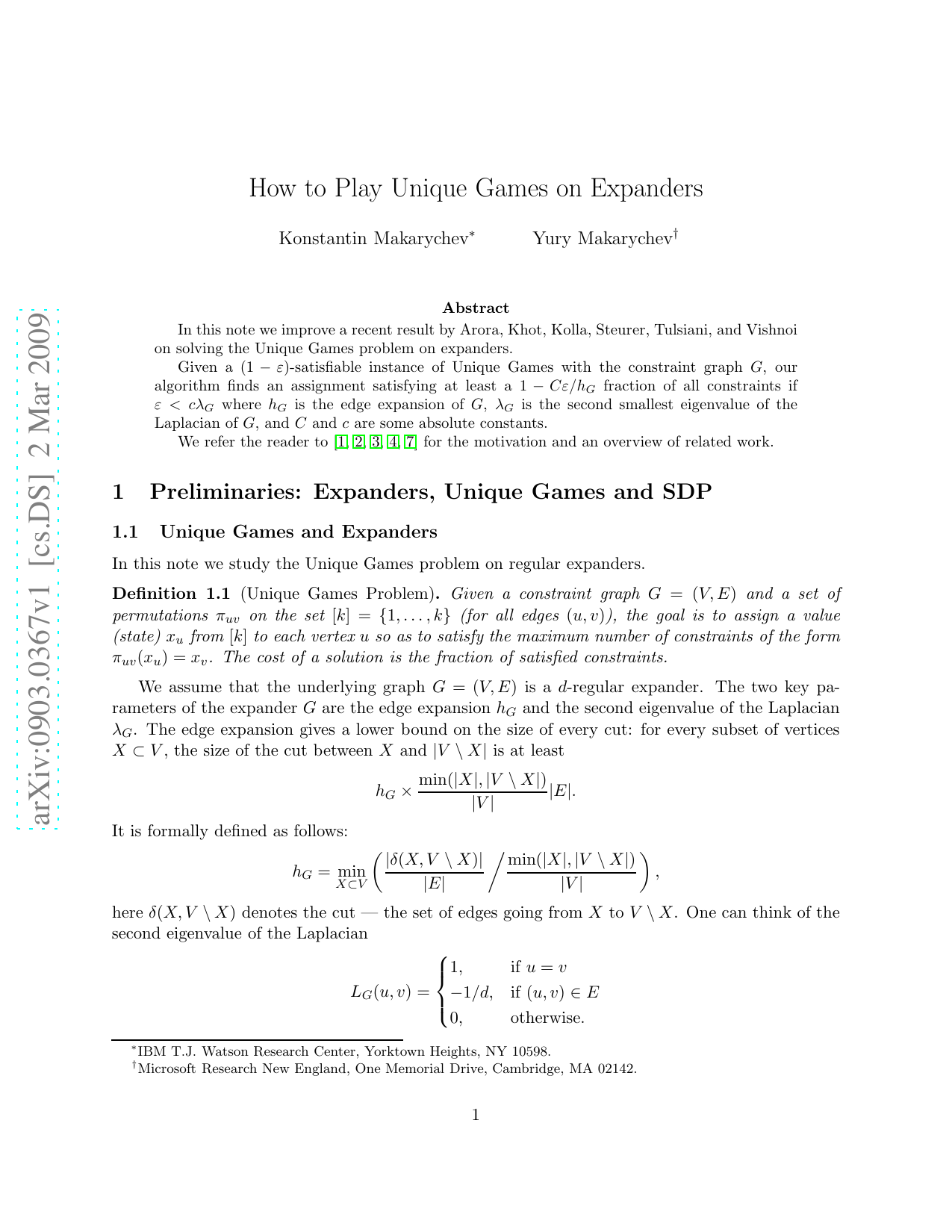
In this note we improve a recent result by Arora, Khot, Kolla, Steurer, Tulsiani, and Vishnoi on solving the Unique Games problem on expanders. Given a $(1-\varepsilon)$-satisfiable instance of Unique Games with the constraint graph $G$, our algorithm finds an assignment satisfying at least a $1- C \varepsilon/h_G$ fraction of all constraints if $\varepsilon < c \lambda_G$ where $h_G$ is the edge expansion of $G$, $\lambda_G$ is the second smallest eigenvalue of the Laplacian of $G$, and $C$ and $c$ are some absolute constants.
Deep Dive into How to Play Unique Games on Expanders.
In this note we improve a recent result by Arora, Khot, Kolla, Steurer, Tulsiani, and Vishnoi on solving the Unique Games problem on expanders. Given a $(1-\varepsilon)$-satisfiable instance of Unique Games with the constraint graph $G$, our algorithm finds an assignment satisfying at least a $1- C \varepsilon/h_G$ fraction of all constraints if $\varepsilon < c \lambda_G$ where $h_G$ is the edge expansion of $G$, $\lambda_G$ is the second smallest eigenvalue of the Laplacian of $G$, and $C$ and $c$ are some absolute constants.
here δ(X, V \ X) denotes the cut -the set of edges going from X to V \ X. One can think of the second eigenvalue of the Laplacian
as of continuous relaxation of the edge expansion. Note that the smallest eigenvalue of L G is 0; and the corresponding eigenvector is a vector of all 1’s, denoted by 1. Thus
Cheeger’s inequality, h 2 G /8 ≤ λ G ≤ h G , shows that h G and λ G are closely related; however λ G can be much smaller than h G (the lower bound in the inequality is tight).
In a recent work [1], Arora, Khot, Kolla, Steurer, Tulsiani, and Vishnoi showed how given a (1 -ε) satisfiable instance of Unique Games (i.e. an instance in which the optimal solution satisfies at least a (1 -ε) fraction of constraints), one can obtain a solution of cost
in polynomial time, here C is an absolute constant. We improve their result and show that, if the ratio ε/λ G is less than some universal positive constant c, one can obtain a solution of cost
in polynomial time. As mentioned above, λ G can be significantly smaller than h G , then our result gives much better approximation guarantee. However, even if λ G ≈ h G , our bound is asymptotically stronger, since
We use the standard SDP relaxation for the Unique Games problem.
For every vertex u and state i we introduce a vector u i . In the intended integral solution u i = 1, if u has state i; and u i = 0, otherwise. All SDP constraints are satisfied in the integral solution; thus this is a valid relaxation. The objective function of the SDP measures what fraction of all Unique Games constraints is not satisfied.
We define the earthmover distance between two sets of orthogonal vectors {u 1 , . . . , u k } and {v 1 , . . . , v k } as follows:
here S k is the symmetric group, the group of all permutations on the set [k] = {1, . . . , k}. Given an SDP solution {u i } u,i we define the earthmover distance between vertices in a natural way:
Arora et al. [1] proved that if an instance of Unique Games on an expander is almost satisfiable, then the average earthmover distance between two vertices (defined by the SDP solution) is small. We will need the following corollary from their results:
For every R ∈ (0, 1), there exists a positive c, such that for every (1 -ε) satisfiable instance of Unique Games on an expander graph G, if ε/λ G < c, then the expected earthmover distance between two random vertices is less than R i.e.
In fact, Arora et al. [1] showed that c ≥ Ω(R/ log(1/R)), but we will not use this bound. Moreover, in the rest of the paper, we fix the value of R < 1/4. We pick c R , so that if ε/λ G < c R , then
Our algorithm transforms vectors {u i } u,i in the SDP solution to vectors {ũ i } u,i using a normalization technique introduced by Chlamtac, Makarychev and Makarychev [3]: Lemma 2.1. [3] For every SDP solution {u i } u,i , there exists a set of vectors {ũ i } u,i satisfying the following properties:
- Triangle inequalities in ℓ 2 2 : for all vertices u, v, w in V and all states i, p, q in [k],
ũi -ṽp
- For all vertices u, v in V and all states i, j in
.
For all u in V and i = j in [k], the vectors ũi and ũj are orthogonal.
For all u and v in V and i and j in
The set of vectors {ũ i } u,i can be obtained in polynomial time.
Now we are ready to describe the rounding algorithm. The algorithm given an SDP solution, outputs an assignment of states (labels) to the vertices.
Input: an SDP solution {u i } u,i of cost ε. Initialization 1. Pick a random vertex u (uniformly distributed) in V . We call this vertex the initial vertex.
We call i the initial state. • Find all states p ∈ [k] such that v p 2 ≥ t and ṽp -ũi 2 ≤ r. Denote the set of p’s by S v : S v = p : v p 2 ≥ t and ṽp -ũi 2 ≤ r .
• If S v contains exactly one element p, then assign the state p to v.
• Otherwise, assign an arbitrary (say, random) state to v.
Denote by σ vw the partial mapping from [k] to [k] that maps p to q if ṽp -wq 2 ≤ 4R. Note that σ vw is well defined i.e. p cannot be mapped to different states q and q ′ : if ṽp -wq 2 ≤ 4R and ṽp -wq ′ 2 ≤ 4R, then, by the ℓ 2 2 triangle inequality (see Lemma 2.1(1)), wq -wq ′ 2 ≤ 8R, but wq and wq ′ are orthogonal unit vectors, so wq -wq ′ 2 = 2 > 8R.
Clearly, σ vw defines a partial matching between states of v and states of w: if σ vw (p) = q, then σ wv (q) = p. Lemma 2.2. If p ∈ S v and q ∈ S w with non-zero probability, then q = σ vw (p).
Proof. If p ∈ S v and q ∈ S w then for some vertex u and state i, ṽp -ũi 2 ≤ 2R and wq -ũi 2 ≤ 2R, thus by the triangle inequality ṽp -wq 2 ≤ 4R and by the definition of σ vw , q = σ vw (p).
Corollary 2.3. Suppose, that p ∈ S v , then the set S w either equals {σ vw (p)} or is empty (if σ vw (p) is not defined, then S w is empty). Particularly, if u and i are the initial vertex and state, then the set S w either equals {σ uw (i)} or is empty. Thus, every set S w contains at most one element.
Lemma 2.4. For every choice of the initial vertex u, for every v ∈ V and p ∈ [k] the probabilit
…(Full text truncated)…
This content is AI-processed based on ArXiv data.