Degrees of Undecidability in Rewriting
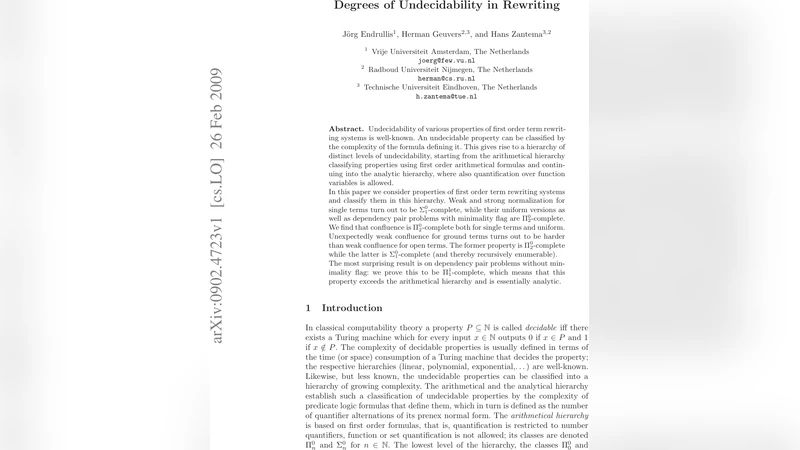
Undecidability of various properties of first order term rewriting systems is well-known. An undecidable property can be classified by the complexity of the formula defining it. This gives rise to a hierarchy of distinct levels of undecidability, starting from the arithmetical hierarchy classifying properties using first order arithmetical formulas and continuing into the analytic hierarchy, where also quantification over function variables is allowed. In this paper we consider properties of first order term rewriting systems and classify them in this hierarchy. Weak and strong normalization for single terms turn out to be Sigma-0-1-complete, while their uniform versions as well as dependency pair problems with minimality flag are Pi-0-2-complete. We find that confluence is Pi-0-2-complete both for single terms and uniform. Unexpectedly weak confluence for ground terms turns out to be harder than weak confluence for open terms. The former property is Pi-0-2-complete while the latter is Sigma-0-1-complete (and thereby recursively enumerable). The most surprising result is on dependency pair problems without minimality flag: we prove this to be Pi-1-1-complete, which means that this property exceeds the arithmetical hierarchy and is essentially analytic.
💡 Research Summary
The paper investigates the undecidability of several fundamental properties of first‑order term rewriting systems (TRSs) by classifying them according to the logical complexity of the formulas that define them. The authors employ the arithmetical hierarchy—Σ⁰₁, Π⁰₁, Σ⁰₂, Π⁰₂, …—to capture properties expressible with first‑order arithmetic, and they extend the analysis to the analytic hierarchy, where quantification over function variables is allowed, giving rise to classes such as Π¹₁ and Σ¹₁.
The first set of results concerns normalization. For a single term, both weak normalization (WN) and strong normalization (SN) are shown to be Σ⁰₁‑complete. This means that the existence of a terminating rewrite sequence can be expressed by an existential first‑order formula and that the problem is recursively enumerable but not co‑r.e. When the requirement is uniform—i.e., every term of the system must be normalizing—the complexity jumps to Π⁰₂‑complete. The additional universal quantifier over all terms raises the classification by one level in the hierarchy.
Next, the authors turn to dependency pair (DP) problems, a central technique for proving termination. When a minimality flag is attached to the DP problem, the decision problem remains within the arithmetical hierarchy as Π⁰₂‑complete. However, the most striking contribution is the analysis of DP problems without the minimality flag. By constructing a reduction from a known Π¹₁‑complete problem (the well‑foundedness of recursive trees), they prove that the unrestricted DP problem is Π¹₁‑complete. Since Π¹₁ lies strictly above the entire arithmetical hierarchy, this result demonstrates that certain termination‑related questions for TRSs are essentially analytic and cannot be captured by any arithmetical formula.
Confluence is examined in parallel. Both the single‑term and the uniform versions of confluence are Π⁰₂‑complete, reflecting the need to universally quantify over all possible rewrite sequences that start from a common term. Weak confluence behaves differently: for open terms (terms possibly containing variables) the problem is Σ⁰₁‑complete, hence recursively enumerable; for ground terms (variable‑free) it escalates to Π⁰₂‑complete. This inversion—ground weak confluence being harder than its open‑term counterpart—is unexpected and highlights subtle interactions between quantifier structure and term structure.
Overall, the paper provides a comprehensive map of where various TRS properties sit within the logical complexity landscape. By pinpointing that the DP problem without the minimality flag is Π¹₁‑complete, the authors reveal a new frontier of undecidability that surpasses the traditional arithmetical boundary. This has significant implications for the design of automated termination provers, confluence checkers, and more generally for any tool that attempts to reason about rewriting systems. It suggests that for certain analyses no algorithmic solution can be expected even when allowing arbitrary higher‑order reasoning, and that future research must either restrict the class of systems under consideration or accept incomplete, heuristic methods.
Comments & Academic Discussion
Loading comments...
Leave a Comment